
"Where an ordinary person stops, we, the military, will go to the end"
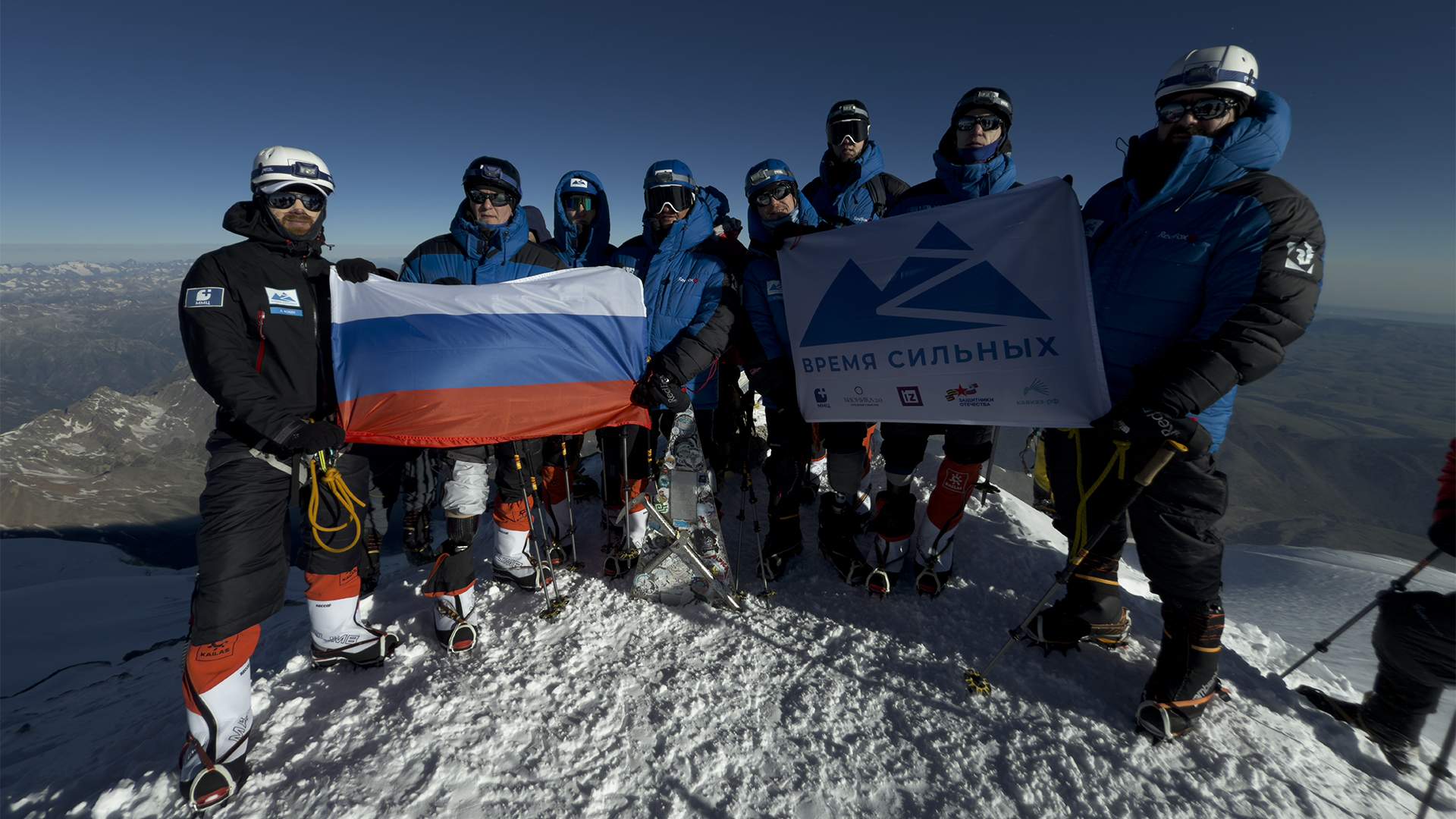
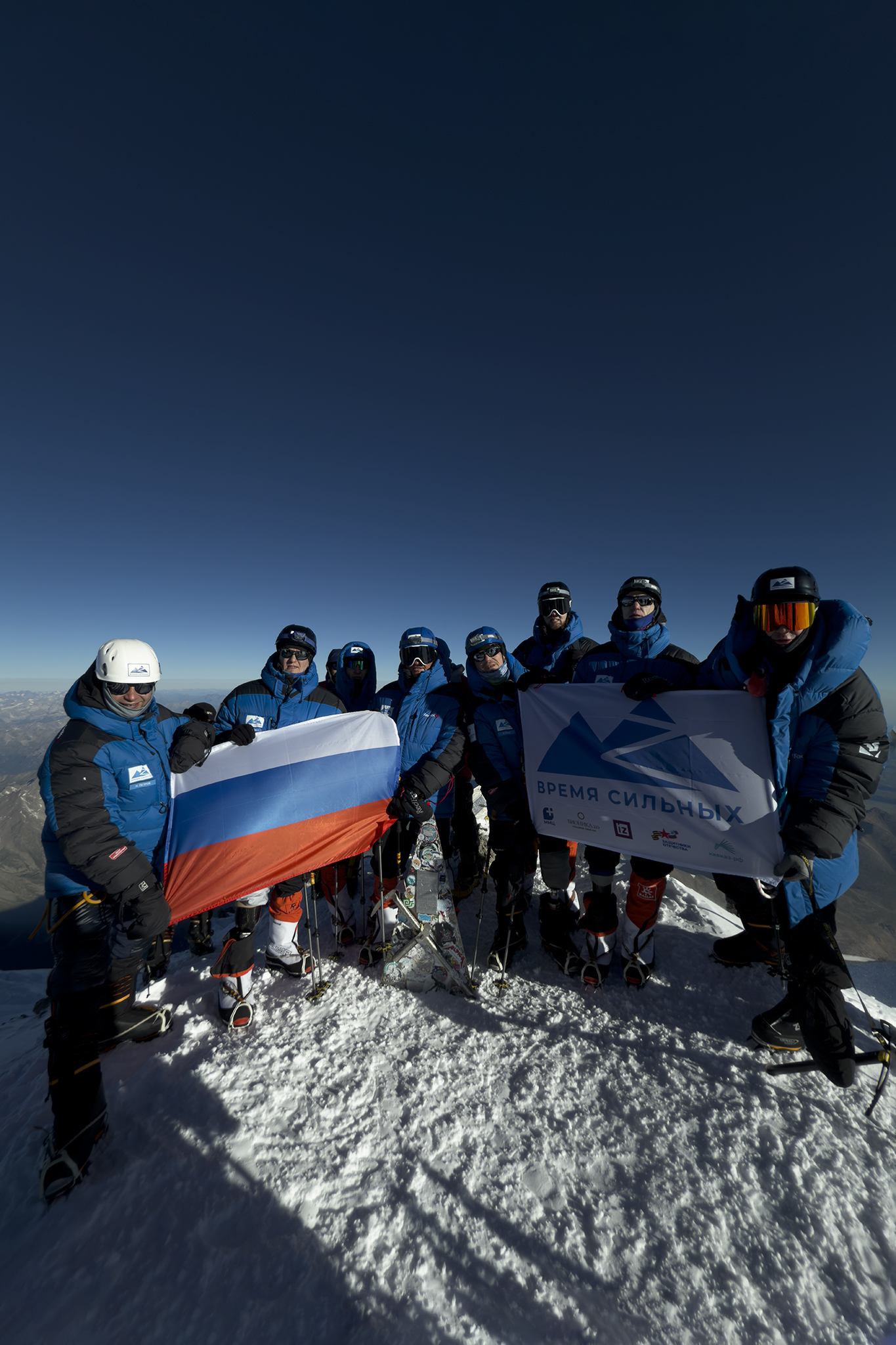
For the first time in history, a group of six people with prosthetic legs climbed to an altitude of 5,642 m above sea level, thanks to the Time of the Strong project. The training started in April of this year. The participants underwent a multi-stage selection process, diverse physical and psychological training, as well as adaptation and individual fitting of prosthetics. For more information about the ascent of veterans of the SVO to Elbrus, see the Izvestia article.
The time of the Strong
For the first time in the world, a group of ITS veterans on prosthetic legs climbed Elbrus to an altitude of 5,642 m above sea level as part of the Time of the Strong project, which launched in April 2025, on the eve of the celebration of the 80th anniversary of the Great Victory. The participants, veterans of their military education from different regions of Russia, underwent a multi—stage selection, functional training, a training stage, trial acclimatization trips to the mountains, individual therapy in leading Russian medical organizations, as well as prosthetics. A representative of the My Medical Center group of companies, which is one of the organizers of the project, told Izvestia about this.

Six veterans of the SVO took part in the ascent. One of them is Artyom Tumak, who was a scout. He received a mine-explosion wound, followed by amputation of the lower third of the lower leg of his left leg. According to him, "there are some restrictions in the movement, but we need to ignore this and look for new ways to do what we need to do."
— At the height, I felt only joy, pride and faith in myself and the team. We did what seemed impossible. We were able to do something that many people don't even want to try," he said immediately after descending from the top.
A former member of the SVO, signalman Alexander Malov, said that before climbing, he did not understand why the area in front of the peak of Elbrus was dubbed the "Zombie Plateau."

— And when I got there, I realized that when you get to the plateau and it seems to be nothing to get to the top, you feel so crazy tired that you move with the last of your strength, like a zombie from a fantasy. But as soon as we reached the top, the fatigue disappeared. I had mega emotions! At the top, I thought: yes, I did it, and our whole team did it. That's the most important thing! Because it's always easy to be alone. And when there is a team, it is much more difficult," he explained.
Alexander also thanked the organizers for carrying out the diagnosis, showing all the weak points of the fighters from the point of view of medicine and revealing the reserves of the body for the assault on Elbrus. He also noted the Bionics 2.0 prosthetics center for the fact that specialists adapted prosthetics and made non-standard, convenient climbing sleeves. Denis Shane-Mitrofanov also expressed his gratitude.
— Thank you so much for pulling me out, motivating and training me. It's a very interesting and rewarding experience. Thanks to our doctors and guides! And to everyone involved in the project, thank you very much! — one of the six participants of the ascent, a veteran of his military, shared his emotions.

Climbing participants:
Today, our country has created all the opportunities for the organization of high-quality prosthetics for people who have lost limbs in a war zone. The state provides certificates for prosthetics after amputation in any of the hundreds of prosthetics centers in different regions of Russia.

— We not only had to prepare the children for the high mountains, increase their physical capabilities and unlock the reserves of the body thanks to a unique medical program developed in our clinics. It was important to inspire, to instill confidence that with the help of modern technologies in rehabilitation and prosthetics, with the support of a team of professionals and people close in spirit, the impossible can become possible," said Alexander Fokin, doctor of the climbing team, Deputy Chief Physician for Physical and Rehabilitation Medicine at the Sports Medical Clinic.
Together with the group, Murad Magomedov, a correspondent of Izvestia, climbed to the top of Mount Elbrus.
The team is most important
Both in the war zone and when climbing Mount Elbrus, you must have people with you whom you trust and who also believe you. There is a parallel between their past and their present. And both then and now, in moments of doubt, fighters always had the thought "I can't give up because I'll let the team down."
— We've become friends here. In combat terms, we have become a group, and in civilian terms, a team. We have a very good team. We understand each other and support each other," scout Artyom Tumak told Izvestia.

According to Ruslan Avzalov, being in the free zone taught them to tolerate pain and discomfort. For fighters, this is not a reason to give up.
"Where an ordinary person stops, we, the military, will go to the end," Ruslan is sure.
Tactics, discipline and teamwork skills were useful to the participants in the mountains. The guys are very different, each of them has their own story, during the project they were really able to become a team. They have undergone medical training, training and prosthetics and were preparing for the ascent as a team, and now they have made their way up shoulder to shoulder with good escort. This is a victory for fortitude, willpower, and motivation.
The Time of the Strong project has given some of them a new goal. In particular, Ruslan plans to start preparing for the ascent to the highest peak on Earth, Mount Everest, after a successful ascent. Someone became a dad during the project, and someone found a good friend. Artyom Tumak noted that in adulthood it is very difficult to meet someone close to you in spirit, but he did it. After climbing, he plans to visit his now-loyal friend Sergei Uzelman to meet his newborn son.

Another important person in the scout's life appeared after being wounded. His commander's sister visited Artyom in the hospital and soon became his wife.
Development of special prostheses
The fighters' prosthetics are designed from different manufacturers, but the stump sleeve was made individually for each participant by Vitaly Degtyarev, a leading prosthetist at Bionics 2.0.
"The sleeve is 95% of the prosthesis," he explained to Izvestia. — You can fasten a foot on it for 2 million rubles or for 10 thousand. But if the sleeve itself is inconvenient, then it ceases to matter. A person simply won't be able to walk on it.
The culvert was made of a very light material — carbon fiber. The guys received new temporary cartridges in May. After that, every day Vitaly Degtyarev was looking for exactly the form in which they would be most comfortable both climbing up and going down.

According to the prosthetist, the stumps behave differently in the highlands. For some, they swell, for others, on the contrary, they dry out. Therefore, right during the acclimatization trips in May, he continued to adjust the sleeve to fit, making it more convenient for climbing and descending.
— This was possible due to the fact that in May, during the acclimatization trip to 4,800 m above sea level, we used thermoformable material. When heated, its shape can be slightly changed. In particular, if a person is rubbing something or if it hurts, - Vitaly Degtyarev emphasized.
In July, during the ascent of the western peak of Elbrus, a prostheticist's backpack contains tools and spare parts for prosthetics instead of food. This was necessary so that no one from the team would stop climbing due to the fact that the screw had burst or lost.

The Western peak of Elbrus
— I tried to make a new permanent sleeve so convenient for them that they would not feel any different, so that the prosthesis would become part of their comfortable normal life. But when we went to 5200 m as a training, I felt uncomfortable. They're walking up there, and I can barely keep up with them on my own two feet. They're machines. Also on new carbon fiber prostheses," the prosthetist noted. — During the ascent, Ruslan Avzalov, a scout, addressed me and said: "Give me all the spare feet, I'll carry them." And I answered him: "Ruslan, just get up — that's the most important thing."
How it all started
Each of the six fighters who were wounded in the CW area with subsequent amputation went their way from accepting the situation to understanding that anything is possible. As former intelligence officer Artyom Tumak said, they are all called people with disabilities, but there are no restrictions, they are "the same people, only with a metal leg."
For the guys, everything started in April with a comprehensive diagnosis of each participant, and in June and July they had to go through the final stage of prosthetics, pharmacotherapy, medical training, and training, after which they received a medical pass to storm Elbrus.
The fighters were so motivated to conquer the top that, according to the team's doctor, Alexander Polkin, deputy chief physician of the Sports Medical Clinic for rehabilitation and sports medicine, they were worried that if someone suddenly had any difficulties, he would not tell about it.

— None of them said, "I can't take it anymore," "I can't do it." The guys had a great desire to conquer Elbrus. They understood why they needed it. And it seems that their motivation is even higher than that of ordinary people who want to climb to this peak," he said in a conversation with Izvestia.
Amputees have a harder time maintaining balance and cushioning when walking. Therefore, doctors have developed a unique program of medical training and exercises that took into account the asymmetric load. In addition, it was adjusted individually for each fighter. With some of them, doctors worked more on the balanced function, with others on the deep muscles of the core.
— We also worked out the functionality that is necessary in high-altitude conditions. Among other things, our unique equipment was used in the clinic — a climate chamber, where they simulated the conditions of the highlands and slowly "lifted" the participants to a height of 3,000 m," the doctor said.

For Alexander Polkin himself, this was his first trip to the mountains. He, like the guys, trained in the climate chamber and underwent a training program. For them, he became not just a team doctor who monitors their well-being, but a "family doctor."
— The biggest rapprochement was during the acclimatization trip in May, when we really went to the mountains and overcame all these difficulties and difficulties together, — the doctor shared his memories. — Mountains bring us closer, it's true. Everything is very family-friendly here. Every participant in the ascent is already perceived by me as a member of our small family.
What will happen to the program in the future
Through the "Time of the Strong" project, the organizers wanted to show millions of residents of our country that veterans of their military who fulfilled their duty to the Motherland with dignity, but lost their limbs, are people who are no different from others, because, despite the injury, they are capable of much.
"All they need in order to find themselves in a peaceful life is highly qualified medical support, high—quality prosthetics and a dream that can inspire," Vladislav Baranov, Chairman of the Board of Directors of the My Medical Center Group of companies, PhD, told Izvestia. — Half of the success of the Time of the Strong project, which we managed to implement, is high—quality medical care, the other half is the motivation and willingness of the children themselves to move forward and live a full life.
He noted that today, available technologies in medicine and domestic methods of diagnosis, treatment, rehabilitation and high-quality prosthetics allow children who have lost limbs to achieve what was previously impossible.
Upon completion of the project, it is planned that the first unique rehabilitation and training program for amputees in Russia will be launched on the basis of the Sports Medical Clinic. Doctors, in cooperation with prosthetics, will be able to help them start mountaineering or other sports.
Переведено сервисом «Яндекс Переводчик»
