The streets of Moscow were flooded again after a tropical downpour. What you need to know
- Новости
- Society
- The streets of Moscow were flooded again after a tropical downpour. What you need to know

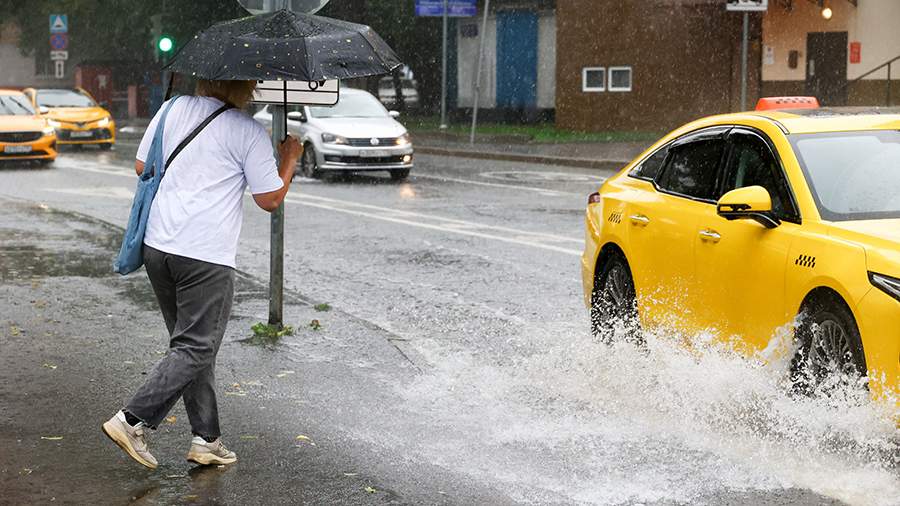
Heavy rains have fallen again in Moscow and central Russia. So, on the night of July 21, monthly precipitation fell in some areas, and the monthly norm has already been met in the city as a whole. For the fourth time in a week and a half, the streets of the capital were flooded, some metro stations stopped working, and street traffic was paralyzed. Forecasters note that in the future, Russians will also expect frequent downpours. How Moscow is experiencing another flood — in the material of Izvestia.
How Moscow was flooded on July 21
• On the night of July 21, Moscow was hit by heavy rain for the third time in a week and a half. The rain started on Sunday evening and lasted until Monday evening. By morning, the monthly precipitation rate had fallen in the capital — it usually amounts to 85 mm, but in Zelenograd the volume of precipitation exceeded 91 mm. In other areas of the city, the monthly norm fell by the end of the day.
• Mosvodostok brigades and special equipment took to the streets of Moscow to quickly allow precipitation to enter the drainage network. The Moscow City Management Complex called on residents to report cases of water accumulation, as well as to refrain from going outside unnecessarily. Motorists were asked to be especially careful on the roads and observe the speed limit.
• That rainstorm led to serious consequences. In the Naro-Fominsk city district, a concrete bridge over the Isma River collapsed, and residents of the village of Aleksino and the Vereysky and Isma farms were cut off from the ground. They are forced to cross the river by boat. In the Istra district, near the village of Hills, the only paved crossing over a stream was washed away.
• Meanwhile, in Moscow, the metro section from Oktyabrskaya station to Belyaevo on the Kaluzhsko-Rizhskaya line was closed due to rain, and seven stations were not immediately accessible to passengers. Trains ran at extended intervals in the opposite direction. The underpass under the MCD-2 Pavshino station was also flooded, and it was closed for passengers to board and disembark.
• Several streets of Moscow were completely flooded. An ambulance was stuck on Schmitovsky Proezd due to huge puddles. In some places, pedestrians are forced to walk along curbs and fence footings. Also in the south, the street parking of cars was flooded, the water almost reached the roofs of several cars left there.
• The next day, on July 22, the rain hit the city with renewed force. Several streets were flooded in the center, the rails at the Bagrationovskaya metro station went under water, and the roof burst in the Kuntsevo Plaza shopping center. However, this downpour turned out to be much shorter and lasted no more than an hour.
How Moscow has already experienced two similar downpours
More recently, Moscow has already been hit twice by heavy rain, which has led to a temporary paralysis of urban life. First, on July 12, a quarter of the monthly precipitation rate fell. The rain was accompanied by hail and strong squally winds. The bad weather caught Muscovites by surprise, as many decided to go on vacation on Saturday after the 35-degree heat. Rain flooded the outer section of the MKAD in the area of km 16, which is why cars traveled through this area in only one lane.
• On July 15, a hurricane with heavy rain hit the capital again. This time, Dmitrovskoe Highway, Varshavskoe Highway, Prospekt Mira and the same section on the 16th km of the MKAD had to be blocked. The passages and lobbies of the metro stations "Bibirevo", "Technopark", "Alexander Garden" and "Rizhskaya" were flooded. Due to a fallen tree, train traffic stopped in the north of the Arbatsko-Pokrovskaya line, and Aeroexpress trains to Sheremetyevo Airport did not run for some time.
Why do heavy rains occur
• According to forecasters, the July 21 downpour was caused by a frontal wave that was pulled into the circulation of an older high cyclone located over Belarus. It also drew in an active frontal wave from the south, which intensified against the background of the cool night. The weather situation turned out to be comparable to a tropical cyclone, when precipitation is not only intense, but also prolonged. Other recent downpours have been at least short-lived.

• One of the reasons for heavy rains is an increase in the overall temperature in the metropolitan area. This leads to an increase in the release of thermal energy and an increase in convective processes, which in turn increases the frequency of heavy precipitation. This trend will only continue in the future. So far, this does not indicate significant climate changes, since decades of observations are required to calculate them, but forecasters have already noted an increase in the likelihood of showers and thunderstorms.
When writing the material, Izvestia talked and took into account the opinions of:
- Leonid Starkov, Gismeteo's leading meteorologist;
- scientific director of the Hydrometeorological Center Roman Vilfand.
Переведено сервисом «Яндекс Переводчик»
