Scientists have found a new source of flares in stellar "embryos"

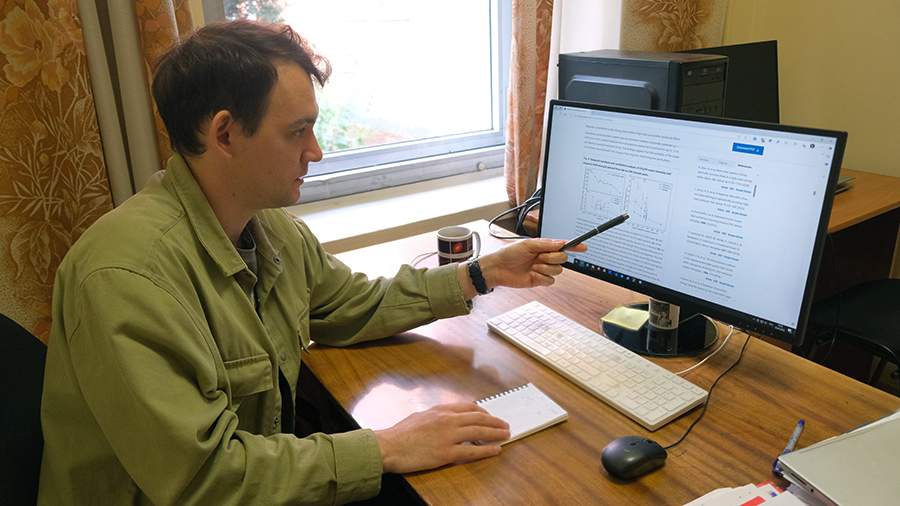
Astrophysicists from Ural Federal University, together with Chinese and Italian colleagues, studied a flash of microwave radiation in the vicinity of a supermassive protostar — the stellar "embryo" — for the first time studied the process of rearranging lines of force in large magnetic fields. These conclusions were made when observing the object G36.11+0.55, which is located at a distance of more than 4 thousand light-years from Earth.

"Scientists have recorded an unusual flash of microwave radiation (maser), which lasted 90 days and released energy of ~103⁹ erg. (a unit of energy. — Izvestia). This is about a million times more than the average solar flare, or about 170 billion times more energy than humanity consumes in a year. At the same time, it was discovered that changes in the brightness of the maser are synchronous with fluctuations in the magnetic field," Sergey Khaybrakhmanov, a researcher at the UrFU Laboratory of Astrochemical Research, told Izvestia.
According to him, such events are associated with the accretion process. This is the fall of matter from the surrounding disk onto the surface of the protostar. But the brightness of the flash, despite its power, turned out to be less than in similar cases. This led to the assumption of a different physics of the phenomenon. As a result, scientists hypothesized that there was also an episode of increased accretion in G36. But at the same time, when falling on a star, a clot of matter "transferred" part of its magnetic field to it, which caused the release of a huge amount of energy.
According to experts, the discovery highlights the importance of magnetic fields as giant energy storage facilities in outer space and their role in the process of star formation.
Переведено сервисом «Яндекс Переводчик»
