Russian scientists have tried to solve the mystery of the flooded Issyk-Kul city.
- Новости
- Local news
- Russian scientists have tried to solve the mystery of the flooded Issyk-Kul city.

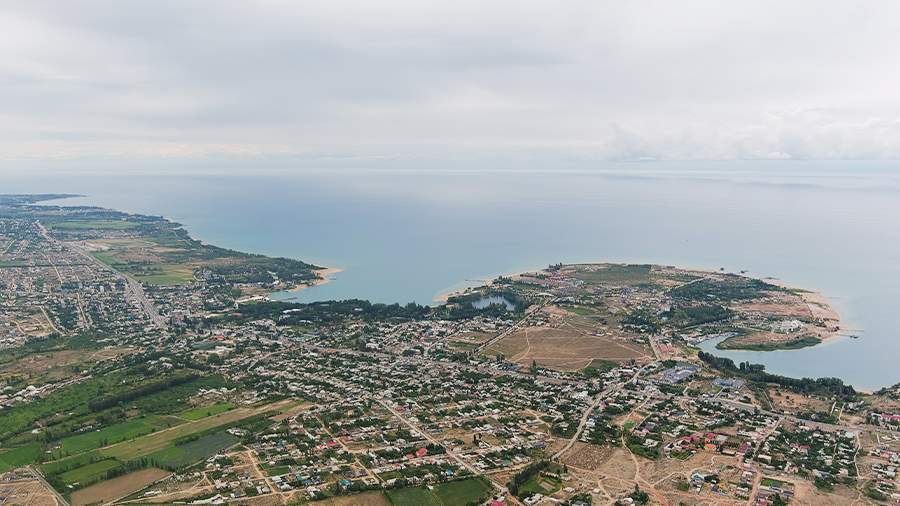
The expedition of the Russian Geographical Society headed to Lake Issyk-Kul in order to uncover the mystery of the city flooded in the Middle Ages. The details of the expedition were shared by Izvestia on July 15.
The city was flooded in the 15th century as a result of an earthquake. After the incident, researchers continue to find fragments of human remains. During the exploration of the territory, one of the scientists was able to find a part of a human humerus.
It is specified that to investigate the mysteries, the expedition members follow the routes of the Russian scientist and traveler Pyotr Semenov-Tyan-Shansky, who was the first to explore these surroundings. During the expedition, scientists use underwater drones, as well as boats.
As a result, the participants were able to find millstones, traces of fires, as well as the ruins of the mausoleum and other small things, among which were vases raised from the bottom. All these factors indicate the former development of the territory before the earthquake disaster.
"The farming style is completely changing in this territory, the population is changing, and the culture is changing. If people had previously lived in cities and were engaged in agriculture, then after that the devastation begins, nomads come here," said Maxim Menshikov, head of the expedition, a junior researcher at the Archaeological Heritage Conservation Department of the Institute of Archaeology (IA) of the Russian Academy of Sciences (RAS).
In the 19th century, during the exploration of Semenov-Tyan-Shansky, many discoveries were discovered and presented, among which was a Catalan map, which indicated a Christian monastery on the northeastern coast of Issyk-Kul. It also contained the belongings of St. Matthew the Apostle.
However, if the monastery was still not found after the flood, during which the building went under water, then he described the discovered Tien Shan mountain system in detail: rock samples, flora and fauna. Now the members of the expedition — geologists, archaeologists, biologists — complement his picture.
According to scientists, biologists are investigating changes in flora, comparing modern data with the herbariums of Semenov-Tyan-Shansky.
"We have already noted about 20-30 plants, which he also noted in his lists. One particular feature that we have already noted is that there are a lot of weeds now. This means that people are making their own changes to it, and now it is becoming more rudimentary, weedy," said Maxim Legotin, one of the expedition members, a biogeographer.
Seismologists are also trying to figure out the frequency of earthquakes in the area, which have a strong impact on the landscape — they change riverbeds. The last serious incident there was in 1911.
"For 250 km, at one point, the mountains rose to a height of 8 to 12 m in just a few seconds. We dug deep trenches and looked at how many earthquakes had occurred over the centuries. There was seismic activation every 2,000 years, followed by a seismic lull for 2,000 years," explained Andrei Strelnikov, scientific director of the Russian Geographical Society expedition, senior researcher at the Schmidt Institute of Physics of the Earth of the Russian Academy of Sciences.
It is noted that Semenov-Tyan-Shansky during his expedition was able to document the so—called petroglyphs - huge boulders left after the glacier. Later, a "tan" appeared on them, and people used them as canvases. The development of technology in the future will help to establish the exact dates of the drawings, so scientists are making an online map of petroglyphs, 3D models of stones.
On June 13, students of the Faculty of History of Lomonosov Moscow State University (MSU) discovered drawings made in blue in Paleolithic cave sanctuaries instead of the usual black, red and yellow in Kapovaya Cave in the Southern Urals in Bashkortostan.
Переведено сервисом «Яндекс Переводчик»
