- Статьи
- Science and technology
- Flying on a VR plane: An AI simulator will teach UAVs to operate without human help

Flying on a VR plane: An AI simulator will teach UAVs to operate without human help
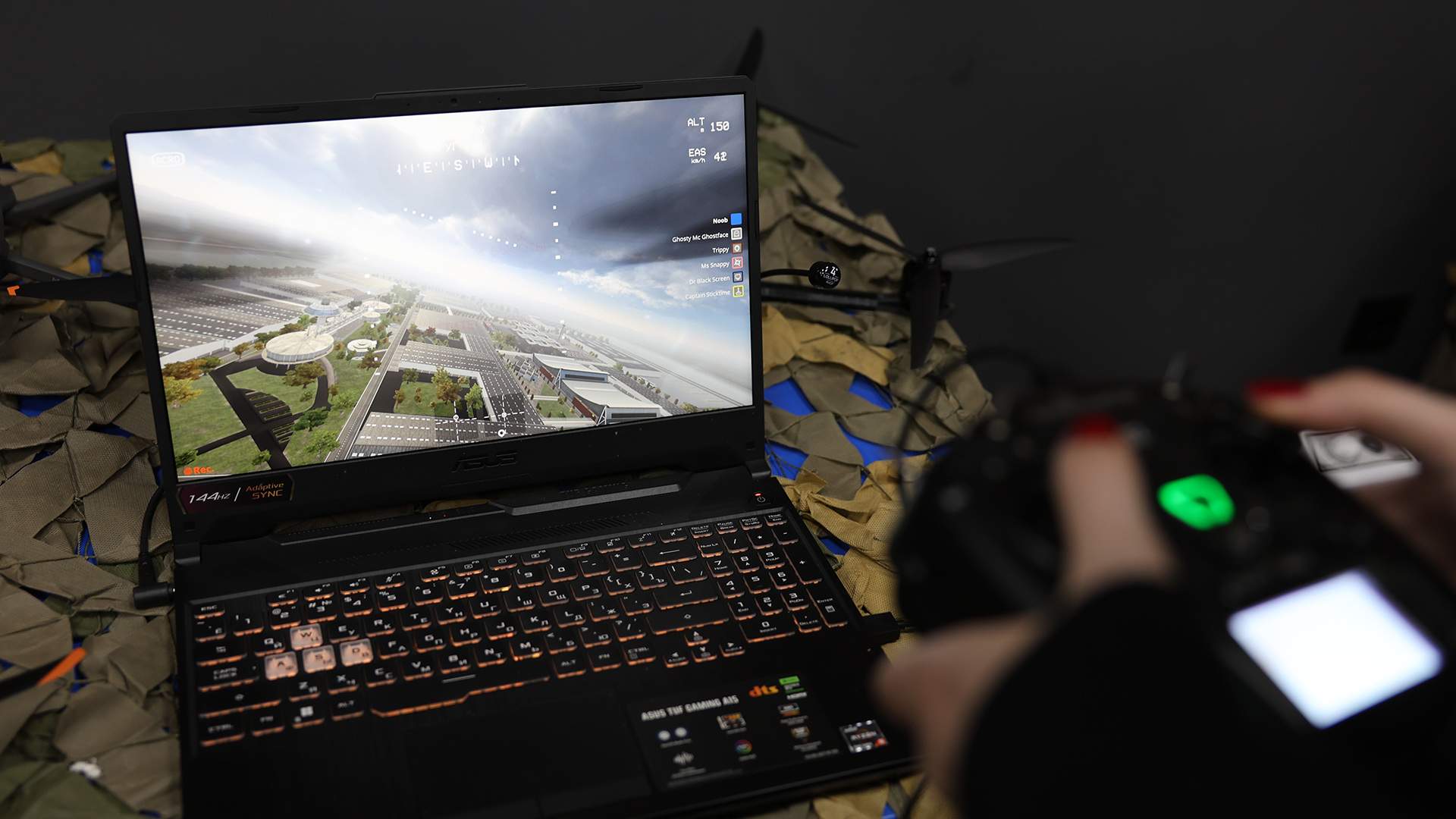
Russian scientists have developed a universal simulator for drones, which is able to simulate any real situation in flight. The data generated by him is necessary for training neural networks that control drones in situations where the operator cannot control the operation of the drone. For example, due to the action of electronic warfare systems. According to experts, domestic software products of this kind are absolutely necessary, since it is simply impossible to collect examples of all possible scenarios in real life, and the use of foreign systems can lead to a technology leak.
Simulation of real flights
Scientists at the Moscow Aviation Institute have created a universal digital platform for flight simulation of unmanned aerial vehicles (UAVs). It can be used to effectively train artificial intelligence (AI), which is used to control drones, in a safe environment before installing it on real expensive devices. The development was created primarily for defense industry enterprises, but it can also be used for civilian purposes. It can simulate any possible scenario in flight and train the neural network to respond to it correctly. The program is already being used at MAI when designing new algorithms for drones. A pilot version of the system is being tested with an industrial partner.

— The goal of the project is to safely and comprehensively work out the algorithms of artificial intelligence that we want to integrate on board. For example, one of the practical tasks that can be solved using a simulator is to practice drone navigation in conditions when the communication signal is lost and you need to safely find your way home to your base," said Vadim Kondarattsev, head of the Artificial Intelligence Laboratory at the MAI Institute No. 8 "Computer Science and Applied Mathematics".

Unlike its analogues, the development allows embedding and testing various AI algorithms, such as computer vision or reinforcement learning (a method based on AI rewarding correct actions), at any stage of a simulated flight. Thanks to modern game engines, including the domestic game engine, the system creates a photorealistic image, simulating what the drone "sees", including through high-tech imaging systems, such as infrared.

— The advantage of this platform is that, firstly, it combines advanced unmanned technologies and artificial intelligence capabilities. Secondly, it models not only individual aspects, but also the entire environment in the surrounding space. Thirdly, it is a domestic technology," added Vadim Kondarattsev.
Consider all possible options
When training neural networks to control UAVs, it is impossible to do without simulators, since in natural conditions it will not be possible to collect all possible variants of real events. And when forming datasets for training, it is important to take into account all the nuances, even the illumination of the area where the flight takes place, Timur Idiatullov, head of the Department of Smart Technology at Moscow Polytechnic University, explained to Izvestia.
— To train neural networks, you need to show all these situations in the form of a dataset. It requires collecting a large number of hours of video, and then labeling it. It's much easier to do this in the simulator. And most importantly, it's cheaper," he said.

Major global companies create their own original simulators, but their use costs a lot of money. Russia needs its own developments that would allow it to simulate unique situations with national specifics. Such as man-made disasters or secret know-how. For example, technologies using swarms of drones or group target interception are relevant now. If you use a foreign product to generate a dataset, there is no guarantee that the development will not "leak" to a foreign server, the expert added.

Today, AI is taught practically on "computer games". The more realistic the physics and graphics in it, the more accurately you can train the neural network to make decisions in various situations and improve machine vision. Military applications are the main ones for such technologies, therefore it is critically important to develop your own software products and achieve technological sovereignty, said Sergey Kurapov, a researcher at MGUTU named after K.G. Razumovsky.

— The characteristics of some UAVs are secret, and it is advisable to conduct AI training with the simulation of such drones in closed programs. Combat drones with AI are mainly trained in three things: finding targets, including disguised ones, self-orientation in space when the signal is lost and returning, and performing combat missions in automatic mode. It also uses refinement to a target confirmed by the operator, when the AI controls the drone itself for the last hundred meters, and the operator watches," he said.

The versatility of the platform will make it possible to simulate the use of UAVs in various types of terrain, whether it is the European part of Russia or the desert, or different weather conditions. It is necessary to model not only the situation in which a decision is to be made, but also the branch of consequences that will follow them. The more complex and more levels there are in the simulation plot, the more autonomous the AI will be at the exit, the specialist added.
Переведено сервисом «Яндекс Переводчик»
