Bauman Moscow State Technical University celebrated its 195th anniversary

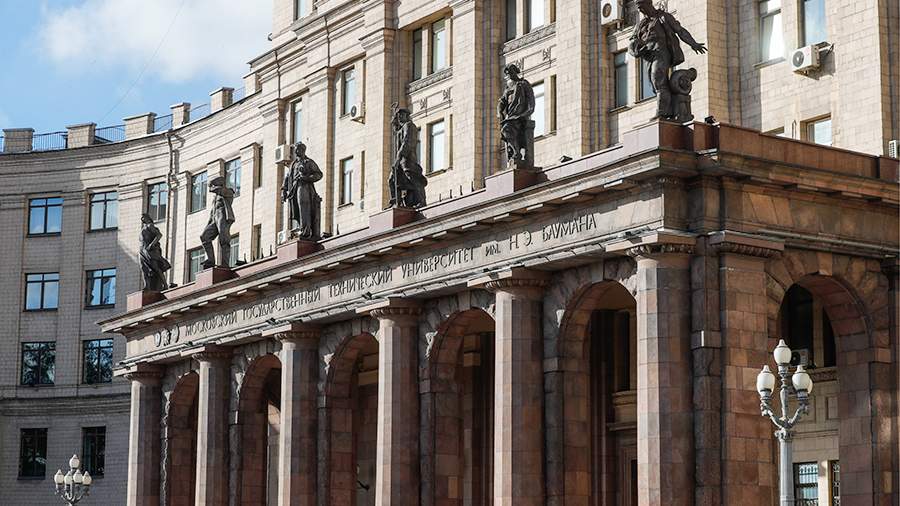
One of Russia's leading technical universities, Bauman Moscow State Technical University, celebrated its 195th anniversary. Pavel Kuznetsov, a correspondent of Izvestia, spoke about the outstanding achievements of the university.
"It's an engineering community, more of a men's community. But there are girls here. There always is. Space beckons," said Tatiana Gorshkova, a laboratory assistant at the Breakthrough Space Research and Technology Design Bureau at Bauman Moscow State Technical University.
The Izvestia correspondent showed what a high-tech satellite looks like. According to him, it is a set of microchips.
"Young scientists will install and assemble microchips. And in a few months, Roscosmos will launch this latest device into Earth orbit on its rocket," Kuznetsov shows.
It is noted that this will be the ninth satellite developed by Bauman scientists to reach outer space. In real time, dozens and hundreds of sensors transmit information to Earth for meteorologists and even help fight sanctions, since the Russian Federation was unilaterally disconnected from marine and river vessel surveillance systems.
"Here are the red dots — these are the ships from which messages were received by our satellites. Our devices transmit this information to the Victoria Next state geographic information system on a daily, continuous, round—the-clock basis," said Dmitry Rachkin, head of the Design Bureau for Breakthrough Space Research and Technology at Bauman Moscow State Technical University.
For 195 years, Bauman Moscow State Technical University has become the flagship of Russian engineering education and a huge research university. Its area is 73 hectares, it has more than 30 thousand students and graduate students. Bauman Moscow State Technical University has trained 250,000 engineers in its history. Among them are Shukhov, Tupolev, Korolev. And now there are new technological buildings and very young, but no less enthusiastic, young specialists.
"If these were the cells of a healthy volunteer, they would form even balls. And since it's Alzheimer's, we see a structural disorder," says Anna Kopylova, a laboratory assistant at the Bauman Moscow State Technical University's Soft Matter and Fluid Physics Research Center.
Laboratories are currently trying to find a cure for Alzheimer's disease in real time. Damaged cells are grown in an incubator and then they will be placed in a chip developed by young university graduates. This is an imitation of the brain — it does not think, but clearly shows how the human brain will react to certain medications.
"Firstly, drug testing will become much cheaper. When they switch to human testing, a huge number of drugs are cut off. We can remove this section between tests and test immediately on human cells," said Danil Bystrov, an engineer at the Bauman Moscow State Technical University's Soft Matter and Fluid Physics Scientific and Educational Center.
In 1830, the university had only 300 students. And today, space, IT, mechanical engineering, radio electronics, and robotics are being studied within its walls. Bauman Moscow State Technical University trains specialists at 20 faculties.

Earlier, on May 22, Russian President Vladimir Putin, after meeting with students at Bauman Moscow State Technical University, instructed Roscosmos to launch small spacecraft for educational and scientific purposes. In addition, Roscosmos, together with the Russian Ministry of Education and Science, was instructed to support internships for students whose programs are related to the rocket and space industry.
Переведено сервисом «Яндекс Переводчик»
