
Parked: Zaryadye showed paintings in the parking lot
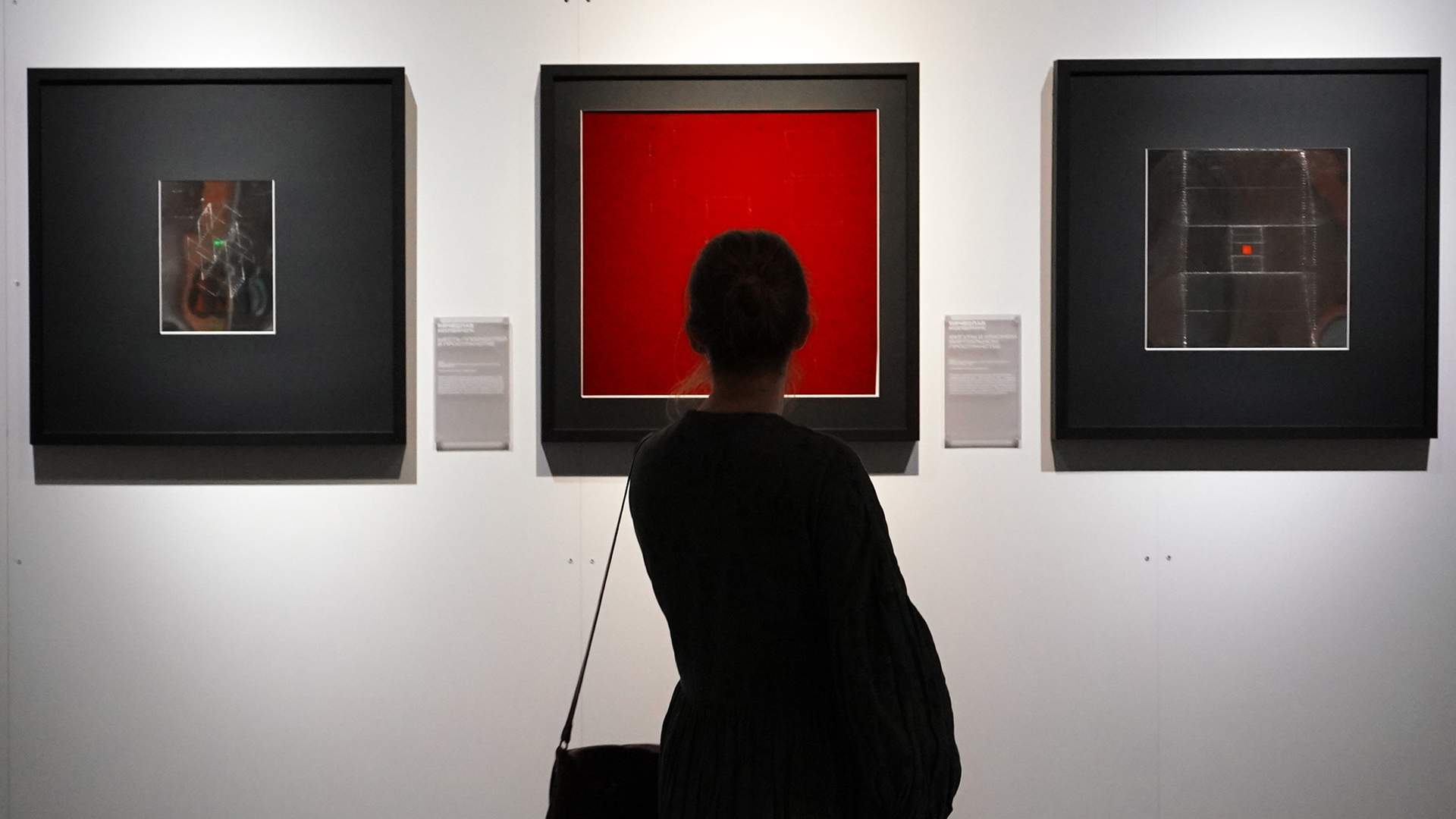
From abstractions by Kandinsky and peasants by Malevich to portraits of Soviet scientists; from kinetic objects by Koleychuk to the chronicle of the creation of the first nuclear power plants. The Pushkin Museum, ROSIZO, Zaryadye Park and Rosatom presented the joint exhibition "Dream Energy", choosing a very unusual place — a hall in the underground parking lot at the Zaryadye Concert hall. The project is dedicated to the 80th anniversary of the Russian nuclear industry, but the result is not an applied anniversary story, but a visual anthem to progress and work for it. Izvestia was among the first to examine the exposition.
An avant-garde approach
Zaryadye Park is increasingly positioning itself as a space for the demonstration of fine art. Exhibitions of classics at the Media Center have already become a tradition (in particular, it was there that a major retrospective of Pavel Filonov was held, made by ROSIZO and the Russian Museum), and modern art has chosen an underground gallery closer to the embankment. As it turns out, there is another place in the park where you can exhibit paintings — not only the latest, but also the old ones, especially demanding to climatic conditions.

Vladimir Martirosov "Air"
The underground parking is located to the right at the entrance to the Zaryadye concert hall, and this is a real functioning parking lot: entering through an inconspicuous door, we see a barrier and parked cars. Apart from an improvised plaque with the name of the exhibition, nothing indicates that the masterpieces of Kazimir Malevich, Vasily Kandinsky, Mikhail Matyushin from the best museums of the country are located very close by. But if we go a little further, we will find ourselves in a spacious exhibition space with high ceilings. Even multi-meter canvases can comfortably fit here, not to mention all kinds of three-dimensional art objects and installations.

The work of sculptor Vladimir Kudryashov "The Worker's Head"
However, there are not so many of both in the new exhibition. The main emphasis is placed on medium—format painting of the Russian avant-garde, but on the authorship of key figures. The Russian Museum has provided several late works by Malevich, where elements of suprematism are combined with socialist—realistic subjects - images of peasants working in the field. The Pushkin Museum has given a series of Kandinsky watercolors: the "airy" abstractions of 1915-1920, which evoke associations either with magical cities or with worlds under a microscope, are known by letter designations — from A to D. There are also items from regional museums — for example, "Still Life" by Alexander Rodchenko from Perm. Contrary to the name, the circles of different sizes depicted on the canvas with melting, as if shimmering contours resemble planets rather than fruits.

Dreams of space
Actually, cosmism turns out to be one of the subjects of the exhibition and is manifested, in particular, in the largest work in terms of format.: "Goodbye, Earth! (Cosmos)" by Boris Okorokov is a realistic piece from a much later time, 1970, from the collection of ROSIZO. But aren't there heavenly spheres on the suprematist canvases of the avant-garde artist, Malevich's colleague Klyun? Quite. Although another motive is more important, to which the same Clune belongs — conditionally it can be called a look beyond reality. In "Geometrization of Space (Crystal)" by Matyushin from the Tretyakov Gallery, we find ourselves inside a crystal structure, watching the bizarre movement and reflection of light. In Filonov's "Heads" from the Russian Museum, we see the thought, the analytical energy of the depicted male characters, staring in surprise and intently into the distance…

Boris Okorokov "Goodbye, earth!"
The project for the anniversary of the nuclear industry could be assembled exclusively from socialist-realistic canvases about the construction of nuclear power plants or from science art. Science, after all. But the organizers of the exhibition decided to take a broader look at the topic: to tell a story about striving for new, unprecedented frontiers. The name "Dream Energy" is no coincidence. Therefore, it all starts with the Russian avant-garde, a third of a century before the era of the peaceful atom. And it continues with the work of the "harsh style" (Tahir Salakhov and other Pentecostals), where courageous workers are engaged in construction on virgin land.

Although there were group and individual portraits of scientists. This is, for example, Igor Kurchatov, portrayed by Leonid Tikhomirov: there are three orders on his jacket, a paper on the table over which the physicist holds a pen, and the background is occupied by the NPP control panel and a board with formulas. Or a painting by Igor Vepkhvadze, in which eight employees of the Research Institute (including one girl) are enthusiastically discussing a model of a certain futuristic factory.
Physics and Lyrics
"Dream Energy" can be perceived as the story of the hero's evolution: in the 1930s he was a collective farmer, in the 1950s he was an oilman or a sleeper in the countryside, and in the 1960s and 1970s he was a scientist. Yes, at different times, the builders of a bright future were presented in different ways. And of course, this exhibition idealizes the path to progress. With its romantic spirit, it resembles the Tretyakov Gallery's "Thaw" project. But why not really return, at least with the help of art, to the era of physicists and lyricists? Reading the information on the stands about the formation of the USSR nuclear industry, looking at the strong-willed and spirited faces in the portraits, one involuntarily begins to think that, no matter how trends change, dreamers have always been the engines of progress.

A smaller copy of the work of the artist Vyacheslav Koleychuk "Atom"
And in this regard, it is not surprising that almost half of the exhibition is devoted to the Russian avant—garde - there are no better dreamers. And yet, despite all the ideology, the heroes of the exhibition are united by the desire for beauty as such, whether it is the beauty of colors and shapes, like those of Kandinsky and Matyushin, the human body, like Alexander Deineka, the formulas that Kurchatov reflects on in the portrait, or the mathematical calculation based on Vyacheslav Koleychuk's complex, self-stressed designs. It is the works of this artist, one of the main Soviet masters of kinetic art, that are most represented here. They become the leitmotif of the project and a visible reminder that physics and lyrics are actually compatible.
Переведено сервисом «Яндекс Переводчик»
