
Share of circumstances: loan delinquency reached a record 1.5 trillion

The overdue loans of individuals have reached 1.5 trillion rubles. This is a record for the last six years (the entire time of statistics), follows from the data of the Central Bank. They do not pay mainly on loans issued in 2023-2024 at high rates to risky borrowers, the regulator said. As a result, risks accumulate in the economy, for which ordinary consumers will have to pay in any case. Banks are already reluctant to ease loan conditions, although deposit yields have fallen for the vast majority of major players. What threats to the economy are created by non—payments in such volume and how a decrease in inflation and debt can stop the growth of delays - in the material of Izvestia.
Why is the loan delinquency rate increasing?
The volume of overdue consumer loans has reached 1.5 trillion rubles. This is a record for the last six years, according to the Central Bank's data, which was studied by Izvestia. The Bank of Russia clarified that the volume of problem loans increased by 400 billion rubles by May compared to the same period last year, their share reached 5.7% of the retail portfolio.

Loans issued in late 2023 and early 2024 at high rates to risky borrowers are overdue, the regulator's press service said. Problem loans are 90% covered by reserves, which means that banks have set aside money in advance in case they are not repaid. Restrictions on loans to borrowers with high debt loads are already contributing to improving the quality of banks' loan portfolios.
The quality of loan servicing has deteriorated sharply in the market, said Mikhail Aleksin, General Director of the United Credit Bureau (OKB). According to him, the risk accumulated throughout 2024, and the peak of delinquencies and defaults occurred in the first half of 2025. For example, according to the bureau, in the credit card segment, the number of delinquencies during this period may increase by 1.5–1.8 million people (there are no exact data for the first six months yet), which is 70-90% more than in the second half of 2024.

We expect an increase in the share of overdue debt in general, said Roman Evdokimov, Vice President for Retail Risks at DOM.RF Bank. High loan rates negatively affect the quality of their service, said Dmitry Zakharov, a representative of Zenit Bank. However, VTB does not record significant changes in the behavior of borrowers, the organization's press service noted. Izvestia also sent inquiries to other major market players.

The level of delinquency is increasing due to the maturation of loans issued during the rapid disbursements of previous years, agreed Yuri Belikov, Managing director of the Expert RA rating agency. In addition, credit activity is slowing down, and against this background, the share of delinquencies is also becoming more noticeable.
Natalia Milchakova, a leading analyst at Freedom Finance Global, believes that another factor that affects the volume of overdue debt is the deterioration in the quality of borrowers themselves and their well—being.
Why has the quality of borrowers deteriorated
At the beginning of 2025, real loan rates reached 35%, Natalia Milchakova recalled. For example, an overpayment on a loan of 1 million rubles for three years at this cost is more than one and a half times. These percentages proved to be unaffordable for many customers who, for one reason or another, had to take out such an expensive loan.
"Major market participants note that delinquency occurs mainly among borrowers who took out loans at high rates and could not cope with the increased debt burden," Mikhail Doronkin, Managing Director of National Credit Ratings (NCR), confirmed.

In conditions of high unemployment, Russians are forced to take out loans for a smaller amount, although the monthly payment on them is still higher than previous levels, said economist Andrei Barkhota. In this case, the real disposable incomes of citizens are gradually beginning to decline.
The situation is getting worse due to inflation, said Yuri Belikov from Expert RA. According to the Central Bank, in May 2025, the annual price increase was 9.9%. Against this background, borrowers' solvency is falling because they have to spend more and more money on basic products and consumption, Andrei Barkhota said.

During a period of high interest rates, conscientious consumers postpone large purchases until better times, while less responsible people take out loans anyway, sometimes realizing that they will not be able to service an expensive loan without delinquencies. Even strict requirements for borrowers do not help banks to recognize such clients in 100% of cases, Natalia Milchakova noted.
However, the risk appetite of financial institutions is very low now. According to the National Bureau of Credit Histories (NBKI), the percentage of loan application refusals exceeded 80% in May.
When will inflation slow down
The situation with the key rate has already begun to change in June: it was lowered to 20%, and the signals from the Bank of Russia indicate that the indicator will be lowered further. However, this is not enough to stop the growth of overdue debt, experts believe.

The situation will change no earlier than 2026, when inflation slows down, Yuri Belikov emphasized. According to the experience of past crises, it takes up to two and a half years to close problem loans, Andrei Barkhota said.
In order for the delay to begin to decrease, it is important for the Central Bank to successfully bring inflation to the target level of 4%, Yuri Belikov believes. In such a situation, citizens will have enough funds to pay off their debts. In addition, after lowering interest rates, loans will be able to be refinanced — people will reissue them on more favorable terms.

Russians will be able to effectively refinance loans if the key rate reaches 12% and loan rates drop to 15% per annum, Natalia Milchakova from Freedom Finance Global said. In this case, the monthly payment would decrease by about one and a half times compared to the levels of the beginning of 2025, and it would become easier for Russians to pay their debts.
"The trend towards an accelerated increase in delinquencies will last until the end of the year," said Mikhail Doronkin, Managing Director of the NKR rating agency.
Until then, the risks of non-payments and bankruptcies from problem borrowers will persist, Natalia Milchakova predicts. All this creates conditions for the deterioration of the situation of the most vulnerable segments of the population and a slowdown in economic growth.

In addition, the increase in the share of delinquencies in the portfolio creates problems for the entire banking sector, Andrei Barkhota noted. The more defaults there are, the harder it is for creditors to pay off depositors who are waiting for interest on their deposits. The profitability of banks may decrease, and the final costs will in any case fall on consumers in the form of less favorable rates for all products.
Banks are already reluctant to ease the conditions on loans, Izvestia wrote earlier. By the end of July, only six banks out of the top 15 had reduced loan rates, while deposit yields had fallen for the vast majority of major players.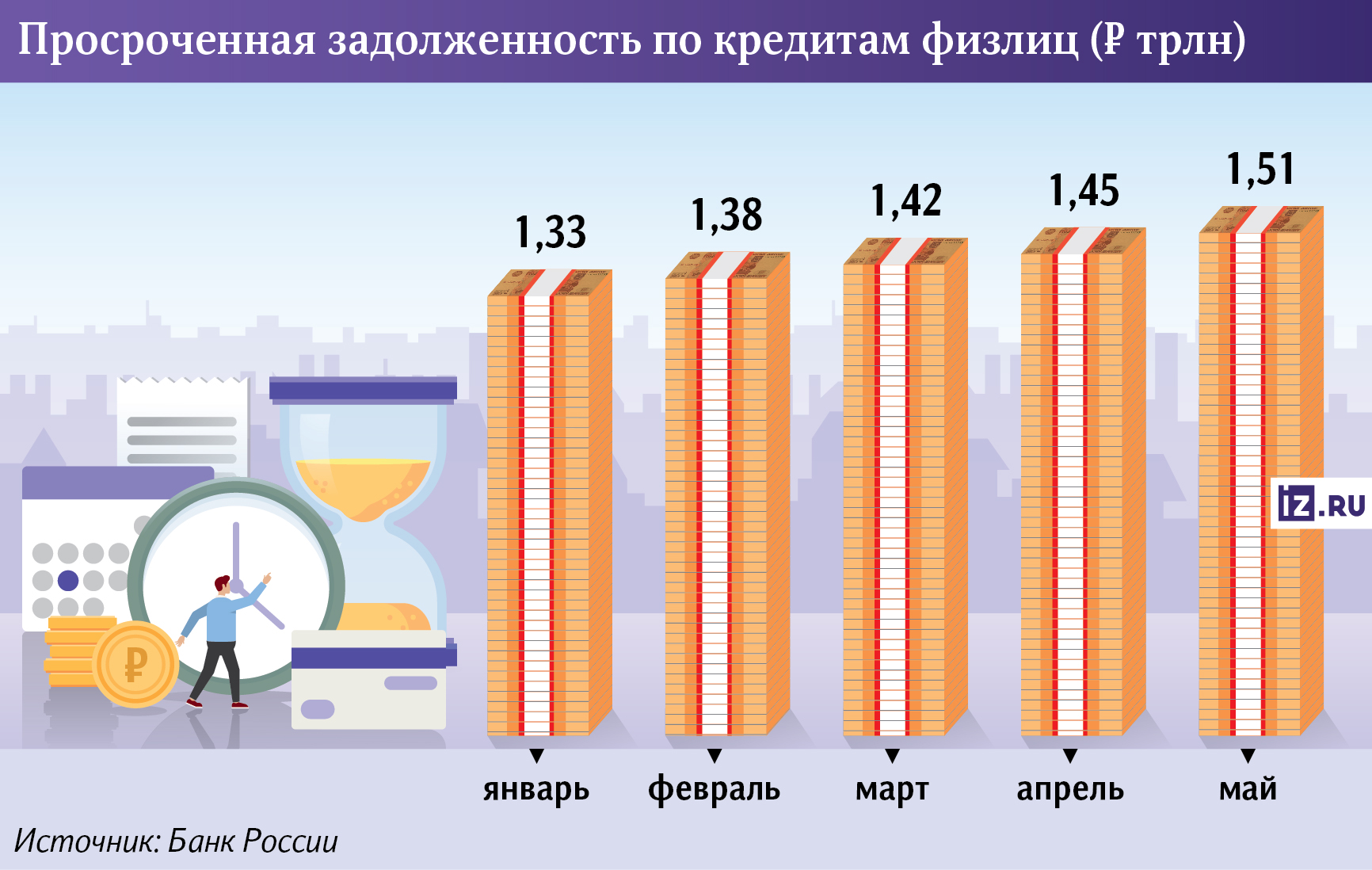
Nevertheless, against the background of a possible reduction in the key interest rate in the future, the situation with problem debts can really improve, says Alexey Volkov, NBKI Marketing Director. As lending increases, the delinquency rate will decrease. In addition, defeating inflation will support Russians and ease their debt burden, Andrei Barkhota concluded.
Переведено сервисом «Яндекс Переводчик»
