
Fuel balance: stock prices for gasoline jumped by more than 10%

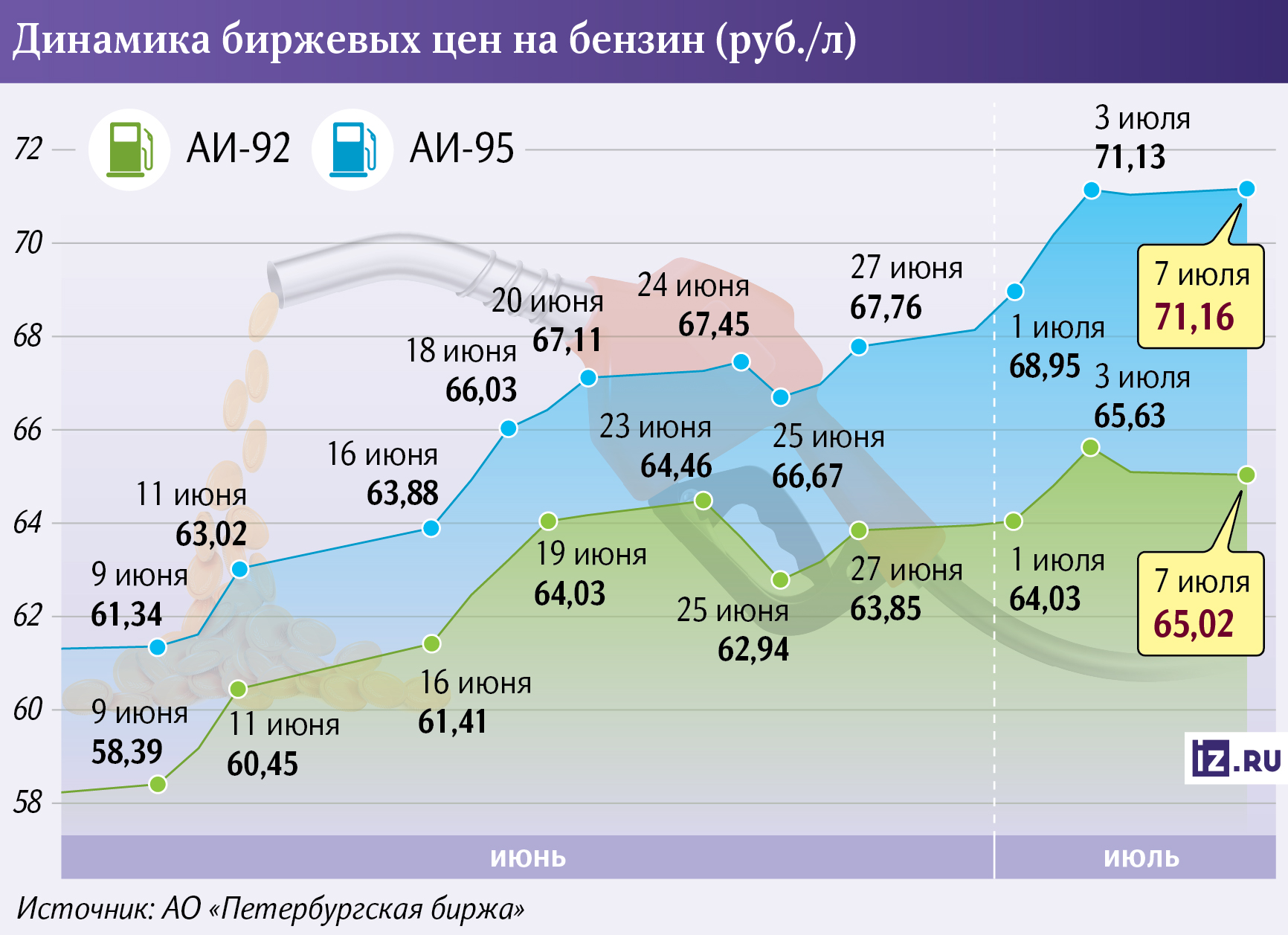
Stock prices for motor fuel accelerated their growth in June. AI-92 and AI-95 increased by 11.47% and 16.66%, respectively. This is the first impressive increase since the beginning of the year. Market participants and experts attribute this dynamic to seasonal demand, refinery repairs, and reduced subsidies for oil workers, who are thus recouping their losses. How this may affect retail and affect the course of the sowing campaign is described in the Izvestia article.
The cost of gasoline
The cost of motor fuel has increased dramatically in the first month of summer. From May to June, prices for AI-92 and AI-95 increased by 4.8% and 0.84%, respectively, while from June to July prices increased by 11.47% and 16.66%. This is evidenced by data from the St. Petersburg Stock Exchange and calculations by Izvestia.
According to experts, seasonal growth in demand and repair schedules for refineries have an impact on the positive dynamics of stock prices for motor fuel. Ekaterina Kosareva, Managing Partner of VMT Consult, recalled that every year the plants undergo scheduled repairs in May and June. Accordingly, the volume of supply is decreasing.

— This leads to an increase in wholesale prices, and then retail prices. In addition, the domestic market is influenced by the conjuncture of foreign markets. At the beginning of the year, the price of Brent was more than $76 per barrel, now oil is trading almost $10 lower," she said.
According to her, due to the decline in world oil prices, the cost of motor fuel has also decreased. Oil companies have become noticeably less likely to receive damping payments.

Sergey Tereshkin, CEO of Open Oil Market, agrees with his colleague. According to him, if in the first quarter of 2025, payments on the damper reached 405 billion rubles, then in the second quarter — 139.7 billion.
— The decrease in subsidies is caused by the fall in oil prices, which led to a decrease in "external" prices for petroleum products, which are taken into account in the damper formula. The lower the amount of subsidies, the lower the marginality of oil refining. It is possible to recoup losses only by increasing stock prices, which happened in June and July 2025," he said.

The expert recalled that, according to the current rules, oil workers are deprived of the right to pay subsidies if the prices of AI-92 gasoline exceed a certain level by 10%, and diesel fuel by 20%. Taking into account the prices included in the Tax Code, the average monthly stock quotation of AI-92 in 2025 should not exceed 66,495 rubles per ton, and diesel prices should not exceed 68,640 rubles per ton, he noted.
As of July 7, the exchange price of AI-92 gasoline was 65,028 rubles per ton, AI-95 — 71 163 , and summer diesel — 56,772 rubles per ton.
In addition, as a source in the industry told Izvestia, oil companies are currently simply buying oil products from each other to raise prices. This information was confirmed by the head of the analytical center of the Independent Fuel Union Grigory Bazhenov.
— In the period from the end of March to the end of September, commercial demand for petroleum products is intensifying. We are talking primarily about the agricultural sector of the economy and domestic tourism. An additional effect is provided by demand from oil companies that trade fuel with each other on the stock exchange," he stressed.

Izvestia asked the St. Petersburg Stock Exchange, which conducts motor fuel trading, for comment on how the trading is controlled.
Farmers complained about rising prices
Meanwhile, farmers are alarmed by rising prices for motor fuel. The Russian Grain Union said that the rise in fuel prices has been noticeable since the beginning of the harvest, which began in mid-June.
The Ministry of Agriculture told Izvestia that the ministry monitors the situation on the fuel and lubricants market on a daily basis. In addition, the recommended volumes of fuel supplies have been worked out with the Ministry of Energy to ensure uninterrupted provision of seasonal field work.
— According to the agribusiness management bodies of the regions, the needs of farmers in fuel and lubricants for this year amount to about 5 million tons of diesel fuel and 700 thousand tons of gasoline. This year, agricultural producers have already purchased 1.5 million tons of diesel fuel and 208 thousand tons of Ai-92 gasoline. In addition, there are reserves in excess of 634 thousand tons and 82 thousand tons, respectively," the press service of the department noted.
They stressed that the Ministry of Agriculture had not received information about disruptions in fuel supplies from the regional agribusiness management bodies.
"At the same time, information about the increase in gasoline prices from the regional agribusiness management bodies is sent to the Ministry of Energy of Russia," the Ministry of Agriculture concluded.
On the eve of the All-Russian Field Day, Deputy Minister of Agriculture Andrey Razin stressed the importance of promptly informing about the problems that have arisen. According to him, although the situation on the fuel and lubricants market is assessed as normal, the incoming signals from the regions are worrying.
Razin noted that the Ministry of Agriculture is closely monitoring the situation on the fuel market, and urged farmers to report any difficulties. This will allow the agency to respond promptly and raise issues with the government to make the necessary decisions. It is important that producers can receive fuel in a timely manner for field work, as delays in deliveries can negatively affect yields and financial results.

Dmitry Gusev, Vice President of the Independent Fuel Union and Deputy chairman of the Supervisory Board of the Reliable Partner Association, recalled that regulators had repeatedly asked consumers to plan their purchases in advance.
"If oil companies have plans and recommendations from the Ministry of Energy, then consumers don't even report projected purchases to the stock exchange," the expert noted.

According to Olga Orlova, head of the Industry department at the Institute of Oil and Gas Technologies, the volume of purchases by farmers does not change radically from year to year.
— Moreover, the Ministry of Energy periodically asks oil companies to increase fuel sales on the stock exchange during the sowing and harvesting season. This year, the price increase is mainly due to external factors, rather than due to the fact that farmers did not warn about the onset of the season," she said.

Izvestia sent a request to Rosneft, Gazprom Neft, Surgutneftegaz, Lukoil, the Agro-Industrial Union and the Association of Peasant (Farmer) Farms and Agricultural Cooperatives of Russia.
The situation on the domestic fuel market
The Ministry of Energy sees no reason for concern. The press service of the department told Izvestia that the situation in the domestic fuel market remains controlled.
— The Ministry of Energy, the Federal Antimonopoly Service and oil companies are aware of the importance of price stability and are taking the necessary measures to maintain the balance. The fuel market remains in surplus, and the demand for petroleum products is fully met. During the summer period, there is traditionally an increase in demand for fuel, which in a market economy affects the dynamics of wholesale prices," the press service of the department noted.
The ministry stressed that in order to further stabilize oil companies have reduced exports, redirecting fuel to the domestic market.

— This will increase the supply on the stock exchange in July and August. In addition, oil companies adhere to a policy of transparent pricing, giving market signals about fair price levels at the beginning of trading sessions. This helps to prevent unjustified growth in demand and minimizes the risks of price speculation. The current supply volumes on the stock exchange are sufficient, and there are no acute problems with logistics and fuel supplies, the Ministry of Energy believes.

At the same time, the ministry stressed that the issue of introducing a complete ban on fuel exports is not currently being considered, as the situation remains manageable. However, this measure may be considered by the government in case of an appropriate initiative from market participants.
— At the moment, such actions are not necessary, as the observed price fluctuations are seasonal. The marginality of gas station operators remains in a comfortable zone, which indicates the stability of the fuel market and the effectiveness of government regulatory measures. The Russian Ministry of Energy continues to monitor the situation and is ready to respond promptly to any changes in market conditions," the ministry added.
However, according to Izvestia's source in the market, retail chains now have negative margins, both for independent and VINKov gas station chains.

"Today, all retail chains have negative margins, taking into account operating costs," says the source.
As for retail, as Yuri Stankevich, Deputy chairman of the State Duma Committee on Energy, already noted in a conversation with Izvestia, "currently retail prices do not reach the minimum economically reasonable 1.5–2 rubles," and slow growth is quite realistic in the summer.
Grigory Bazhenov from the Independent Fuel Union recalled that the government is now additionally discussing the issue of increasing sales standards on the stock exchange, as well as adjusting the damper. According to him, the situation with price volatility may last until October.
Переведено сервисом «Яндекс Переводчик»
