The sense of duty: how will the US trade truce with EU countries end


The global economy will slow down regardless of whether Donald Trump decides to extend the freeze on duties for the European Union or raise them to the promised level of 20%, and if negotiations fail, then 50%, experts polled by Izvestia believe. The 90-day respite is coming to an end. But even if the US president keeps the base rate at 10%, global GDP growth may slow to 1.7% instead of the 2.7% projected at the beginning of the year. Internal disputes about the budget policy of the States add to the tension. Amid the cost discussions, Trump once again came into conflict with Elon Musk — the billionaire called the draft financial plan wasteful. Whether the American administration will extend the tariff freeze is in the Izvestia article.
The 90-day truce between the United States and other countries
On April 2, US President Donald Trump announced the imposition of import duties against 185 countries. The base rate is 10%, but it is higher for individual countries: for example, 20% for EU members, 25% for some goods from Canada and Mexico.
However, a week later, on April 9, the collection of fees for most states was postponed for 90 days — the states decided to negotiate. This has affected almost everyone except China.: with him, the "trade truce" began to operate only on May 12 for the same three months.
Negotiations with trading partners were chaotic. Since June 1, Trump has even promised to increase duties on the EU to 50%. So far, the United States has managed to come to only one beneficial agreement — with Great Britain, which agreed to American terms. At the same time, Washington decided to end all discussions with Canada over its tax on digital services for American technology companies.
At the same time, according to European Commission spokesman Olof Gill, if the parties do not come to a "mutually acceptable solution", the EU will introduce countermeasures on July 14 or earlier. Later it became known that the European Union is ready to agree to a base rate of 10%, but in return requires exceptions for the most important industries. In particular, the alliance seeks to reduce tariffs of 25% on cars and spare parts, as well as fees of 50% on steel and aluminum. According to Brussels, Trump's duties already affect about 70% of the exports that the bloc supplies to America.
It became clear that such a "respite" of 90 days did not give any positive results in terms of redirecting trade, said Evgeny Smirnov, Head of the Department of World Economy and International Economic Relations at the State University of Management (GUU).
— It is simply impossible to direct commodity flows to other countries and diversify the supply of goods in such a short time. Most likely, the US trading partners at this time focused on working out bilateral agreements, either with the States themselves or with alternative countries that can be launched in 2025-2026," the specialist said.
Will Trump extend the tariff freeze on July 9th
The American economy is currently solving one of the key problems — reducing the trade deficit, said Arina Surkova, an expert at the RUDN University Faculty of Economics. She added: in this case, there are two scenarios — to limit imports by increasing customs duties and to attract industrial production to the country by offering corporations investment incentives.
It is still difficult to predict what decision Trump will make on trade duties in a week. However, U.S. Treasury Secretary Scott Bessent had previously hinted that the July 9 deadline would probably be extended for those countries negotiating with the United States. Then he mentioned 18 important trading partners, without specifying which countries he was talking about.

In any case, global economic growth will slow down, experts interviewed by Izvestia believe. According to the IMF, global GDP increased by 3.2% in 2024. However, now he is under pressure from several political and economic factors at once, in particular, trade wars. Analysts are confident that Donald Trump will not abandon his idea to protect the domestic market by imposing import duties. But much will depend on their scale.
"However, if new deadlines are set or countries manage to conclude reasonable agreements on tariff levels, the global economy will gradually adapt to them," said Olga Belenkaya, Head of the Macroeconomic Analysis Department at Finam.
In the short term, the duties will create a supply shock for the United States, meaning imports will rise in price. And for countries that are subject to restrictions, there will be a demand shock, as their export orders will decrease, Arina Surkova from RUDN University believes. At the same time, there is a possibility that the US tariff policy will simply redistribute foreign trade flows between America and its main partners.
According to the expert, this is unlikely to significantly reduce global production — perhaps even boost it a little. However, the growth of the global economy in this case will still not exceed 2.7–3%. The World Bank has already lowered its forecast for global GDP growth in 2025 by 0.4 percentage points, to 2.3%.
The turbulence of trade policy in the world will lead to a slowdown in both American GDP and the economies of countries that depend on exports to the United States, he added. According to Andrey Barkhota, PhD in Economics, in this scenario global production will grow by only 1.7–2%.
What did Musk and Trump argue about?
Nevertheless, the United States itself, as a state, needs an increase in duties. Donald Trump's trade war is an attempt to slow down the growing national debt, which has already crossed the $37 trillion mark. Natalia Milchakova, a leading analyst at Freedom Finance Global, pointed out that a quarter of US budget revenues are spent on servicing huge obligations.
The draft budget for next year is currently being discussed in America. Trump himself calls it "big and beautiful." The president proposes to reduce taxes, while preserving benefits for a number of industries, and at the same time reduce government spending by $1.5 trillion, including by eliminating subsidies to some other industries, Natalia Milchakova recalled. In particular, he intends to support the mining and defense industries, as well as farmers, through low rates.
However, the document has already provoked harsh criticism from Elon Musk. The billionaire is confident that a new financial plan is needed, which will not include such a rapid increase in public debt. In addition, he warned that in the future he could create an opposition party in opposition to the president's fiscal policy. According to him, the time has come for a new faction that will "really take care of people."
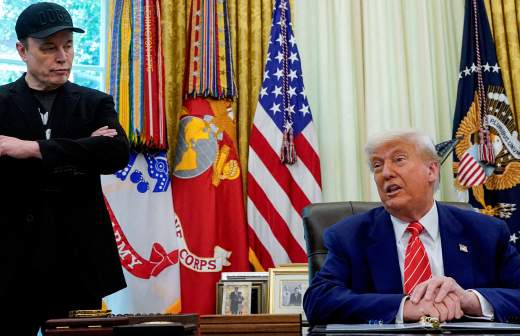
The reduction in support will affect precisely those industries that, on the one hand, move the American economy forward (technology, green energy), and on the other, are monopolized by several major corporations — Apple, Google, Natalia Milchakova added. The subsidy cuts will also affect Musk's own business, his Tesla electric car company. That is why the billionaire is so concerned about the president's fiscal policy.
Commenting on the attack of the American entrepreneur, the US president advised him to "turn down the shop and return home to South Africa." According to him, without launching rockets, satellites and electric cars, the country would have saved a fortune. He promised to check on Musk's business. In response, on July 1, Tesla shares fell by almost 8%.
What does Russia have to do with Trump's tariff wars
Russia was not included in Trump's "tariff list". However, the US administration has recently threatened to impose 500 percent tariffs on Russia's trading partners for not supporting Ukraine. The project will also be directed against India and China, which import Russian oil. As Izvestia wrote earlier, in this case, buyers of Russian hydrocarbons will stop trading with the United States, while the products of these countries will find their buyers in alternative friendly markets.
Trade wars are also having an impact on Russia through a slowdown in global GDP, which is already causing oil prices to decline. Although Brent quotes have regained some of their losses (on July 1, it is trading at almost $67 per barrel), overall, energy prices have fallen by a quarter since the beginning of the year. Because of this, the Ministry of Finance tripled its budget deficit forecast to 3.8 trillion rubles.
Переведено сервисом «Яндекс Переводчик»
