
Who ordered a taxi: carriers are asking to create an adapted car for them

Carriers are asking to create an adapted car for taxis. They contacted the Ministry of Industry and Trade and the manufacturers, Izvestia learned. Among the proposals are reinforcement of the steering rack, suspension and a hydro—mechanical "automatic", which is not found on any domestic car. Without the adaptation of cars, the established business model of taxi companies in megacities becomes unprofitable, which creates risks for the entire market, the fleets said. The Ministry of Industry and Trade told Izvestia that by the end of the year a by-law will be adopted with a list of Russian-made models approved for taxi driving.
The perfect car for a taxi
From March 2026, the provisions of the law on the localization of new cars for passenger transportation will come into force. The Public Council for Taxi Development (OCRT) conducted surveys of market participants to determine the conditions for a painless transition from foreign cars to domestic cars. It turned out that without technical adaptation, the car models available today cannot fully operate in large cities, and their economies are unprofitable.

Taxi companies note the low reliability of a number of components and assemblies of domestic cars. At runs of up to 100,000 km, valves burn in engines, problems with the oil pump are noted, followed by wear of bearings and camshafts.
According to the OCRT, rubber-metal hinges, stabilizer bushings, and ball bearings in the suspension serve for 30-60 thousand km, which is not enough for commercial operation of carriers. The steering rack may require repairs for as long as 20,000 km, taxi drivers say. The automatic transmission (CVT) "walks" for 100,000 km, after which it requires expensive repairs. The carriers have already fixed transmission failures for 30 thousand km of mileage. They see the biggest problem of domestic machines in the insufficient resource of the variator.

"When developing a new car model, engineers calculate the resource of components and assemblies depending on the purpose of using the car," Andrey Kapitan, a member of the OCRT and head of the 495 taxi company, told Izvestia. — For example, Lada Vesta cars were created for personal use and the CVT resource is stated by the manufacturer at 150 thousand km.
According to him, such a mileage is enough for an ordinary citizen for five to seven years, and in taxis cars "leave" it in a year and a half, after which you need to change the transmission at a price of up to 500 thousand rubles.

For comparison: previously, reliable four-stage hydromechanical automatic transmissions with a resource of under 300 thousand km were installed on Lada Granta. They served well in taxi companies, says Andrey Kapitan. With regular oil changes, such a box on old Lada cars "nursed" up to 500 thousand km.
Currently, Granta machines are not sold, and taxi companies consider it impossible to transfer drivers to cars with manual transmissions.
"The fact is that the business model of large taxi companies is based on renting cars to hired drivers who drive shifts at 12 o'clock," the chairman of the Taxi Development Committee of the Moscow Chamber of Commerce and Industry told Izvestia Vasily Baranov. — In traffic jams, drivers have pain in their legs, they feel uncomfortable when driving. When the driver gets tired, the movement of the vehicle turns out to be ragged, which affects the comfort of movement.
As a result, drivers receive a lot of complaints from passengers, he added.
— In mobile applications, they are given a low rating for jerks when driving, which affects subsequent orders, — Spartak Zabolotsky, an investor in Chocolate taxi, told Izvestia.

Therefore, drivers no longer get behind the wheel of cars with mechanics in large cities, carriers say.
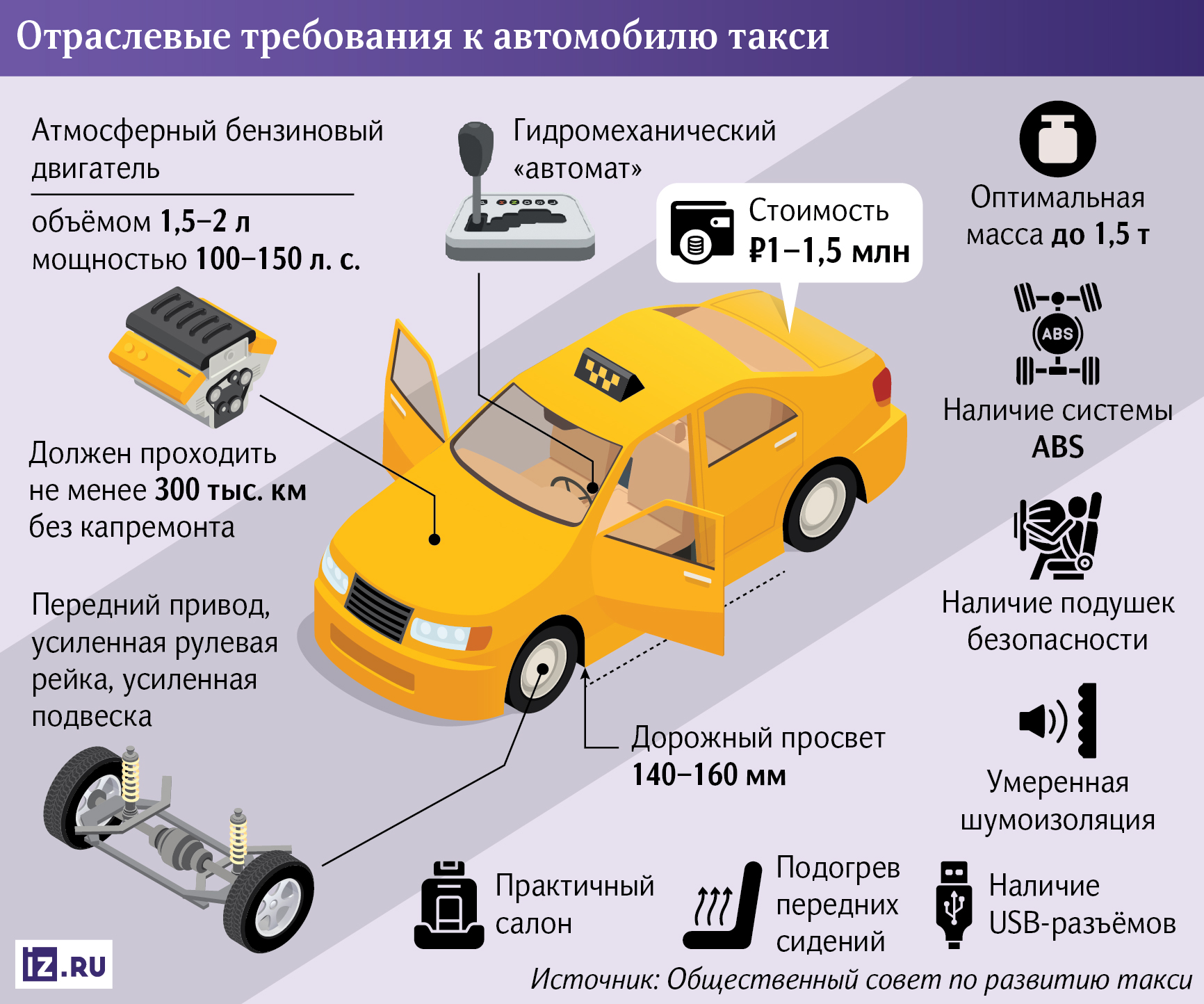
— For the taxi service, it is advisable to develop a taxi version with an atmospheric gasoline engine with a volume of 1.5–2.0 liters (without a turbine for durability), — Vasily Baranov continued. — The box is a classic hydromechanical "automatic" (not a variator). The cars need to have a reinforced suspension, a simplified interior for easy cleaning, a roomy trunk and optionally factory-installed gas cylinder equipment.
For example, Skoda Octavia for taxis are available with a simplified configuration and the possibility of installing gas cylinder equipment, the expert noted.

The OCRT interviewed carriers and submitted to the Ministry of Industry and Trade a list of criteria for the operation of cars in taxis. The NGO asked the agency to initiate the development of a state standard for cars involved in passenger passenger transportation based on them.
The Ministry of Industry and Trade told Izvestia that by the end of the year, a by-law will be adopted with a list of Russian-made models approved for work in taxis. The editorial board also sent inquiries to automakers and taxi aggregators.

AvtoVAZ noted that the manufacturer has direct communication with industry representatives.
"We are preparing special offers for taxi models, including using the profitable tools of our Auto Finance Bank," the press service of AVTOVAZ told Izvestia. — We support the idea of creating a platform for discussing the application of the taxi law within the framework of the Russian Union of Industrialists and Entrepreneurs (RSPP).
Localized cars are much cheaper to buy and maintain. The average price of a Lada is 1.5 million rubles, and a Chinese car is 3.5 million, AvtoVAZ added.
Domestic cars in taxis
There are many Kia, Hyundai, Toyota, Skoda, Volkswagen cars in taxi companies that serve their time — their resource is five to six years. Spare parts are more expensive, but there is less downtime. The profitability is 15-20%, taking into account the long six-year operation, said Vasily Baranov.

For Chinese Geely, Haval and Chery, the resource of components (CVT, suspension, engine) often does not exceed two to three years. The profitability is 10-12%. Therefore, cars from China are still losing out in the long-term economy, but they can be a temporary solution with a tight budget, he added.
According to him, the profitability of domestic cars (Moskvich, Lada Granta and Vesta) in taxis is 5-10%. The price for them is small, but there are weak points — it is a variator with a resource of 80-100 thousand kilometers and electronics. These cars are not ideal for daily taxi operation and require improvements in reliability, the expert concluded.

According to Irina Zaripova, chairman of the Public Council for Taxi Development, the profitability of a car for taxi transportation depends not only on the reliability of the automatic machine, but also on the cost of parts.
— I'll give you an example of the cost of spare parts for cars from a taxi company. The front headlight on a Lada Vesta costs 25,240 rubles, on a Moskvich 3 — 12 thousand, on a Jetta VA3 — 3.5 thousand, on a Renault Logan — 5 thousand rubles. The taillight for Lada Vesta consists of two parts and costs 22 thousand rubles, and for Renault Logan — 2.7 thousand rubles," the expert noted.

Practice has shown that Korean, German and Japanese cars have been used in taxis for five years without any major repairs or capital investments, said Omar Bahamaev, founder and CEO of Avenue Group Taxi. According to him, cars made in China have been in operation for three years so far and some brands have proven themselves positively.
"We had no experience operating Moskvich cars, but there was a controversial experience operating Lada Vesta on a CVT caused by expensive maintenance due to the cost of components," he said.

According to Vasily Baranov, low profitability or lack thereof in taxi companies, insufficient reliability of cars (frequent breakdowns, low resource nodes) leads to higher costs. Without government support, such as subsidized leasing programs or tax incentives, a wave of bankruptcies of small and medium-sized taxi companies is likely in the next one to two years, the carrier said.
— The unreliability of the CVT is a myth that has developed based on the operation of the first designs of continuously variable transmissions. Today, if the instructions are followed, these units are durable. At the same time, variators are much more affordable for consumers," Sergey Ilyinsky, Director of Public Relations at AVTOVAZ, told Izvestia. — I do not know of any manufacturer in the world (perhaps with the exception of Metro Cab) that would specifically customize their cars for taxi needs (perhaps with the exception of more durable interior upholstery and the removal of some options).
According to him, a careful taxi driver operates a car in the same way as an ordinary owner.
Earlier, AvtoVAZ President Maxim Sokolov, in an interview with Izvestia at SPIEF 2025, said that the classic automatic transmission would still appear on the Lada Azimut crossover.
Now this machine is undergoing all the necessary cycles of bench, road and climate tests for reliable and long-lasting use, said Sergey Ilyinsky. All AvtoVAZ models that are already present in taxis are undergoing the same tests, he added.
According to industry data, 30-40% of the taxi fleet today are Lada cars, he concluded.
Переведено сервисом «Яндекс Переводчик»
