- Статьи
- Economy
- Closed for key: business reduced investments in projects with capital investment protection by 1.5 times

Closed for key: business reduced investments in projects with capital investment protection by 1.5 times

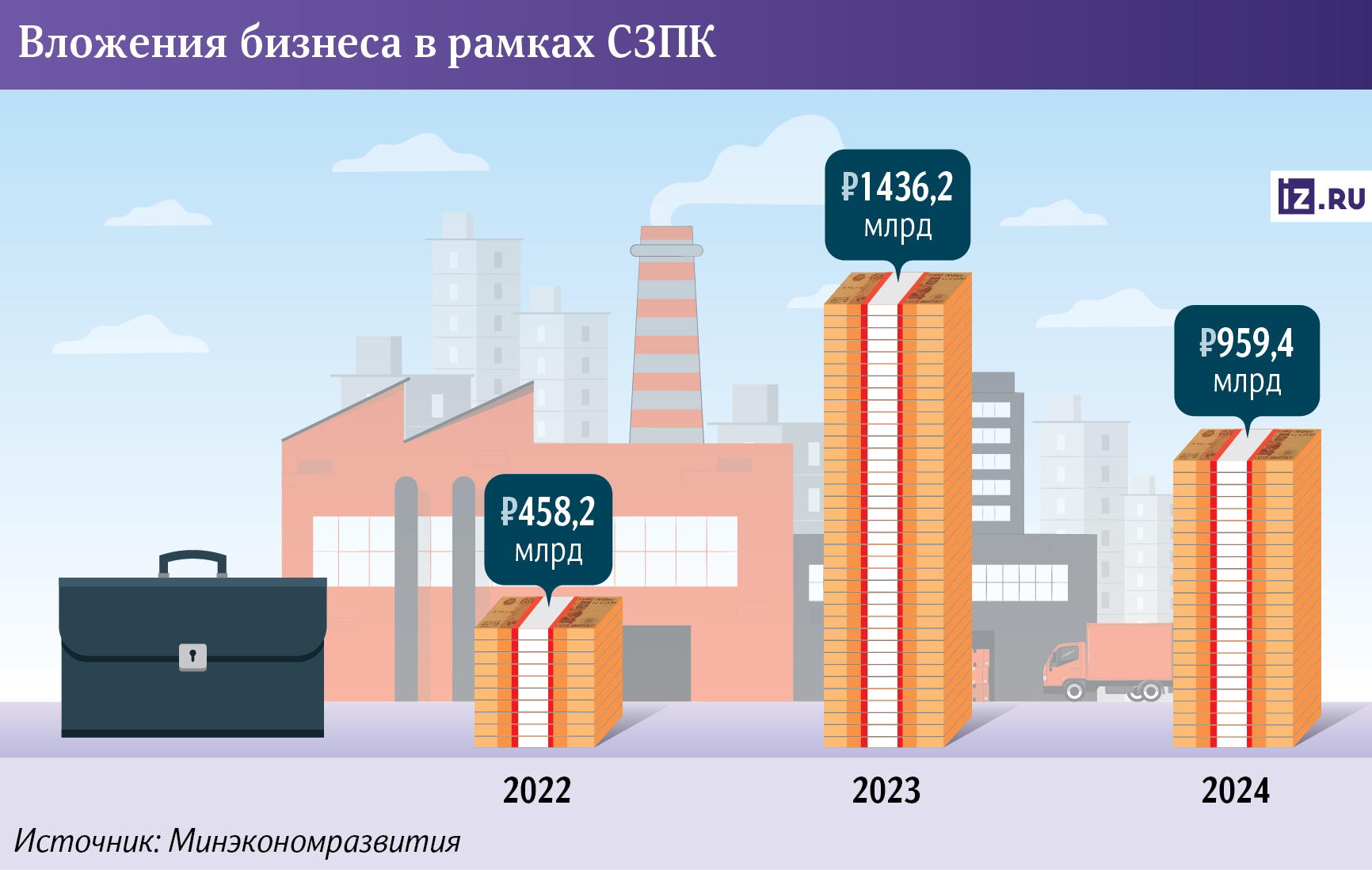
Companies have reduced the volume of investments under the agreements on the protection and promotion of capital investments (NWFPs) by almost 1.5 times in 2024, to 960 billion rubles, Izvestia found out. This happened despite the benefits that this mechanism offers. And although such projects were not subject to increased taxation and should have been popular, investments decreased. The main reason is the high key interest rate, which does not allow financing long—term projects. Because of this, the economy is only slowing down more. What preferential instruments do Russian businesses still have and what can make NWPC more attractive — in the Izvestia article.
How do investment protection agreements work?
In 2024, companies invested about 960 billion rubles under agreements on the protection and promotion of investments, the press service of the Ministry of Energy told Izvestia. For comparison, a year earlier, the volume of such investments was almost one and a half times more — over 1.4 trillion. For example, in 2024, thanks to this mechanism, money was invested in the Apatit mineral fertilizer plant in the Leningrad Region (33 billion rubles), in the Ultrabuild MDF woodworking enterprise in Kaluga (26 billion rubles), and in the Chegem Agro greenhouse complex in Kabardino-Balkaria (9.3 billion rubles).

The Apatit mineral fertilizer plant in the Leningrad region
In total, 2.9 trillion rubles of the target 4.4 trillion have been invested during the operation of the mechanism (since 2020), said Murat Kerefov, Deputy Minister of Economic Development.
— These are projects from a wide variety of fields: baking production, precision casting plants, greenhouses and meat production, mining and processing plants, transport hubs. More than 36,000 jobs have been created. 14 projects worth more than 142 billion rubles have already been finally commissioned," he told Izvestia.
NWPC is a mechanism of public-private partnership, under which the investor receives guarantees from the authorities. First of all, we are talking about the "stability of conditions" — tax, land, urban planning — for up to 20 years. This is especially important for large, capital-intensive projects with a long payback horizon, said Vladimir Chernov, analyst at Freedom Finance Global.

Businesses are protected from deteriorating conditions: from tax increases, the abolition of benefits, or stricter regulation. Other advantages are transparent parameters of interaction with government agencies and the right to receive compensation for infrastructure costs, for example, if the company is building a road to the facility. Moreover, benefits are available only for large—scale projects: with costs from 750 million at the federal level and from 200 million at the regional level, said Sergey Tinkov, Associate Professor of the Department of Entrepreneurship and Logistics at Plekhanov Russian University of Economics.

Why has business reduced investments in capex protection projects
One of the reasons for the decline in investments within the NWPC is the high base of previous years. In 2023, the demand for the mechanism was increased, Alexey Ravinsky, CEO of Launch Group, drew attention. Then the mechanism was fully restarted after significant changes were made, the press service of the Russian Union of Industrialists and Entrepreneurs (RSPP) told Izvestia. It has been made more attractive to businesses thanks to tax deductions.

In 2024, interest in this tool should also have been high. After all, NWPC projects are exempt from the increase in tax rates that were adopted last year and have been operational since 2025. However, investments still decreased due to the high key, Alexey Ravinsky explained. Last year, it was gradually raised from 16% to a record 21%. Even higher market rates have reduced the profitability of long-term investments, making many projects less attractive from a financial point of view, the expert noted. That is, even despite the large-scale benefits, companies are still in no hurry to invest in long-term development. Because of this, the economy is only slowing down more.
"Nevertheless, business is still directly interested in the NWPC as a mechanism that provides, in particular, stable conditions for investment projects over a fairly long horizon — namely, stability and predictability are in particular demand now," the Russian Union of Industrialists and Entrepreneurs noted.
What are the risks due to the reduction of investments in the framework of the NWPC
Due to the high key interest rate, it is difficult for companies to invest and invest in their development, which creates difficulties in the context of an already slowing GDP. As Maxim Reshetnikov, the head of the Ministry of Economy, said at SPIEF 2025, the economy is already cooling, and according to business estimates, it is on the verge of going into recession. The decline in investment, even for such a profitable instrument as the NWPC, is a vivid example of the difficulties that businesses are currently facing.

However, the Central Bank believes that high rates do not overcool the economy at all, but only bring it out of overheating. As the head of the regulator, Elvira Nabiullina, made it clear, it is important to control inflation now — and the Bank of Russia is ready to keep the key high for as long as the situation requires.

Investment protection agreements are one of the most well—developed and implemented mechanisms for stimulating business investment, added Mikhail Khachaturian, Associate Professor at the Department of Strategic and Innovative Development at the Financial University. However, the mechanism can be further improved.

According to the Russian Union of Industrialists and Entrepreneurs, there are a number of proposals from companies that are currently being discussed. In particular, to remove restrictions on the combination of tax benefits — for example, the deduction for the NWPC and the federal tax deduction. It is also possible to simplify the procedure for concluding agreements, especially for medium-scale investment projects, added Vladimir Chernov from Freedom Finance Global.
 In addition, according to him, enterprises can now take advantage of other support measures. Among them are subsidized and concessional loans, benefits operating in the territories of advanced development (TOP) and in special economic zones (SEZs).
Переведено сервисом «Яндекс Переводчик»
