
Arrest-wise: Armenian Church may be deprived of independence
Armenia may amend the Constitution, according to which the independence of the church from the state will be limited, the country's parliament told Izvestia. Currently, the Basic Law of the Republic stipulates that religious organizations are completely separated. Moreover, pro-government deputies have begun to make proposals on the introduction of a tax on the church, added Gegham Manukyan, a parliamentarian from the opposition Armenia faction. The split between the government and the church is intensifying in the country. On June 27, Archbishop Mikael Ajapakhyan was detained. Earlier, a criminal case was opened against him on grounds of public calls to seize power. Prior to that, Archbishop Bagrat Galstanyan and businessman Samvel Karapetyan were detained. Why the Armenian authorities began to actively oppress the church is in the Izvestia article.
The detention of Archbishop Mikael Ajapakhyan
The Armenian Church may be deprived of independence as a result of its conflict with the authorities, Gegham Manukyan, a deputy from the opposition Armenia faction, told Izvestia.
— Everything can be expected. They [the authorities] are preparing to discuss amendments to the Constitution at the request of Azerbaijan. We are sure that one of the points will be to remove the mention of the Armenian Apostolic Church (AAC) so that it would not be independent," he said.

Azerbaijan wants Armenia to amend its Constitution, as it contains a reference to the declaration of independence of 1990, according to which Nagorno-Karabakh is part of the country. In addition, pro-government deputies have already begun to make proposals on the introduction of a tax on the church, Manukyan added.
Formally, Armenia is a secular state. But Article 17 of the Constitution of the Republic stipulates that religious organizations are separated. And the 18th article states that "Armenia recognizes the exclusive mission of the Armenian Apostolic Holy Church as the national Church in the spiritual life of the Armenian people, in the development of their national culture and the preservation of their national identity."

Meanwhile, the conflict between the Armenian authorities and religious organizations, which has been going on for several years, is taking on new momentum. On the morning of June 27, more than 30 security forces broke into the building of the Shirak Diocese to arrest its head, Archbishop Mikael Ajapakhyan. However, he was not there at the time, and the archbishop went to Etchmiadzin, the spiritual and administrative center of the Armenian Apostolic Church, to hold a meeting of priests.
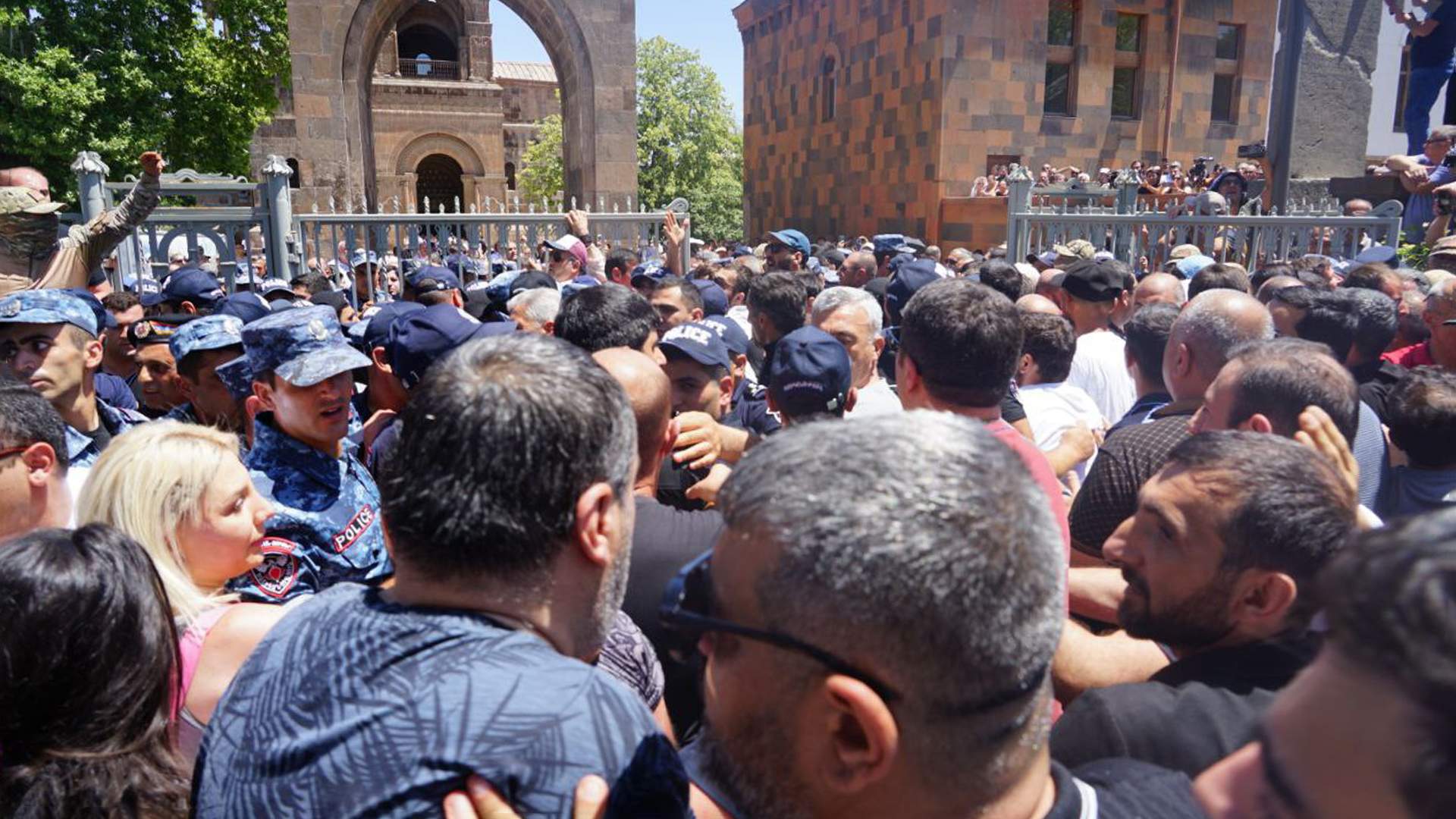
Later, the special forces of the National Security Service entered the territory of Etchmiadzin. The National Security Service tried to detain Ajapakhyan, but the parishioners who quickly gathered prevented them from doing so: dozens of local residents and priests gathered at the residence. Later, clashes broke out between them and the police. The clergy surrounded the car of the Armenian National Security Service to prevent the archbishop from being escorted out.

The National Security Service, in turn, blocked Isakov Avenue, along which citizens tried to get to the monastery complex to protect the church. Additional police forces, the Red Berets, have also arrived in the territory of Etchmiadzin.
At that time, Mikael Ajapakhyan's health deteriorated, and he received first aid. As a result, the archbishop agreed to go to the Investigative Committee and take part in the investigative actions, his lawyer Ara Zohrabyan reported. Earlier, a criminal case was opened against the head of the diocese on grounds of public calls to seize power.
As pressure on the church increases from Yerevan, it finds more and more support from the opposition. For example, the Armenia faction declared its readiness to seek the impeachment of Nikol Pashinyan and nominate the archbishop as prime minister.

A few days earlier, Armenian security forces detained Archbishop Bagrat Galstanyan, one of the country's most prominent opposition leaders and religious figures. He was accused of preparing terrorist attacks, as well as attempting to seize power. The "Holy Struggle" movement, led by Galstanyan, allegedly prepared to overthrow the government, according to investigators.
The previous high-profile incident was the arrest of Samvel Karapetyan, a Russian businessman and head of the Tashir Group of companies. On June 18, he was charged with publicly calling for the seizure of power. Karapetyan is one of the largest benefactors of the Armenian Apostolic Church.

Police officers stand in a cordon near the building of the Investigative Committee in Yerevan, where Samvel Karapetyan, a Russian businessman and president of the Tashir Group of companies, was taken.
The aggravation of the situation around the church in Armenia is being closely monitored in Moscow. "This is an internal matter, of course, of Armenia. Of course, we are interested in maintaining the rule of law and peace in Armenia. And for Armenia to be a prosperous, stable country, friendly to Russia," Kremlin spokesman Dmitry Peskov said on June 25. The Armenian authorities need to put into practice their declared commitment to democratic values and respect for the feelings of believers, the Russian Foreign Ministry said on June 27.

The conflict between Yerevan and the Church
The conflict between the Armenian authorities and the church has been going on for a long time. The main reason is political differences. The Armenian Apostolic Church has consistently criticized the policy of the authorities, especially in matters related to foreign policy and the settlement of relations with Azerbaijan.
In 2024, thousands of people protested in the republic over the delimitation of the border in the Tavush region. They were organized by the now detained Bagrat Galstanyan. At that time, a pedestrian march took place in Armenia from the border villages to the capital, and later the archbishop held mass rallies in Yerevan.

Archbishop Bagrat Galstanyan, leader of the opposition movement, at a protest rally in the city center
Despite the fact that the protests stopped for a while, representatives of the church have repeatedly spoken out against Yerevan's policy. The Church, although it should not be considered as a powerful civil institution, can attract a significant part of the population to the ranks of the opposition. And we must not forget that more than 90% of the Armenian population are believers.
It is obvious that such conflicts are not at all in favor of Prime Minister Nikol Pashinyan, who has been pursuing a policy of settling relations with Azerbaijan for a long time. Moreover, parliamentary elections will be held in the republic in 2026. At the same time, the rating of the authorities is rapidly falling.
According to a Gallup International opinion poll, more than 67% of Armenian citizens have a negative opinion of Nikol Pashinyan's work. According to polls conducted by MPG, one of the leading research and consulting companies in Armenia, only 8.2% of respondents are satisfied with his work.
Increasing pressure on the church is the initial stage of preparation for the elections in the republic, Vadim Mukhanov, head of the Caucasus sector at the IMEMO RAS, tells Izvestia.

Prime Minister of Armenia Nikol Pashinyan
— Pashinyan is radical, tough-minded and will really fight for power by all possible means, prolonging the powers of the ruling party in 2026 so that it retains a monopoly position in parliament. To do this, he clears the field. These are preemptive strikes," the expert believes.
What is happening in Armenia resembles the previous situation in Georgia, Mukhanov believes. But at the same time, according to him, it is possible that the difficulties in the country are temporary. Georgian ex-President Mikheil Saakashvili also had a conflict with the Georgian Orthodox Church. Nevertheless, religious organizations and the authorities are not in opposition.
Meanwhile, pressure on the church is now being observed in other countries of the post-Soviet space. We are talking about Ukraine, where the persecution of the UOC began after 2014, and Moldova, where disagreements between the Moldovan Metropolia (part of the Russian Orthodox Church) and the Bessarabian Metropolia (part of the Romanian Patriarchate) have recently intensified.
Переведено сервисом «Яндекс Переводчик»
