
Less than half: 6 of the 10 largest banks lowered mortgage rates in June

More than half of the major banks have eased conditions on market mortgage programs after reducing the key rate in June, Izvestia found out. Nevertheless, even now, real rates on average start at 25% — this is a barrier level, because the overpayment on such loans can be fivefold. At the same time, preferential mortgages are also becoming less affordable for Russians. After refusing to charge fees from developers, banks tightened the conditions for it, increasing initial payments and requirements for borrowers. As a result, the issues are falling. When housing loans will become more affordable for ordinary people — in the Izvestia article.
Mortgage rates in Russian banks
Six of the top 10 banks have lowered real rates on basic mortgage programs, according to data from the websites of credit institutions that Izvestia has studied. The average level of the total cost of housing loans (CPI — takes into account not only the rate, but also additional loan payments, for example, insurance) dropped below 28%, decreasing by 1 percentage point per month. At the same time, the minimum CPI level for mortgages fell by 1.2 percentage points, to 25%.
Credit institutions changed the terms after the Central Bank unexpectedly lowered the key rate on June 6 by 1 percentage point to 20%.

According to the United Credit Bureau (OKB), now the average mortgage bill is 5.7 million rubles, and the average term is 26.5 years. Overpayment of even the most profitable housing loan on the market with a down payment of 20% will be almost fivefold.
"Lowering interest rates does not make market mortgage loans really more affordable, since under standard conditions the debt burden and overpayment remain unbearable," said Yuri Belikov, Managing Director for Validation at Expert RA rating agency.

Mortgages will become truly affordable only at rates below 15% per annum, the analyst said. But such values, most likely, should be expected no earlier than next year. In the meantime, banks are continuing to carefully adjust conditions, taking their time to seriously reduce the cost of loans.

Major players began to gradually lower mortgage rates at the beginning of the year, anticipating a softening of the Central Bank's policy, Yuri Belikov noted. However, this decline is happening very slowly: lenders are trying to avoid sharp fluctuations by synchronizing loan rates with a drop in the cost of raising funds (that is, with deposit rates).
That is why banks may not actively adjust interest rates on market mortgages now, explained Irina Nosova, Senior Director of the Financial Institutions Ratings Group at ACRA. The financial institution issues all borrowed funds at the expense of the money of the population and businesses attracted to deposits. Deposit rates have exceeded 20% for a long time (although they have now dropped to 18%), so loan yields should be above this level.

In any case, a reduction in market mortgage rates will make it at least a little more attractive to borrowers, which is why the share of this product in loans may increase somewhat, Irina Nosova said. Izvestia sent a request to banks about whether the number of approvals for applications for market mortgages could increase.
Why can a bank refuse a preferential mortgage?
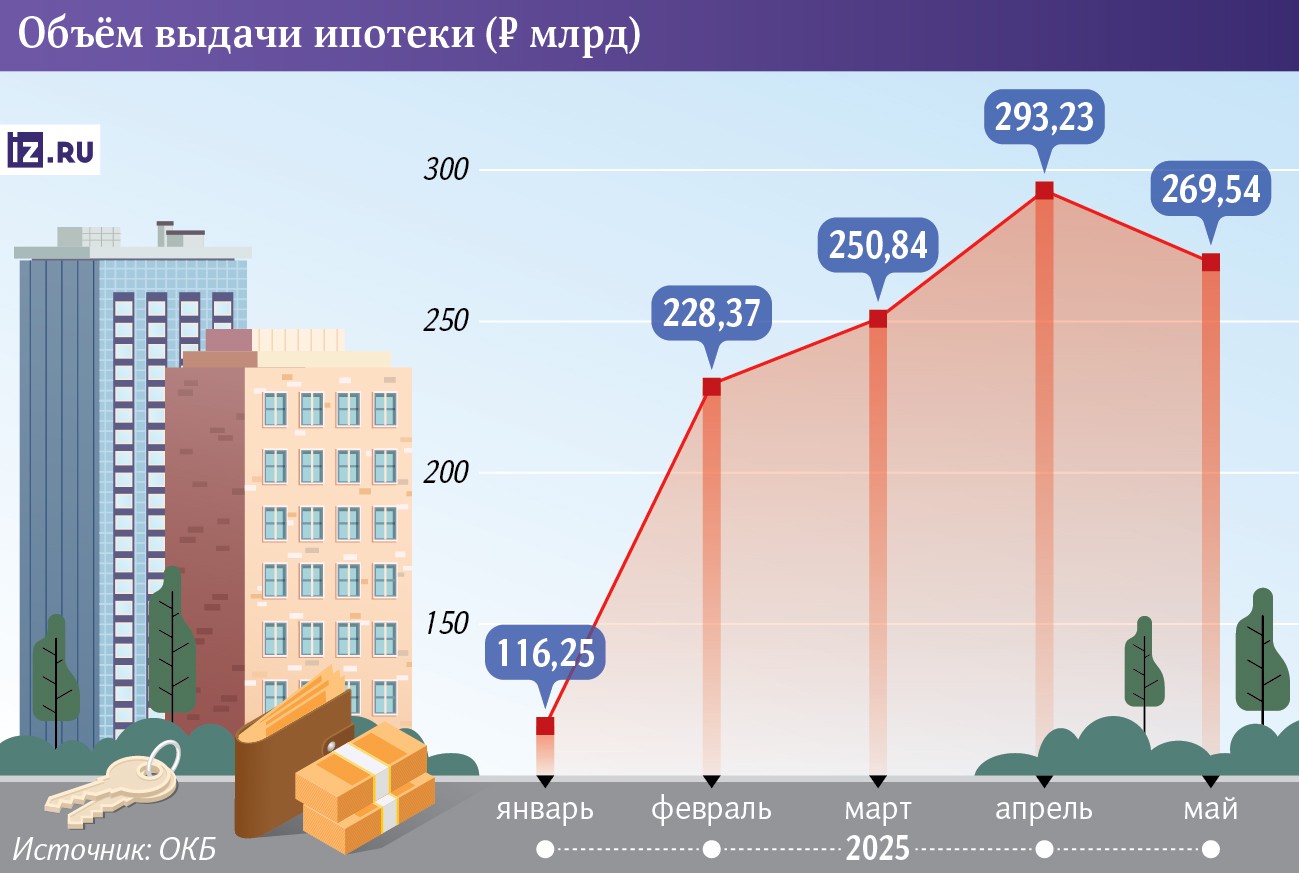
By the end of May, banks issued 8% fewer mortgage loans than a month earlier — 61 thousand loans worth 270 billion rubles, according to OKB data. The decline is primarily due to preferential mortgages. Disbursements under government programs decreased for the first time since the beginning of 2025.
This is happening against the background of the refusal of major players from charging commissions from developers, the Finance Ministry told Izvestia earlier. The practice began to leave the market in May 2025. And before that, in the last few years, if a developer wanted to sell housing under a state program, he had to pay an additional 4-10% per annum for each apartment — in fact, to co-finance a preferential loan.
This happened because due to the high key issue of government programs, they became unprofitable for banks. Officials fought with such commissions: even the president spoke out against it.
However, the authorities are in no hurry to increase the level of reimbursement for preferential loans, as they already spend a lot of money on them. The share of preferential programs in mortgage loans averaged 80% in May, according to data from the United Credit Bureau (OKB). At the same time, the difference between preferential and market rates reaches 17-21 percentage points, which means that the main debt burden on housing loans in the Russian Federation is now borne by the state.
But while deposit rates remain high, issuing preferential mortgages without developer fees is extremely unprofitable for banks, said Mikhail Goldberg from Dom.RF. Although the government reimburses the amount of annual interest on preferential programs equal to the key rate (currently 20%) + 3.5 percentage points (that is, in the amount of 23.5%), such a product is still not marginal for banks. For most banks, even the minimum cost of a market mortgage now exceeds 25%. Izvestia asked the Central Bank how the regulator assesses the market situation after the cancellation of commissions for developers.

After the abandonment of commissions, the profitability of preferential loans for banks decreased, so they began to issue them more cautiously, warned economist Andrei Barkhota. Now it is more difficult to get such a mortgage: banks refuse borrowers with high debts or unstable income.

In addition, financial institutions have raised down payments on preferential mortgages, said economist Alexei Krichevsky. This is the reason for the decrease in payouts.
Developers, realizing this, are trying to stimulate demand with "discounts" on apartments, but no more than a third of potential buyers agree to such conditions.

— Those who still take out loans at 25-28%, completely exhaust their solvency. Due to the high monthly fees, they have to save heavily on daily expenses, which creates financial stress," said Andrei Barkhota.
Globally, people no longer have money, so payments will not be able to grow steadily, Alexey Krichevsky believes. A "cosmetic" reduction of the key rate to 20% has little effect on the situation. So far, ordinary housing loans remain inaccessible to a significant part of Russians. And preferential programs remain the driver of the market, Sovcombank summarized.
Переведено сервисом «Яндекс Переводчик»
