Still fruits: Ilya Mashkov's retrospective is full of still lifes


Scattered fruits, buxom nude models, sun-drenched Crimean landscapes. The Tretyakov Gallery presented an exhibition of Ilya Mashkov, the most optimistic and joyful representative of the Russian avant—garde. The singer of plenty, who has gone from daring primitivism and screaming fauvism to ceremonial socialist realism, has not been honored with such a large-scale solo retrospective for a long time. Having collected about 200 works from many museum and private collections from all over the country, the State Tretyakov Gallery for the first time shows Mashkov's work so voluminously, even excessively — just in the spirit of the hero's art. Izvestia was among the first to evaluate this project.
Avant-garde solo
This June, the Tretyakov Gallery staged three solo retrospectives at once, claiming to be blockbuster (such a fashionable definition now causes skepticism in the art community, but the essence does not change). First, Bryullov, now Mashkov, and a week later, Deineka. And one can argue as much as one likes that monographic exhibitions are boring, but real practice shows that the potential of such projects is by no means exhausted.
However, Mashkov's show fits into another line, focused on the Russian avant-garde. Russian Russian Museum recently hosted major exhibitions by Lyubov Popova (at the Jewish Museum), Mikhail Matyushin and Elena Guro (at the Zotov Center). This week, the Russian Museum will show the huge project "Our Avant-garde", and the Museum of Russian Impressionism will compare the Russian Fauvists with the French. Obviously, this is also a long-term trend.
In general, God himself ordered Mashkov to be presented on a large scale. Fortunately, all his best things are kept in Russia. But they are scattered across regions in such a way that it is not an easy task to assemble them in one place (especially in the current conditions, when everyone needs the avant—garde). But the Tretyakov Gallery succeeded. The third floor of a new building on Kadashevskaya Embankment was allocated for the exhibition. A spacious, bright, airy room, where Mashkov's life-loving painting "sounds", it seems, even more joyful.
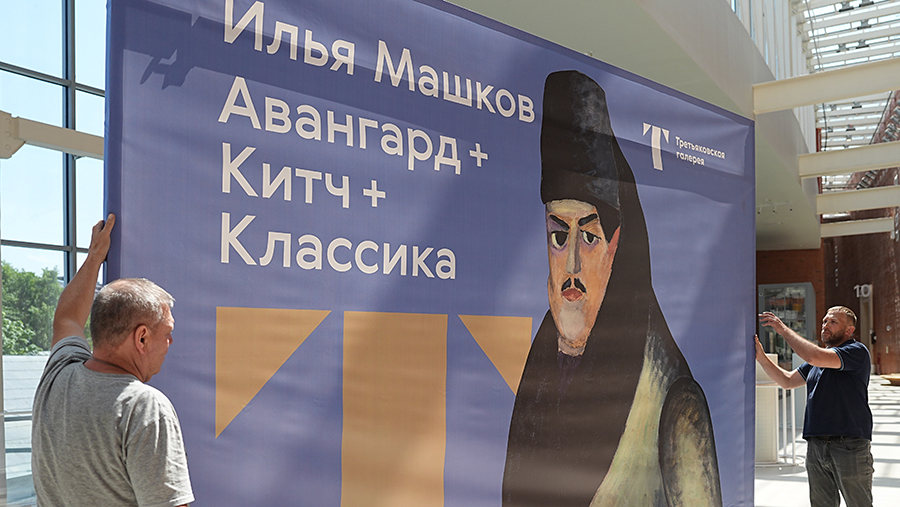
The design and architecture are very restrained, even strict, although the intriguing name is "Ilya Mashkov. The avant-garde. Kitsch. Classic" could justify the wildest visual solutions and combinations. The only unusual thing is the decision to paint the walls above the paintings blue, while the canvases themselves hang on a neutral light gray background. But, most importantly, it does not distract from the works of art, does not suppress them.

Where's kitsch, and where's classic
Mashkov, however, is not so easy to suppress. In particular, his works from the period of the beginning of the activities of the Jack of Diamonds association are bright, catchy, colorful. They are the ones who open the exhibition, and this is logical not only from the point of view of chronology, but also in fact. All subsequent creative stages of the artist are still less significant than this one. However, the textbook "Self-Portrait" (1911), where the exaggerated figure of a man is assembled from two-dimensional geometrized planes and placed on a "childish" background with a boat, is pushed to the far wall, which is not immediately visible.
And the viewer is greeted by canvases depicting fruits (including a masterpiece from the Russian Museum "Still Life with pineapple": the round shape of the painting itself is associated with a large dish on which fruits "dance a round dance"). And it is this motif that becomes the key to the whole narrative: everything begins with still lifes, and ends with them. It is tempting to see this as a concession to the tastes of the general public, after all, Mashkov's portraits, even today, after more than a century, can shock an unprepared viewer, but still lifes are liked by everyone, simply pleasing to the eye.
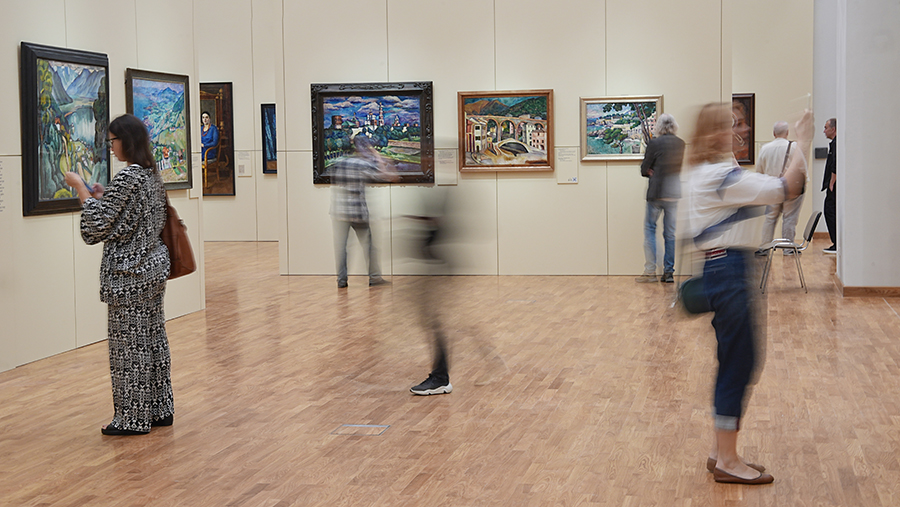
But the curatorial idea was apparently different: to visually show through one genre the metamorphoses of Mashkov's style. The very avant-garde, kitsch and classics stated in the title. The most interesting thing is that the line between such seemingly distant aesthetic systems turns out to be blurred, and sometimes completely illusory. And the further you go, the more you wonder: maybe the real kitsch is not paintings inspired by street signs from the 1910s, but, for example, late socialist realist compositions?
Here is the "Greetings to the XVII Congress of the CPSU (b)" of 1934. A bust of Stalin towering in front of a bronze figure of Lenin, a red star behind, flanked by Marx and Engels, surrounded by flowers, flowers, flowers, and three cherries coquettishly hanging from a pedestal. Alternatively, there are two versions of the work "Soviet Loaves" (1936): placers of pretzels, loaves, cheesecakes, lamb and other flour products are laid out against the background of the Soviet gingerbread coat of arms. In a later version, the artist added a cornucopia of fruits. The question of whether a simple Soviet citizen could have seen something like this in real life in 1936 does not even arise.
Cornucopia
On the other hand, aren't the "classicist" still lifes of the 1920s true avant-garde, where porcelain figurines in the form of dressed-up noblemen of the 18th century turn out to be next to "seasoned" apples against the background of a romantic landscape? This is eclecticism, polystylistics, all the more daring in the context of the artistic trends of the early Soviet era — constructivism and others. By the way, like "Soviet Bread", "Still Life with porcelain figurines" is also presented in two versions — from the collections of the Yaroslavl Art Museum and the Tretyakov Gallery. There are quite a lot of such pairs at the exhibition. The solution may not be the most practical (why bring a thing from another region if there is a similar one of your own?), but it brings a lot of joy. For connoisseurs, it's like an invitation to a painter's creative workshop. To the general public, it's like a game of "spot the ten differences."
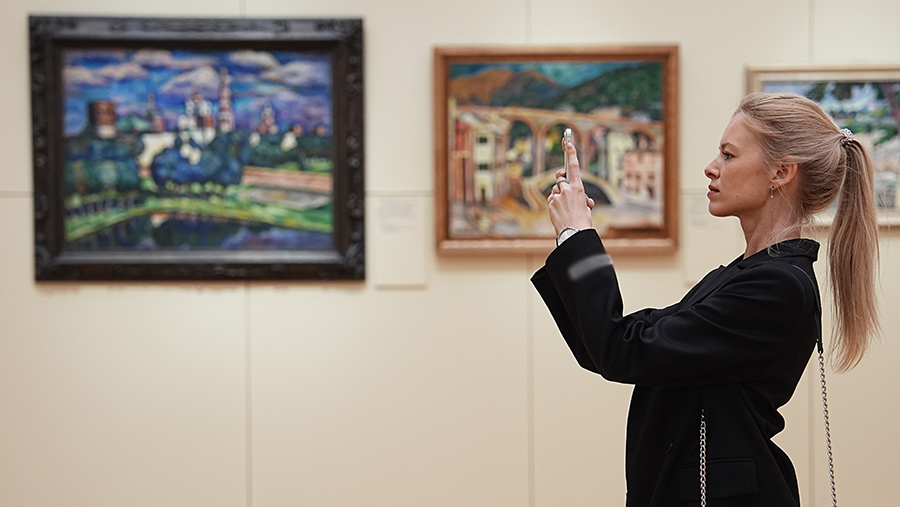
Yes, at some point it may seem that there are too many still lifes here, and there are too many landscapes. And not only because of the pairs of originals and author's repetitions. Let's say, why so many views of Crimea, especially in the 1930s? But for Mashkov's art, this excess is so organic! He needs the tables in the paintings to be full of phenomena, colorful natural panoramas to attract the eye at once, and the models in the portraits to be magnificent, portly. A separate section of the exhibition (immersed in semi-darkness for the safety of the works) is allocated for graphics, and basically these are just all kinds of nudes. The viewer can see how the painter moves from the boring academic studies of the early 1900s to more individual mature images, where this very desire for Rubens' feminine beauty manifests itself.

And here we can recall another Tretyakov Gallery project, which is being shown very close to Kadasha, in the Engineering Building in Lavrushinsky Lane: it's about the Boris Kustodiev retrospective. For all the stylistic distance, they have something in common. And two simultaneous GTG expositions, consciously or not, reveal this similarity. In an era of famine, disasters, wars and revolutions, both painters create an illusory world of abundance, carefree and beauty.
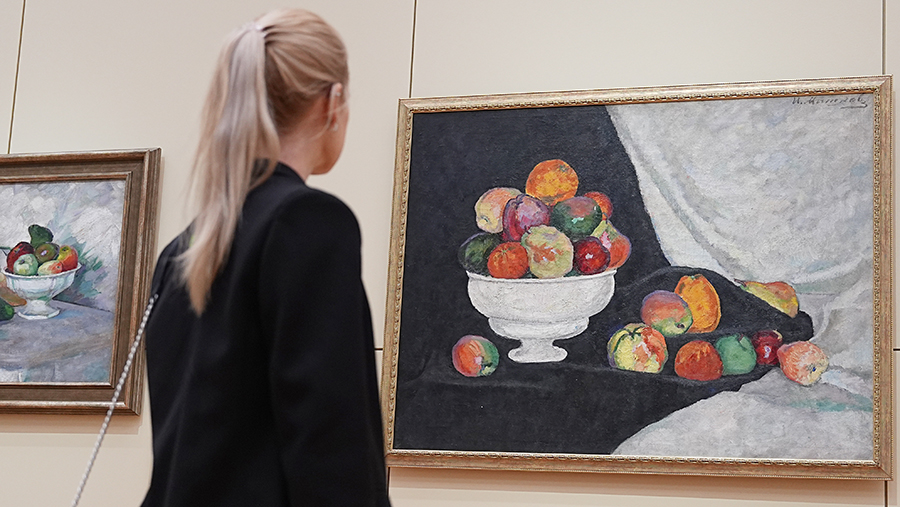
For one, it's merchant Russia with fairgrounds and tea parties on the veranda, for the other, the feasting bourgeois city of the empire (you involuntarily recall the lines "Eat pineapples, chew grouse..."), and then the Soviet "paradise", with collective farm idylls and Crimean beaches. One has a charming splint, the other has a flirtation with primitivism, Fauvism, Cezannism and, finally, socialist realism. But both have well—being and well-being again. Well, it really doesn't happen much. Especially today.
Переведено сервисом «Яндекс Переводчик»
