- Статьи
- World
- The rebellion has been unleashed: how the protests in the United States strengthen the positions of Republicans and Democrats

The rebellion has been unleashed: how the protests in the United States strengthen the positions of Republicans and Democrats
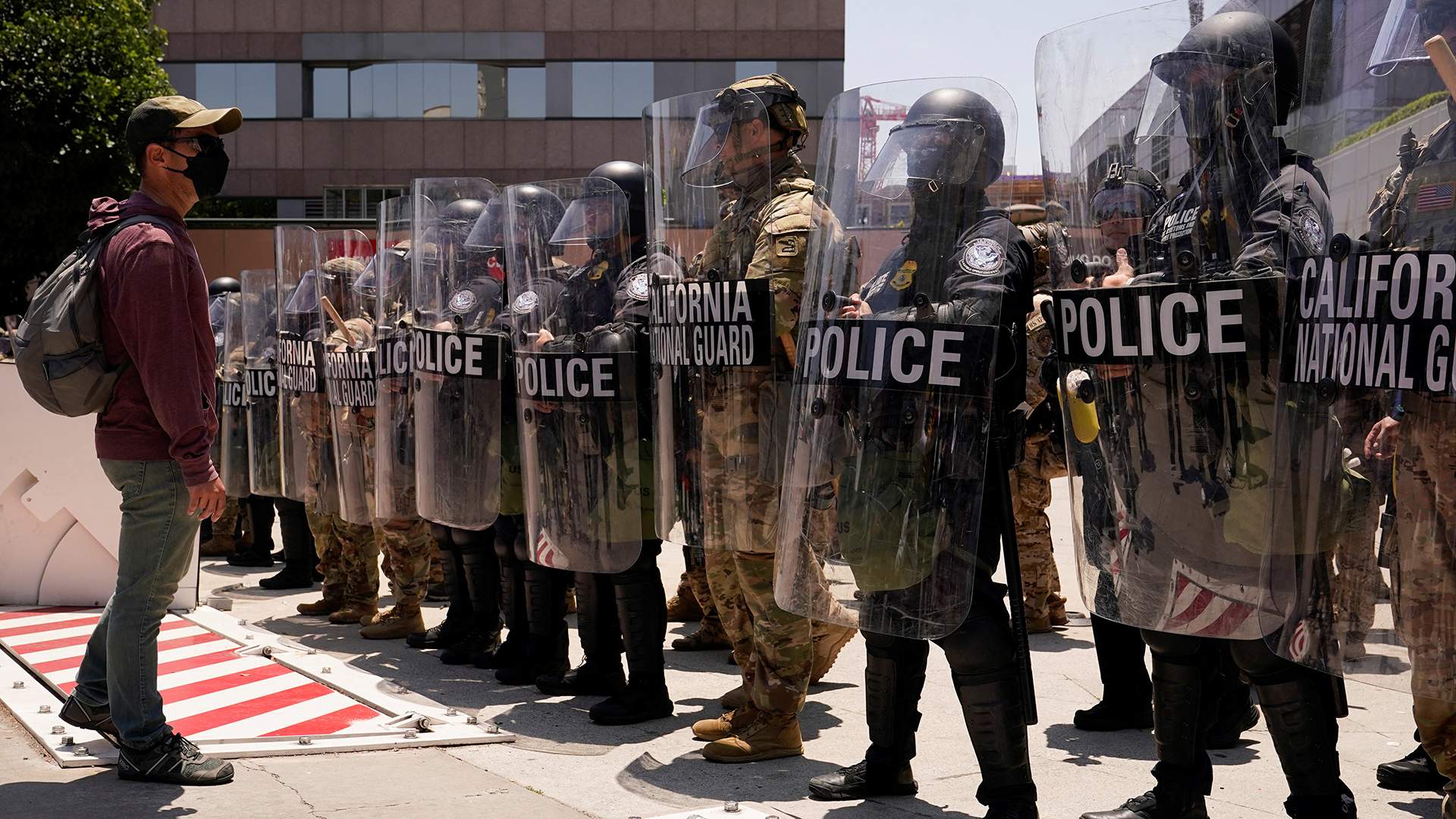
Anti-immigration protests have already engulfed the largest cities of ten states across the United States and can bring the confrontation between the Republican and Democratic parties to a new level, experts interviewed by Izvestia believe. The most difficult situation remains in Los Angeles, where discontent against Donald Trump's policies continues unabated, and an emergency regime has been introduced in the city. To quell the unrest, the president deployed the US National Guard to the city, which the local authorities regarded as an encroachment on their autonomy. How the protests strengthen the bipartisan split in the United States and how much the situation affects the ratings of the main opponents — in the Izvestia article.
Where are the protests going in the USA
Anti-immigration protests have been going on for five days in Los Angeles and nearby cities. The riots began on June 6 after the migration and customs service conducted raids against illegal immigrants and detained 118 people. At first, the protests were exclusively peaceful, local authorities say. The situation escalated when on June 8, Donald Trump, bypassing California Governor Gavin Newsom, ordered the deployment of a US National Guard unit in the city. For the first time in several decades, the federal authorities have made such a decision without the consent of the head of state. An emergency situation has been declared in downtown Los Angeles, and a curfew has been imposed.
Governor Gavin Newsom and Los Angeles Mayor Karen Bass sharply criticized the federal government's decision, calling it illegal and saying it was "purposefully inflammatory." Earlier, the state authorities refused to deport illegal migrants en masse, which Trump began fighting immediately after his inauguration. White House Deputy Chief of Staff Stephen Miller called the riots in Los Angeles an insurrection and justified the actions of the federal authorities as a "struggle to save civilization."
Donald Trump openly clashed with the governor of California, allowing the possibility of his arrest due to his refusal to facilitate the deportation of illegal migrants. In response, Gavin Newsom called what was happening the actions of a "dictator, not the president" and wrote on the social network X that "this is an undoubted step towards authoritarianism."
California is home to the largest number of migrants in the United States — more than 3 million, while they also make up a third of the total population of Los Angeles. California is considered a state where they traditionally support the Democratic Party, which advocates for the rights of minorities, including migrants from Latin America.
Since parts of the US National Guard were sent to California, the protests there may decline, and the authorities will try to prevent a repeat of the "summer BLM rebellion" in Trump's first term, Mikhail Mironyuk, associate professor at the Department of Politics and Management at the National Research University Higher School of Economics, tells Izvestia. In addition, according to ABC, there are now more American military personnel in Los Angeles than at US bases in Iraq and Syria. As of June 11, 4.8 thousand National Guard and Marine Corps soldiers are deployed in California, 2.5 thousand military personnel are stationed in Iraq, and 1.5 thousand in Syria.
Since the beginning of the protests in Los Angeles, more than 400 people have already been detained, dozens of injured protesters and journalists are regularly reported. Riots and police detentions are also taking place in New York, Atlanta, Chicago, Dallas and Philadelphia. In Chicago, a car drove into a crowd of protesters, and in Los Angeles, two journalists were injured by rubber bullets in the midst of street battles between protesters and police. At the same time, the Democrats will "rock" the situation in other states that support them, experts say.
"The closer we get to the Mexican border, the more migrants there are, legal and illegal," says Konstantin Sukhoverkhov, program manager at the Russian Council on International Affairs.
The protests have spread to Texas, where Republicans are in power, and the geography of the rallies is likely to expand. Riots, first of all, may begin in other southern states, led by Democratic governors. We can talk, for example, about such states as New Mexico or Arizona. They will try to use the situation for political purposes, exposing Trump's policy as unconstitutional and immoral, the expert noted.
In connection with the events in California, protesters across the country are preparing the largest rally against Donald Trump called No Kings. According to Axios, it will be held simultaneously in 1,800 locations in contrast to the military parade in the District of Columbia in honor of the president's birthday on June 14.
The Party struggle in the USA
The reaction to the protests in Los Angeles has sharpened the fundamental political dichotomy of the United States - the struggle between supporters of big and small government, says Egor Toropov, an expert on the United States and an analyst at the National Research University Higher School of Economics. That is, the confrontation between two opposing ideas regarding the powers of the authorities in the fields of public policy and the private sector.
— California Governor Gavin Newsom is once again zealously opposing the Trump—led federal government, both politically and ideologically, defending the sovereignty of the state. The governor is aiming to fight for the White House, trying to strengthen his internal party positions in the upcoming primaries of Democratic candidates for the 2028 presidential election," the expert added.
The current president will no longer appear on the ballot and considers his political steps through the prism of his historical reputation. The governor, aiming at the struggle for the White House, has repeatedly made image zigzags over the past year, from promising to become the leader of the democratic opposition to Trump to embracing him against the backdrop of fires in Los Angeles and appealing to the political center by agreeing with individual Republican positions, Egor Toropov continues.
"Now Newsom is once again becoming the leader of the resistance to the Republicans, using — like the struggle in Aikido and judo — their antagonism to him, which has already allowed him to neutralize internal party criticism," he believes.
Thus, the governor of California increases his chances of winning not only in the internal party primaries, but also in the general presidential elections. Newsom has become an acceptable figure for broad sections of Americans, both by winning over some of the centrist and wavering ones, and by regaining his position among the Democrats, who will determine their nominee in the upcoming presidential elections, the Americanist said.
The confrontation between the governor and the president is beneficial to both sides in terms of ratings, because Trump, unlike the 2020 protests, acts not in words but in deeds, and the Democrats have a chance to strengthen the ranks of their electorate, concluded Egor Toropov. Although some figures suggest the opposite: against the background of the split between the central government and the head of California, Donald Trump's approval rating dropped to 45%, lower than that of his predecessors Joe Biden and Barack Obama, The Economist reports. But it is possible that the president's numbers may rise if the protests are successfully suppressed.
— On the other hand, in the wake of the protests, the Democratic Party can find support for the battle with Trump and his policies, at least on the migration issue, "earning points" for future voting, Konstantin Sukhoverkhov is sure.
The conflict may create a bipartisan crisis or remain another stage in the eternal battle between the "reds" and the "blues." However, the United States is once again faced with a choice — between ensuring national security and the struggle for democratic rights, between the centralization of power and the autonomy of the states.
Переведено сервисом «Яндекс Переводчик»
