
The SCO happened: the CIS can grow at the expense of the organization's countries

The CIS Plus platform has begun to be developed in the Commonwealth of Independent States, the organization told Izvestia. Countries can join the new format both as partners and as observers. For example, the SCO members, as well as the organization as a whole, can join the CIS Plus. The sides have promising areas for cooperation: economic, humanitarian, and security, experts emphasize. The role of international organizations and associations in the Eurasian space has recently increased: for example, the SCO and BRICS are attracting more and more new partners. Why states are interested in these formats of cooperation and what benefits Russia will receive from this is in the Izvestia article.
Development of the CIS Plus platform
The CIS Plus platform has begun to be developed in the Commonwealth of Independent States, Andrey Sazonov, director of the Department for Cooperation in the political, Humanitarian and Social spheres of the organization, told Izvestia.

— The CIS Plus platform is being developed, like BRICS+, which involves attracting partners who are not necessarily formally part of the organization. In other words, the format of participation in the CIS is possible through membership, but also through partnership and observation," he said.
For example, the SCO member states or even the organization as a whole could become participants in the new format, Sazonov said.
"I think it's both." A dialogue is expected not only at the organizational level, but also at the partner level. We are ready, because they participated," says the director of the department. — Our CIS participated in BRICS+ as an organization. At the same time, individual BRICS+ countries participated as states. That is, both do not contradict.

Earlier, the CIS Plus format was proposed by President of Kazakhstan Kassym-Jomart Tokayev. According to him, the new format of the commonwealth would become the basis for the expansion of regional relations of the CIS. After that, the organization began discussing this format.
The CIS and the SCO have many points of contact. For example, the fight against terrorism, control and suppression of drug trafficking are important for both organizations, Belarusian political scientist Alexei Dzermant tells Izvestia.

President of Kazakhstan Kassym-Jomart Tokayev
"Therefore, countries such as Pakistan, India, and Iran could also benefit from the CIS Plus format," he says.
Organizations will be able to unite in solving humanitarian and cultural issues as well. One should not forget about the economic aspects: China, one of the leaders in the SCO, would rather benefit from such integration, and initiatives within the CIS could be continued there, the expert believes.
The expansion of contacts between organizations is also beneficial for Moscow, especially against the background of the West's incessant attempts to isolate it.
— This is an opportunity to find new partners, new markets, and negotiate with those states that do not obey the dictates of the West. Russia is also a key element of security in Eurasia. Therefore, this may give Moscow participation in a new alternative world order project, where it will occupy a central role, rather than a subordinate one, as Western states see it," the expert says.

Currently, the vast majority of post-Soviet states are already involved in the work of the SCO, Dmitry Sidorov, head of the Department of Foreign Regional Studies at MGLU, told Izvestia.
— First of all, the CIS Plus could help bring together various associations in the post-Soviet space. The creation of CIS Plus can be considered as one of the stages of the formation of a Large Eurasian Partnership. It is important that this initiative does not become a formality and produces real results," the expert draws attention.

Expansion of the Eurasian space
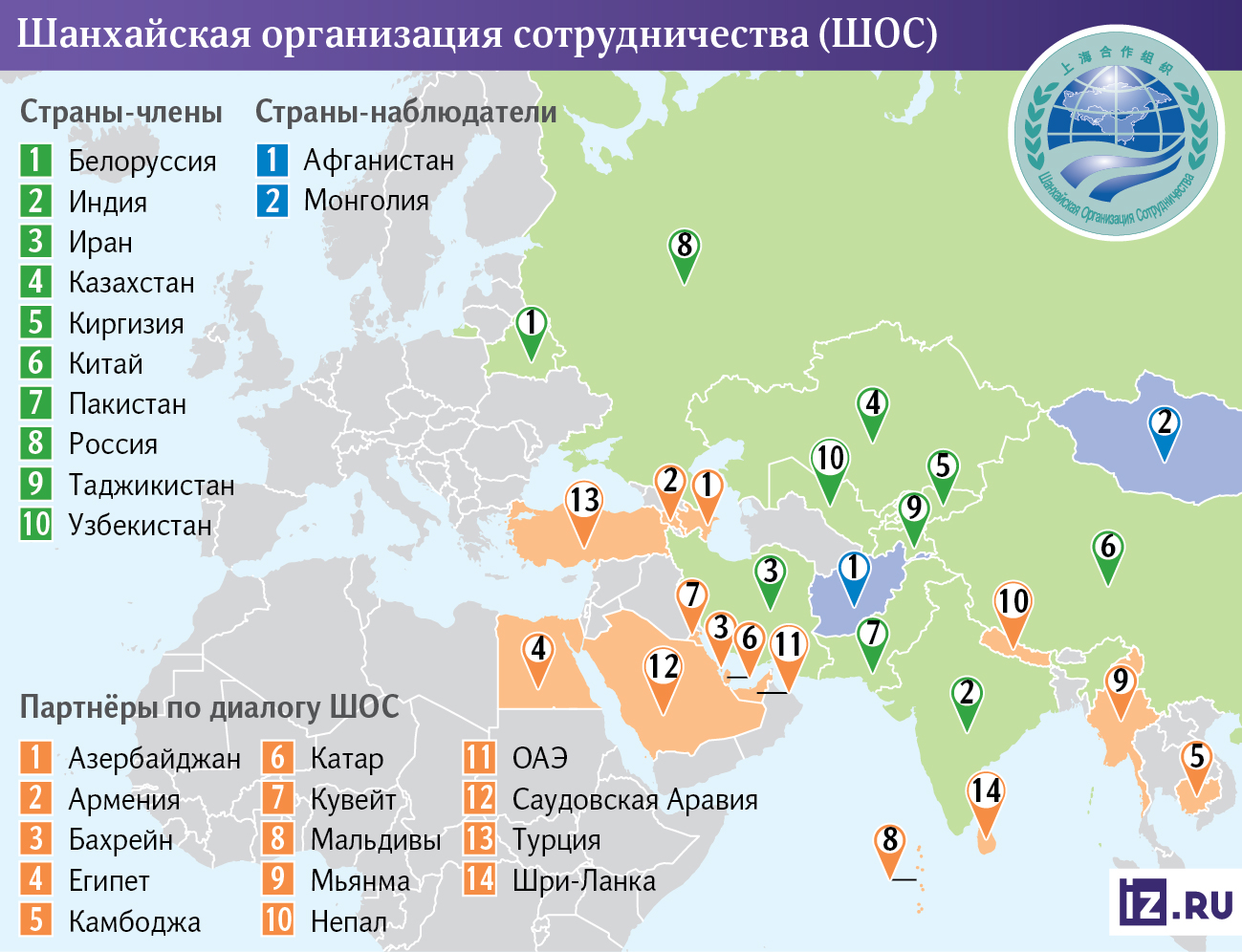
Recently, there have been more and more new formats of cooperation in the Eurasian space. In addition to the CIS, the Shanghai Cooperation Organization is also expanding. For example, in 2024, Belarus became the 10th member of the association, joining India, Iran, Kazakhstan, Kyrgyzstan, China, Pakistan, Russia, Tajikistan and Uzbekistan. Two more countries have observer status — Mongolia and de jure Afghanistan. The SCO also has 14 dialogue partners. Cambodia, Sri Lanka, Armenia and Azerbaijan have already applied for a change of status to an observer country.
At the same time, the organization itself is ready to cooperate with other structures. For example, the SCO secretariat told Izvestia that they do not rule out the unification of markets with BRICS in the future. Such cooperation can help countries cope with the consequences of the harsh US tariff policy and accelerate de-dollarization.

BRICS is also dynamically expanding. In January 2024, Egypt, Iran, the United Arab Emirates and Ethiopia joined the association, and in 2025 Indonesia joined. Moreover, a whole new category of partner States has emerged, which includes the countries of Asia, Africa and Latin America. And BRICS+ invariably attracts even more participants. A meeting in this format was held at the Kazan summit in October 2024. The leaders of the CIS countries, including Alexander Lukashenko, Nikol Pashinyan and Ilham Aliyev, as well as delegations from Asia, Africa, the Middle East and Latin America, as well as heads of a number of international organizations, including the UN and the SCO, attended the meeting.
The interaction of the CIS and BRICS countries has already strengthened the commonwealth's position on the world stage, Vladimir Putin said in October 2024. As the Russian president pointed out on the eve of the XXVIII St. Petersburg International Economic Forum in June 2025, "together with our partners, primarily in the BRICS association, we intend to continue working to build an effective system of equal and mutually beneficial international cooperation."
Another economic association, the EAEU, is actively developing in the Eurasian space. As early as this month, the countries of the union may conclude agreements on free trade zones with Mongolia and the UAE. The EAEU aims to sign an agreement with Indonesia at the end of the year, and negotiations with India and Tunisia may begin soon.

New Delhi, India
Back in 2015, Vladimir Putin put forward the initiative of the Greater Eurasian Partnership as an idea for building new economic ties. Just a few days ago, Russian Ambassador to India Denis Alipov said that this initiative is being viewed with interest in New Delhi. By the way, India, being a member of both BRICS and the SCO, could lead the other major players.

New organization formats are becoming more and more popular, and participation in them increases the status of countries, which is also why states strive for such cooperation, says Andrei Kortunov, an expert at the Valdai Club.
— Most of these formats do not impose strict obligations on the participants. That is, unlike classical integration projects or military-political alliances, such new-generation multilateral associations are extremely flexible. It can be said that so far the "entrance ticket" to these structures is issued free of charge. This is also their advantage, it makes them attractive," says the expert.

It is important to note that the expansion of organizations and their cooperation with each other also contributes to the creation of a new architecture of Eurasian security. Earlier, Russia and Belarus invited all Eurasian countries to join the dialogue on security on the continent to develop a Eurasian Charter on Diversity and Multipolarity in the 21st Century.
Now it is important for organizations and their participants to gather all joint ideas so that work can begin on their basis, at least in the simplest areas. And then, perhaps, it will be possible to move on to more complex and less obvious issues of forming a full-fledged Eurasian security system, Kortunov concluded.
Переведено сервисом «Яндекс Переводчик»
