- Статьи
- Army
- Getting back on their feet: how veterans of their military find themselves in peaceful life after severe wounds

Getting back on their feet: how veterans of their military find themselves in peaceful life after severe wounds
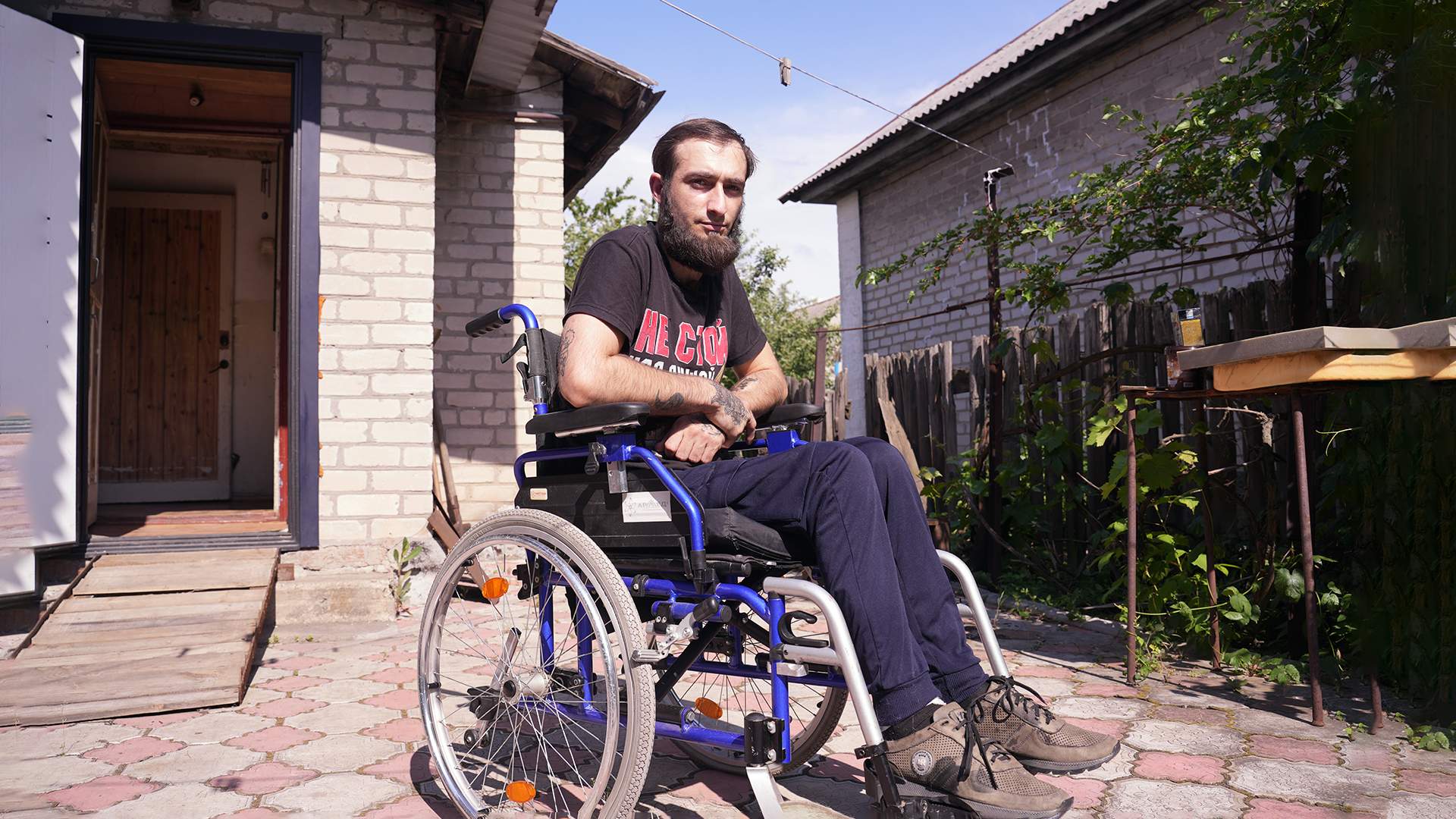
"Getting back on your feet, even if it is physically impossible to get up," they say. These guys were seriously injured, followed by amputation or paralysis. A difficult period of acceptance of a new state. And - moving forward step by step, including returning to work. One of our heroes today serves in the Interior Ministry, another has opened a wheelchair repair shop, and the third works at the military commissariat. What helps veterans overcome obstacles and what kind of support they need in the first place is in the Izvestia article.
All for the sake of the family
Dmitry's call sign is Twilight. Because when it all started in 2014, he - at that time a 22—year-old guy — was so imbued with what was happening that he could not sleep because of the relentless excitement. He worked in the mine during the day. In the evening I went on duty at the checkpoint. Since then, it's been the same — gloomy, Twilight.

Dmitry Twilight
Today, 11 years later, Dmitry's spine has been fractured, part of his spinal cord has been removed, and he uses a wheelchair. Reflecting on those distant days, he says, "It couldn't have been any other way. I would have fit into this story anyway. Even knowing what lies ahead. The only thing I would advise myself to be more vigilant on the battlefield."
During our conversation, Dima freezes at times, clenches his teeth, clenches into a ball. Severed nerve endings make themselves felt, causing phantom pains. When he was in the hospital, the doctors told him: "One option is to remove all the nerves, the other is to leave, it will be difficult, but there is a chance that the sensitivity in his legs will return." The patient chose the second one. Three years have passed. Nothing has changed.

In 2016, Dmitry got a job at the SOBR, and in a few years he became the recipient of three crosses "For service in special conditions." In 2022, his unit was sent to Mariupol.
— We carried out assault missions, — says Twilight. — At the end of March, our group took over the creamery. March was a turning point for me. My daughter was born on the 14th. On the 22nd, I was wounded…

Daughter's name on her hand, daughter is the main meaning of life
On that day, he recalls, information was received that the Ukrainian DRG was moving into their square. We were preparing for the meeting. Dmitry, being a machine gunner, took up the defense. An hour, two hours of silence. The order comes: "Let's move on!" This moment of relaxation played a cruel trick on him — Twilight, without worrying, went outside. There was a burst of gunfire, also from a machine gun, from the house opposite. As he fell, he managed to see the enemy shooter on the second floor.
Despite the danger, the comrades pulled Dima out. As they were leaving, they fired a grenade launcher — the Ukrainian machine gunner fell out along with the balcony. Then the wounded man was carried on a stretcher for 5 km. They were driven to Novoazovsk, where there was no light in the hospital. And then to Donetsk, where he spent eight hours on the operating table. The surgeon, golden hands, extracted the bullet, removed the bone remains, and fastened the vertebrae with metal staples.
— Then there were five months of rehabilitation in Moscow, where I learned to eat, get up in bed, and sit up again, — says Dmitry. — After that, I returned home to my wife. And he immediately said, "You can't pull it off. Leave me alone. You're young. I'll understand..."
And the wife left. And Dima, according to him, understood and did not condemn.

Dmitry Twilight with his sister Lina
His older sister took him in. "I was lucky to have a sister," says Twilight. He has been reinstated in the Ministry of Internal Affairs and works in a security company at the migration service. He says that if there were no work, no society around, it would be difficult: sitting in four walls is a difficult ordeal. He regularly conducts classes for unarmee soldiers, teaches them how to use edged weapons, and shares his combat experience. And he also says that the main meaning of life for him is his daughter (even if they don't see each other often).

Dmitry has been able to handle knives since childhood, today he teaches this to the yunarmeytsev.
"It's all for her,— Dmitry explains. — She keeps afloat like no one else. For her, I want to work, develop, and be the best.
Stop fighting
One of those who was wounded in the spine, lost part of the spinal cord, was paralyzed from the waist down, but waited for the moment when the sensitivity in his legs made itself felt — Maxim, a resident of Makeyevka, call sign — Duke. In 2014, he graduated from the 11th grade. He went to Russia with his father. In 2020, he returned to his homeland.
"I went to serve," Duke says. — In 2022, we were thrown to Mariupol.

The two most difficult days were in April. On the 1st, his squad entered the garage cooperative. A sniper opened fire on them near the building. Duke managed to hide under the walls and then saw a soldier of the Ukrainian Armed Forces opposite. That fatal case, when you need to get ahead of the enemy for a split second — raise your weapon, pull the trigger.
— I changed my hand and fired. I wounded him and immediately rolled away," Maxim goes over in his memory. — Then I threw a grenade behind the garage. I still dream about this situation. I wake up and search convulsively on the bed for the automatic…

Maxim Eskin
On April 4, he was wounded in the same direction. It hit me from the back, damaged my vertebrae, ruptured my spleen, and tore the muscles in my legs. He passed out during transportation to the rear. He regained consciousness two days later in the hospital. Then there are hospitals and rehabilitation centers for more than a year. Today he lives in a private house alone — or rather, with a little Pomeranian friend. Parents are nearby, they come in regularly, they help with everything.
But, Maxim explains, I want more independence, autonomy. He can move around in the yard and in the house. But you can't go out the gate anymore, you can't get the same groceries in a wheelchair. I appealed to the city authorities — please help, while there is silence. People with disabilities were also promised cars with manual controls, and several dozen veterans even received them. Max also submitted the documents, and again there was silence. Another problem is that there is no water in the water supply. Garbage has not been taken out on his street for the second week.
"If these basic issues were solved, life would become much easier," Duke shakes his head. — But it's like when you come back, you continue to fight with someone.
Maxim built himself a wheelchair with his own hands. And just the other day he opened a workshop for the repair of technical equipment for sick people. He has placed ads and is waiting for calls. The plans include an office based on the Union of Veterans of Afghanistan and the SVO, where they promised to help. I really want, he explains, to finally get off the ground and start moving forward.
Without delay
Kongar Kilan-ool is from Tuva. I spent three years on the front line. He started as a combat medic, and his last position was commander of a sapper platoon. Last November, he was wounded in the Kherson region.

Kongar Kilan-Ool during treatment after injury
"During the mission, I was hit by a PMN—4 mine,— Kongar shares. — My right foot was torn off, it was hanging by a tendon. Evacuated. They operated on him six hours later. Everything went well.
After that, there was a hospital in Crimea, where local doctors took care of the wounded as if they were relatives. Vishnevsky Hospital in Moscow. Accepting his disability wasn't easy, he explains. Although in the end it came to the realization that a severed leg is still not a sentence. In March, Congar put on a prosthetic leg. A month later, he returned to his native Tuva. They asked me to stay in the military unit. But, he shakes his head, it was necessary to stop, to rest.

Currently, Kongar works as a senior specialist at the military commissariat of his native Chedi-Khol kozhuun (district). Next to him is his wife, two daughters, who finally waited for their father. Recently, he and other veterans took part in the Republican Defenders of the Fatherland Cup, where his team took second place.: Kongar himself, for example, shot with an arrow.

Archery at the Defenders of the Fatherland Cup tournament
Speaking about the return of front-line soldiers, he notes the importance of socialization, especially for people with limited mobility, who often lock themselves in. A good example of such measures is the same tournament. It is necessary to get a job, although there is no need to rush here, a person must come to his senses after returning. And most importantly, he must be provided with all the necessary benefits and payments, preferably without delay (unfortunately, this process has not been sufficiently established yet). This is an important foundation on which a person can safely build his future life.
Переведено сервисом «Яндекс Переводчик»
