Percentage ratio: every tenth small company with loans has problems paying them off


One in ten companies from the small and medium-sized enterprises (SMEs) sector, using borrowed funds, had problems repaying loans. In the first three months of this year, almost 70,000 such enterprises applied for restructuring. This is twice as much as a year earlier, follows from the data of the Central Bank (Izvestia analyzed them). The reason is that the business mainly took out loans at floating rates, and after the growth of the key interest rate, the interest on loans soared. How big the problems of the companies are and what decision the regulator can take in connection with this situation is described in the Izvestia article.
Restructuring of SME loans in 2025
The small and medium-sized enterprises (SMEs) sector experienced increased debt repayment problems in the first months of 2025. From January to March, 68.6 thousand companies applied for loan restructuring — for comparison, in the same period last year there were half as many — 35.2 thousand, according to the information bulletin of the Central Bank.
According to the regulator, by April 1, 2025, 665.5 thousand SMEs had debts. In other words, almost every tenth small company with loans has applied for restructuring. Izvestia sent a request to the Central Bank and the Ministry of Energy, whether this poses risks to the country's economic stability.
Restructuring is a change in the terms of a loan for those who find themselves in a difficult situation. However, this does not mean that borrowers will completely stop servicing their debt to banks. There are several ways to solve the problem. For example, you can delay repayment — this will allow you to temporarily avoid paying off debts. Or increase the term: then the total loan repayment period will increase, and the monthly payment amount will decrease. This makes it possible to save the company and continue working, explained Alexander Isaevich, CEO of SME Corporation.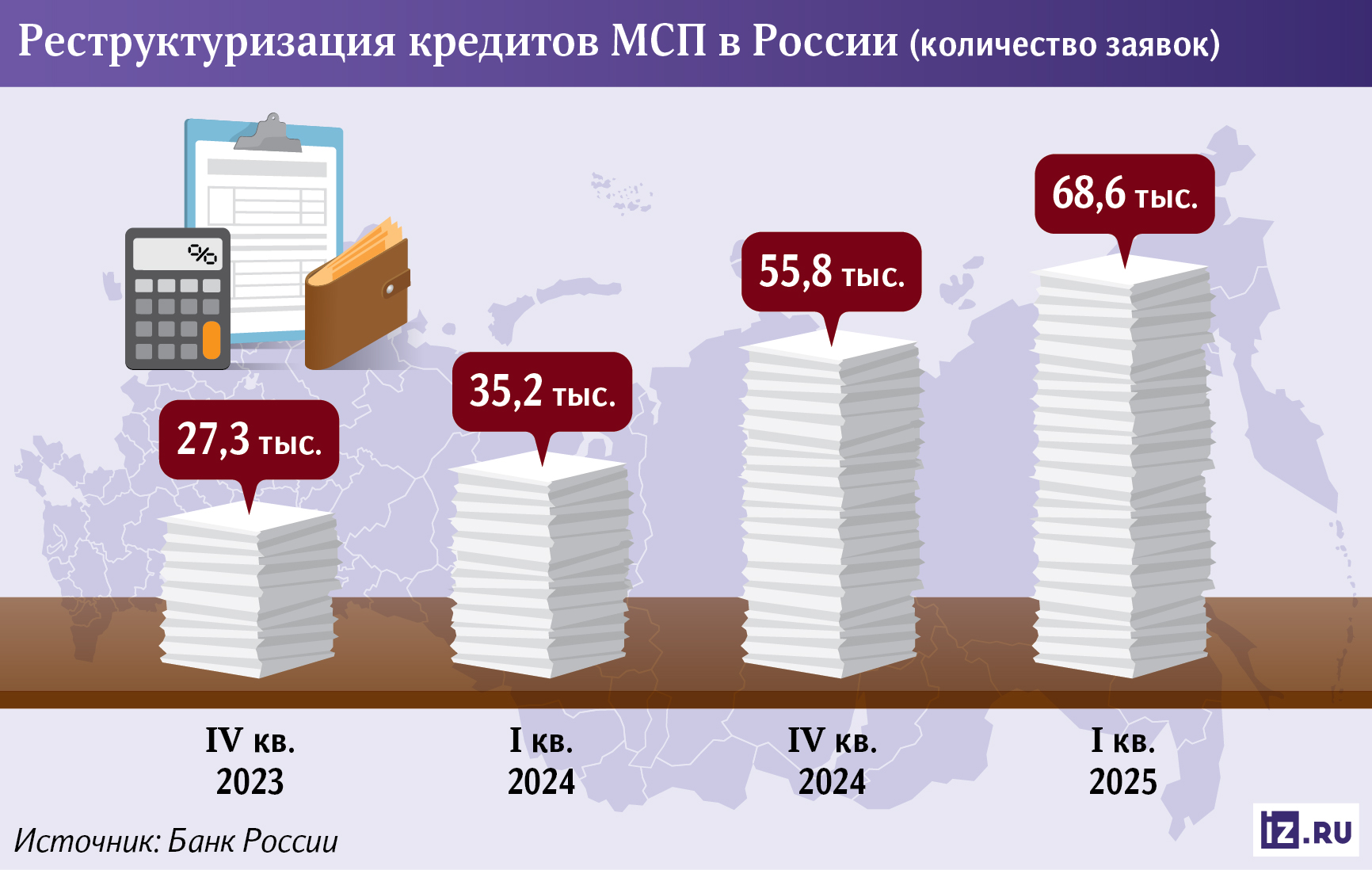
Most of the restructuring requests come from companies in the service sector — catering, retail, tourism, partly construction and logistics, said Sergey Katyrin, President of the Chamber of Commerce and Industry of the Russian Federation. He added: these industries are more sensitive to fluctuations in demand, they have a high dependence on working capital. In addition, the SME sector often lacks an "airbag" — small companies are more tied to the rhythm of payments from customers, Alexander Isaevich explained. And recently, payment delays have become more frequent. Moreover, state-owned companies also have such a problem, he said.
Pavel Samiev, Chairman of the Opora Russia Committee on Financial Markets, noted that the largest number of applications for loan terms are for medium- and long-term loans.

On May 26, the Central Bank called on banks to meet corporate borrowers facing temporary difficulties and offer loan restructuring. In order to reduce costs for banks and facilitate this process, the regulator has temporarily relaxed the requirements for the formation of reserves for such loans.
The regulator explained: in this way, banks should help companies and individual entrepreneurs with not too high debt burden, who have been servicing the debt regularly for the last six months and have provided the bank with a realistic business plan for the next three years.
How companies repay debt
In 2023, there were low loan rates and high business activity. Because of this, there were few applications for debt restructuring in 2024, said Sergey Tinkov, Associate Professor of the Department of Entrepreneurship and Logistics at Plekhanov Russian University of Economics. However, the situation changed in the same year, as consumer demand declined in many sectors of SME operations, so their turnover either stabilized or decreased. In addition, loan rates have increased, which led to a surge in applications in 2025.
The investment activity of companies has inertial properties and large time lags, independent expert Andrey Barkhota recalled. This means that the slowdown in investments began back in 2024, and the culmination of the process will be at the end of 2025 – the first half of 2026.
As Sergey Tinkov clarified, this was facilitated by an increase in inflation, which led to an increase in the key rate — it has been at the level of 21% since October. In 2024, SMEs were already taking out loans at high rates, so the debt burden increased and led to a wave of restructurings this year.
Most of the loans were provided to SMEs at a floating rate — "key plus 3-7 percentage points" — which means that interest rates on loans have now skyrocketed to about 28%. In addition, general economic factors have a significant impact on the inability to cope with debts — a decrease in consumer demand in certain market segments, an increase in the cost of products and services, said Sergey Katyrin, President of the Russian Chamber of Commerce and Industry.
— If the high rate remains for a long time, for example, for six months or a year, then we will see an even greater increase in restructurings among companies... However, some will be able to recover after that, while others will not," said Pavel Samiev from Opora Russia.

However, according to him, the experience of previous restructurings — for example, in 2009-2011 — shows that the economic situation in the company is not deteriorating, and many enterprises then reach a normal level of debt servicing.
Izvestia has sent requests to banks asking for comment on whether they are recording an increase in the number of loan restructuring applications.
How small businesses can operate at high rates
— The increase in the number of restructurings indicates difficulties with liquidity and may temporarily freeze development plans — the business focuses on maintaining operational activities. But it is important to understand that restructuring is not a waiver of obligations, but a tool to keep the business afloat. In the future, if such companies successfully adapt, they will return to investment," Sergey Katyrin emphasized.
Expensive money leads to a decrease in investment activity in the SME sector, which postpone investments in projects until better times, agreed Sergey Tinkov from Plekhanov Russian University of Economics. According to him, companies will continue to actively apply for restructuring until high-interest loans decrease.
However, when making a decision on the key rate, the regulator will pay more attention to price increases than to the situation with debt repayment by companies, says Igor Dodonov, an analyst at Finam Financial Group. The expert explained: in the weekly data, inflation in the Russian Federation is gradually slowing down — for example, on May 19 it was 9.9%, but inflation expectations have increased this month.
The central Bank is likely to refrain from lowering the rate at the June 6 meeting, but then begin to ease monetary policy, the expert believes.
Переведено сервисом «Яндекс Переводчик»
