Commodity contribution: Russia will supply food to Burkina Faso and Niger

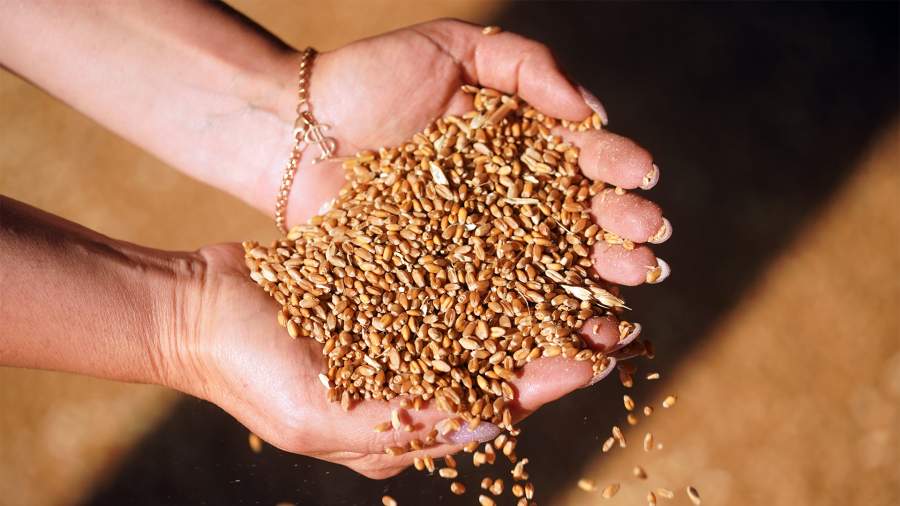
In May, Russia will transfer 709.5 tons of humanitarian aid to Burkina Faso, the Russian Foreign Ministry told Izvestia. In addition, the Russian side is completing the necessary procedures for providing gratuitous aid to Niger in the amount of up to 20 thousand tons of wheat. Moscow is ready to provide new humanitarian supplies if agreements are reached, Russian Agriculture Minister Oksana Lut told Izvestia. In 2023, the Russian Federation announced the transfer of humanitarian aid to six African countries — Mali, Burkina Faso, Zimbabwe, Eritrea, Somalia and the Central African Republic. Russia may change its approach to providing humanitarian assistance to Africa amid a reduction in US programs, experts say.
Which African countries are Russia helping?
Russia will transfer new shipments of food aid to the poorest countries in Africa.
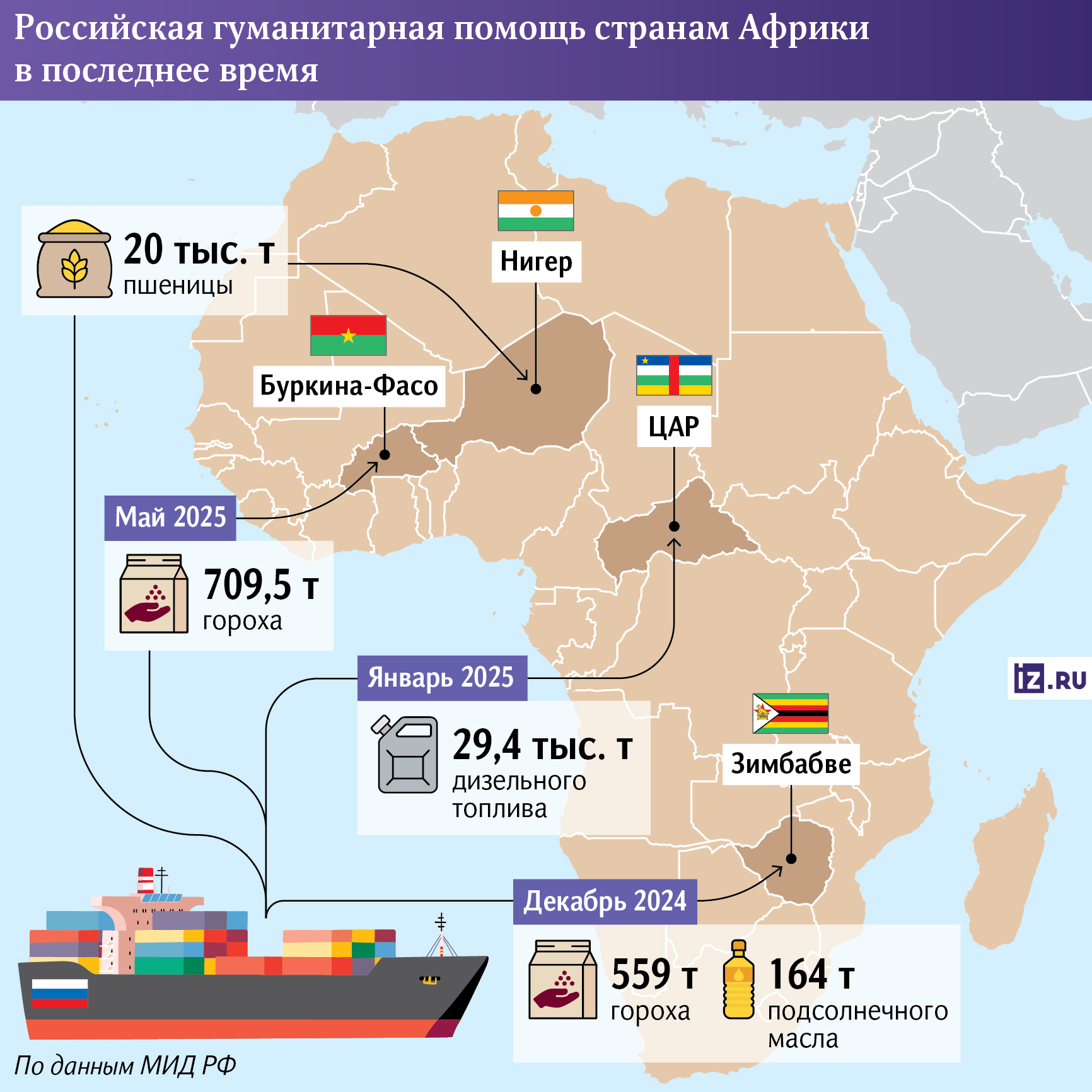
— Recently, 559 tons of peas and 164 tons of sunflower oil were shipped free of charge to Zimbabwe (December 2024), as well as 29.4 thousand tons of diesel fuel to the Central African Republic (January 2025). In May, 709.5 tons of peas are expected to be transferred to Burkina Faso. The Russian side is completing the necessary procedures for providing gratuitous aid to Niger in the amount of up to 20 thousand tons of wheat, the Russian diplomatic department told Izvestia.
The Russian Federation is ready to continue to carry out new humanitarian supplies if agreements are reached, and all the necessary volumes are available, Agriculture Minister Oksana Lut told Izvestia.
— Our decision on humanitarian supplies is made by the president. Therefore, if there is such a decision, of course, we will provide everything. We have no information that there have been official inquiries. This is, of course, a matter of communication between our leader and his decision-making. In terms of volumes, of course, we have volumes. If necessary, we will supply all the volumes on which agreements will be reached," she said.
Russia is one of the main grain exporters in the world, with a share of about 25%. Deliveries of Russian agricultural products by the end of 2024 amounted to 109 million tons, which is equivalent to $43 billion, the Minister of Agriculture said in April. According to her, Russian exports of agricultural products have increased 2.5 times over the past 10 years, while agricultural production in the country has increased by 33%. At the same time, the share of Asia and Africa in Russian exports of agricultural products amounted to 74% in 2024.
Recall that the problem of global hunger has sharply worsened in 2022-2023 after the COVID-19 pandemic and disruption of global supply chains. Western countries launched an economically unjustified money issue and "swept away all food products from the world market in their favor, abusing their monopoly position," Vladimir Putin said in June 2023. At the same time, the Russian leader announced gratuitous supplies of 25-50 thousand tons of grain for Burkina Faso, Zimbabwe, Mali, Somalia, Central African Republic and Eritrea.
"Humanitarian aid supplies to the mentioned states are currently being carried out through the UN World Food Program at the expense of Russian contributions," the Russian Foreign Ministry said.
In most cases, Russian humanitarian aid is sent to African states with which relations can be characterized as friendly (Zimbabwe) or even allied (Mali, Burkina Faso, Central African Republic), Ivan Kopyttsev, a junior researcher at the Center for the Study of North Africa and the Horn of Africa at the Institute of Africa of the Russian Academy of Sciences, explained to Izvestia.
— These states consistently support the position of the Russian Federation in the international arena, and cooperation with them covers a wide range of areas, including the military sphere. At the same time, in some cases (Somalia), humanitarian aid supplies should rather be considered as a contribution by the Russian side to solving global challenges, such as fighting hunger and eliminating the consequences of natural disasters," the expert said.
How other Powers support Africa
The humanitarian situation in the world is further complicated by Western sanctions. The existing restrictions are aimed at the insurance of agricultural products and the production of agricultural machinery, the EU is also going to introduce protective duties on fertilizers from the Russian Federation and Belarus. In addition, the Black Sea Grain Initiative has been terminated due to non-fulfillment of conditions by Ukraine and the EU. Despite the fact that Moscow and Washington have agreed to resume the grain deal, so far this has not been achieved, primarily due to Western sanctions and the position of the EU, which refuses to lift restrictions from the Rosselkhoznadzor.
The humanitarian situation in Africa may also be affected by the US line. The administration of Donald Trump has declared trade a new cornerstone in the policy of building relations with the states of the continent. Humanitarian projects are being curtailed everywhere amid the reform of the USAID (Agency for International Development) and a sharp reduction in funding. "The change in the long-standing patterns of humanitarian cooperation is happening before our eyes and, apparently, will entail the formation of a corresponding "niche," said Kopyttsev.
It should be recalled that the United States annually allocated about $70 billion in various grants around the world, primarily through USAID. About a quarter of the USAID budget went to African countries. After the arrival of the Trump administration, the agency's work was suspended, the budget and staff were reduced. Secretary of State Marco Rubio stated that of the entire list of USAID programs, only 17% will continue to operate.
In the short term, the reduction of US humanitarian programs will negatively affect the poorest segments of the population, since the mechanisms of this assistance to a certain extent still had a positive effect. However, in the long term, African countries have the opportunity to move away from dependence on humanitarian aid, Vsevolod Sviridov, deputy director of the HSE Center for African Studies, told Izvestia.
— This may be Russia's unique advantage and offer for Africa — not to replace, not to supply the same amount, but rather to change the approach to providing humanitarian assistance. In other words, it's not goods that should be transferred, but tools, such as drones and digital technologies for agriculture, fertilizers, and seeds adapted to local conditions," the expert said.
Traditionally, Europe's participation in promoting Africa's development has been based not on gratuitous supplies, but on investments in land, infrastructure, and educational initiatives. Now they are trying to replace the United States, perhaps Brussels will put forward new initiatives. However, this will not be a significant success, since the main agricultural exporters from the EU countries have no great interest in such gratuitous supplies, Sviridov concluded.
Переведено сервисом «Яндекс Переводчик»
