This is how steel was tempered: parts for nuclear power plants will become twice as strong.
- Статьи
- Science and technology
- This is how steel was tempered: parts for nuclear power plants will become twice as strong.

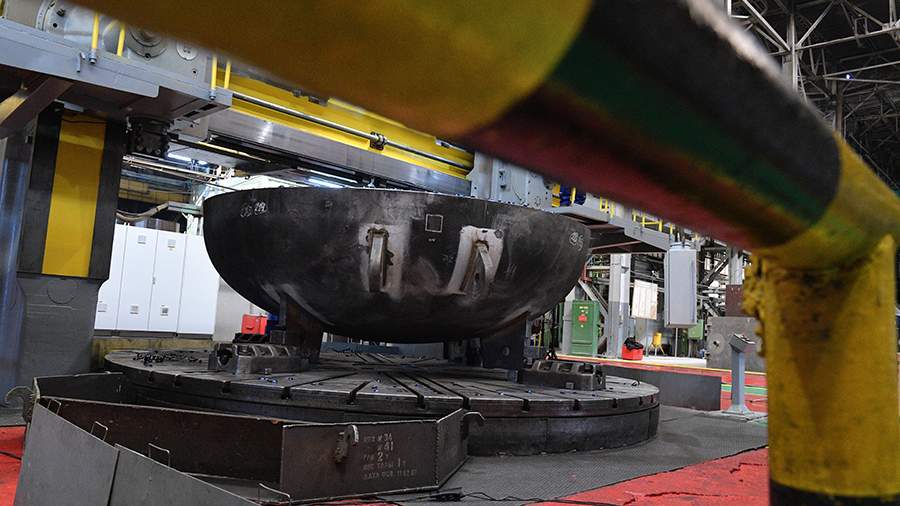
Russia has proposed a new technology to increase the wear resistance of parts for nuclear power plants. These products experience increased mechanical and thermal stress. The method is based on laser thermal hardening of metal elements. The implementation of the development will accelerate their processing, increase the strength of alloys by 1.5–2 times and prolong the life of the equipment. This will reduce the cost of replacing components and servicing energy facilities, experts say.
How metals harden
Scientists from the Engineering Center at Vladimir State University (VlSU) have found a way to extend the life of metal parts that are used in extreme conditions at nuclear power plants and other energy facilities. The technology is based on the laser hardening method, a method of hardening the surface of parts to increase their wear resistance.
— This method is in demand for processing parts that experience high friction, shock loads and high temperatures. For example, gears, shafts, valves. Intensive mechanical and thermal effects lead to their accelerated wear. Laser thermal hardening increases the surface hardness and strength of parts without changing the geometry or properties of the core of the material," Maxim Kuznetsov, General Director of the center, told Izvestia.
He explained that the proposed technological process is a sequence of operations for heating, holding and cooling alloys. During processing, the laser beam locally heats the subsurface layer to temperatures above the phase transformation boundary. In this case, the crystal structure of the material changes. The exposure time depends on the scanning speed and the shape of the laser spot. In turn, cooling occurs due to the removal of heat into the inner layers of the modified material.
— Nowadays, quenching with high-frequency currents is more often used. However, there is excessive heating of the parts, which leads to deformations. With laser thermal hardening, by heating only the near—surface layers, the total amount of heat invested is reduced, which significantly reduces the deformation of the material and reduces processing time," explained Maxim Kuznetsov.
According to the expert, the technology makes it possible to control the parameters of the impact on the material with high accuracy. Including withstanding the required degree of hardening, the depth of surface treatment and the trajectory of the scanning beam. This is important for compliance with technical specifications and strict standards in the nuclear industry.
— The technology was used to process pumps of the second cooling circuit of nuclear power plants. It was necessary to harden the surface from 45 to 53 HRC (a unit of measurement for the hardness of materials on the Rockwell scale, which is widely used for metals. — Izvestia) to a depth of only 0.6–0.8 mm. The proposed method allowed us to meet these requirements," Maxim Kuznetsov gave an example.
The development makes it possible to double the service life of products, the specialist added. This will help reduce the cost of replacing components, maintenance of nuclear power facilities, as well as the cost of electricity. At the same time, it is important that the technology allows for the establishment of single and small-scale production of a wide range of products.
Laser hardening method
The proposed method makes it possible to increase the wear resistance and resource of individual components of high-tech equipment at nuclear power plants, said Alexey Kuzmin, First Deputy Head, Director of Production at CCBM. For example, if previously it was necessary to replace a part after 10 thousand hours of operation, now these procedures can be performed after 24 thousand hours, that is, after several years of continuous operation, he explained.
— One of the advantages of laser hardening is the absence of manipulation, except for moving the beam along the processing path. In addition, with such processing, due to the high rates of local heating and cooling, the hardness of the material is usually higher than with traditional volumetric quenching or high—frequency current quenching," said Viktor Petrovsky, head of the MEPhI Laser Center.
According to him, the main application of laser hardening is related to the localization of heat in a strictly defined area. Often, in order to increase the life of parts, it is not necessary to strengthen its entire surface. It is enough to process areas subject to high loads.
— In such applications, the technology can provide significant benefits compared to traditional methods of thermal hardening, both in terms of productivity and labor savings. However, it makes no sense to use laser hardening to harden small gears, screws or rods," the scientist explained.
However, localization of laser radiation can sometimes be a disadvantage, Viktor Petrovsky noted. For example, if the width of the treated area exceeds the size of the laser spot. In this case, to fully cover the surface, a multi-pass scan with overlap is required and partial softening of the already treated areas occurs. This leads to uneven hardness of the reinforced material.
In order to process hardening surfaces in one pass with uniform hardness and to the same depth, optical laser beam expansion systems and techniques using high-speed beam vibrations are currently being developed, the specialist added.
Переведено сервисом «Яндекс Переводчик»
