- Статьи
- Society
- You can lick the sticks: intestinal bacteria have been found in the shish kebab blanks

You can lick the sticks: intestinal bacteria have been found in the shish kebab blanks
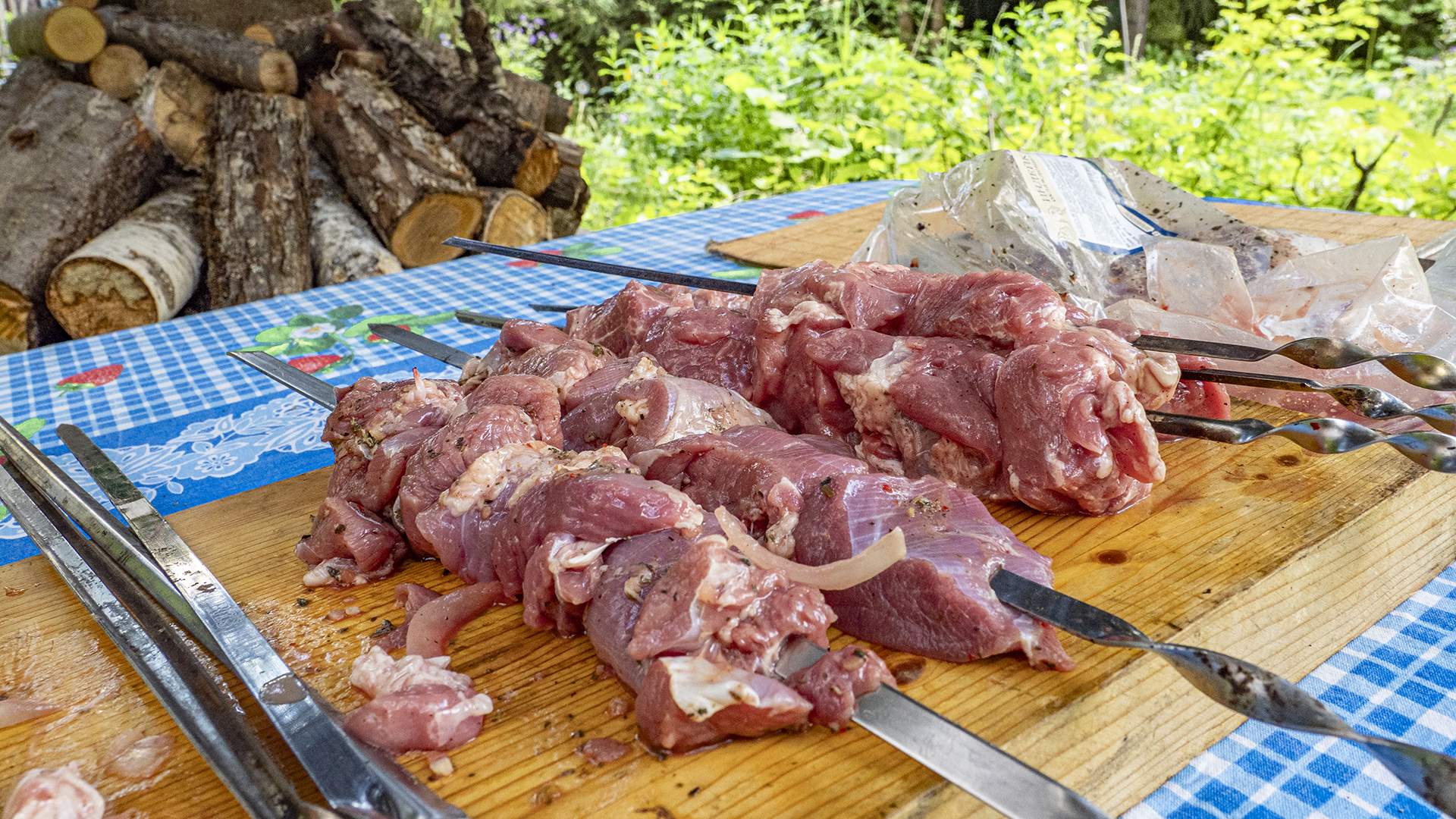
Buying semi—finished barbecue products in a store for the May holidays can result in poisoning for Russians at least, and infection with infectious diseases at most. Microorganisms were detected in all samples of shish kebab that Izvestia purchased in stores and submitted for examination. The permissible values were exceeded, but in one case it was the most critical, which indicates that the products were stale. E. coli was found in two more samples. Editorial correspondents, along with experts from the Popular Front, conducted raids on Moscow markets: inspections showed that most sellers lacked or expired veterinary certificates. About why there is no control over meat products and how to set it up - in the material of Izvestia.
What the examination showed
An increase in poisoning and referrals to medical institutions in connection with acute intestinal poisoning was recorded by doctors during the May holidays, Elena Specsenko, head of the Roskachestvo Center for Food Safety Competencies, told Izvestia. Among the dangerous products, including shish kebab, Izvestia found out as a result of its own investigation.
On the eve of the May holidays, the editorial staff conducted a control purchase of meat products for cooking shish kebab in seven of the most popular hypermarkets. The goal is to find out how high—quality meat is for cooking Russians' favorite May dish and whether it is safe to eat it.

All the purchased samples were sent to the testing reference laboratory of the National Center for Safety of Fish and Agricultural Products (FSBI NCBRSP) with a legal address in Moscow.
We are talking about products manufactured by Filhe Property LLC, Miratorg-Kursk LLC, Miratorg-Bryansk LLC and the OK hypermarket chain (the latter have their own production facilities). The samples were ordered online on the official websites of the retail chains where they were sold, and then they were delivered by courier to the laboratory. The journey time from the shops to the laboratory took no more than an hour.

According to the results, all samples of shish kebab contained microorganisms that got there during production. We are talking about the CMAFAnM index (the number of mesophilic, aerobic and facultative anaerobic microorganisms). It allows you to determine the condition of the product: it characterizes its quality, freshness and safety, and also shows the level of sanitary and hygienic regimes in production, storage and transportation conditions.

Exceeding the permissible standards of KMAFAnM indicates insufficient heat treatment of the product, violation of the sanitary and hygienic regime of production, rules of transportation and storage, experts explained.
In addition, E. coli was found in two samples. Both are manufactured by Miratorg.
Three more samples, produced by Indilight and the Magnolia and Verniy retail chains, are being tested. At the time of publication, their examination had not been completed.
What the manufacturers said
All producers reacted approximately the same way to Izvestia's request and the results of the examination. As an argument, they referred to a violation of the temperature regime during the delivery of meat from the store to the laboratory.
So, the Miratorg company reported that the meat samples were selected incorrectly — the test report allegedly did not specify the date, time and method of sampling (in fact, all these data are in the protocol. — Izvestia). Also, according to the manufacturer, the samples should be withdrawn at the place of sale, that is, in the store, and the laboratory address is indicated in the protocol.

"It is not possible to judge the reasons for the violation of the temperature regime of product samples due to the lack of correct information about the methods of sampling from the places of sale, as well as the subsequent modes and periods of storage and transportation of samples by the customer to the test site," the response says.
In general, the company expressed distrust of the expertise conducted by the Federal State Budgetary Institution "NCBRSP".
"The results of the tests are questionable and unfounded, and therefore cannot reliably indicate the detection of E. coli group bacteria in the samples, as well as an excess of the CMAFAnM index," Miratorg concluded.

As proof of the proper quality of the products produced, Kursk and Bryansk Miratorg sent examination protocols of the very types of kebabs that Izvestia bought in the store. These studies were conducted in other testing laboratories in mid-April 2025.

The protocols indicate that no foreign microorganisms or bacteria were detected in the samples. Miratorg acted as the customer of the examination within the framework of its own production research.
The company also stated that the company has high production standards, and all products undergo a full range of sanitary and veterinary control. And that previously there were no cases of detection of E. coli and microorganisms in this barbecue. The company has attached certificates of compliance to the response.

Meat processing enterprise APH "Miratorg" in the Bryansk region
E. coli can be inside meat, as it lives in the body of animals. Or it can be introduced into the product by a person at the cutting stage if sanitary standards are not observed in production, said gastroenterologist Andrey Yakushev. Also, according to him, the bacterium can get into the products during transportation with non-compliance with sealing and temperature conditions.
At the same time, the expert recalled that E. coli can be non—pathogenic, that is, it does not provoke diseases, and pathogenic - pathogenic.
— The second variant of E. coli causes diarrhea, nausea, vomiting and dehydration. Kidney damage or urinary tract pathology may occur in children and people with weakened immune systems due to infection," he added.
There are also carcinogenic strains of E. coli that increase the risk of developing cancer, the specialist added.

The examination showed an excess of the KMAFAnM indicator in products sold by Auchan Retail Russia and OK.
Auchan told Izvestia that the Filhe Property meat processing plant was certified and passed a supervisory audit in 2025. "There have been no complaints from customers about this product," the response emphasized.
In response to the same examination indicator, the OK press service reported that meat for customers is always sent in thermal packages with a cold storage battery. So it was with the sample purchased by Izvestia.
"We recommend that immediately after receiving the delivery, we ensure storage on our own according to the conditions indicated on the package, or heat the product," they said.
The protocol submitted for review established a violation of the temperature conditions for sample delivery to the laboratory, said Svetlana Gil, Director of Quality at OK. According to her, this factor could have influenced the increase in the CMAFAnM index in the sample.

"According to our information, a violation of the temperature regime could have occurred during the transportation of the sample to the laboratory," she added.
Andrey Yakushev noted that a violation of the temperature regime can lead to the proliferation of various microorganisms in products, including pathogenic ones.
"In this case, the risk of infection increases, for example, salmonellosis or shigellosis," he added. — These infectious diseases are extremely dangerous for children, the elderly and people with weakened immune systems. The most common complications of salmonellosis are acute renal failure, toxic and dehydration shock, and damage to the cardiovascular system. With shigellosis— dehydration occurs.
If infected with these infectious diseases, fatal outcomes are possible if treatment is started untimely, the expert emphasized.
Elena Guseva, Head of the Microbiological Research Department at the National Center for the Safety of Fish and Agricultural Products, noted that the excess of CMAFAnM values in the barbecue samples is expected.

— Meat cannot be sterile. And the minimum number of microorganisms is possible only in canned food," she said. — Exceeding the KMAFAnM index does not directly indicate a poor quality of meat, but indicates its stale nature, the likelihood of an unpleasant odor from it.
Pavel Shapkin, the head of the National Consumer Union, also told Izvestia that the excess of microorganisms in raw shish kebab samples was not surprising.
— The product is non-sterile and is subject to heat treatment. With high—quality roasting, 99% of bacteria die," he explained.
Experts did not record the excess in terms of KMAFAnM in ready-to-use products, so we cannot talk about its insecurity for humans, the expert emphasized.
Violation of the temperature regime of meat storage leads to the proliferation of microorganisms. This may be due not only to manufacturers, but also to the retail chain or the delivery service, concluded Elena Guseva.
The "black" market
After receiving the results of the examination, Izvestia, together with experts from the Popular Front, conducted inspections of points in Moscow markets where meat is sold, and found that not all proper storage conditions were met, and manufacturers did not always have veterinary certificates confirming the safety of their products.
For example, at one of the points in the Moscow region, treasured beef meat is sold on the shelves. The meat smells disgusting, and it's impossible to stay indoors. If you look closely, you can see yellow spots on it, which indicate that it is stale. In addition, the seller refused to provide us with veterinary certificates.
At another point in the same market, Izvestia was shown a room with refrigerators to prove that the goods were stored in the right temperature conditions. But there's a flaw here, too: the refrigerators are covered in street dirt and blood.

Violations were also recorded at the market in the south of Moscow. For example, offal, chicken and other meat are stored at one of the points on the street at plus temperature. At the same time, the seller assured the correspondent that the goods had just been delivered, so they had not yet had time to put them into the room.
In fact, the products have been standing outside for several hours and getting wet in the rain. No one was going to deliver it. The sellers refused to show the documents for the product.
At another point in this market, there were documents for meat products, but with expired shelf life.
For example, we were shown documents for pork and beef, according to which the shelf life of meat expired on April 28, and now it's the 30th. At the same time, the product continues to be on the shelves.

In addition, in this market, as in the previous one, the storage conditions of offal are violated.
At another market in the Moscow region, spoiled meat products are again sold in several locations located next to each other. At the same time, there is a long queue for the goods, mostly elderly people.
When asked by Izvestia about the quality of the product and the expediency of its sale, the cashier of one of the outlets replied that the products were allegedly for animals and she did not see anything wrong with their sale.
Despite the obvious spoilage of the product, at almost all points of this market, each seller has veterinary opinions on the quality of meat from a laboratory located at the market. The only caveat is that the conclusion is issued for one carcass and without specifying the expiration date, and more than one product is sold on the counter.
The laboratory at the market said that there are veterinary certificates for all meat, but you need to ask the sellers at the points.

"Everyone works with their supplier, and all sellers at the points must have documents for their products," said one of the laboratory staff.
At the same time, no one in this market provided veterinary certificates for the meat sold to Izvestia.

All producers are required to register with the Rosselkhoznadzor's Cerberus system, and each batch of meat must receive an electronic passport in the Mercury state system, Victoria Korneeva, chief state inspector of the State Veterinary Supervision Department, reminded Izvestia. According to her, this is the only way to track the path from the farm to the counter, ensuring the safety and quality of products.
— If the entrepreneur does not register in the system, therefore, he does not have veterinary accompanying documents for the products. This means that it violates the technical rules of the Customs Union and sanitary regulations," she added.

Eleonora, a certified specialist of the Mercury system, noted that it is impossible to obtain the necessary documentation for meat products without the participation of a veterinarian. And a fine of up to 40 thousand rubles is provided for the sale of meat bypassing state control, she recalled.
Compliance with sanitary rules and regulations during the technological process is the main component of product quality. Proper use of inventory, washing and disinfection, compliance with basic hygiene rules, compliance with temperature conditions, the integrity of the cold chain during transportation and timely laboratory monitoring are the key to the release of a high—quality and safe product, Elena Specenko is convinced.
Pavel Shapkin recommended that consumers pay attention to the appearance of meat and evaluate its smell.

— If there are extraneous notes in the meat, such as antiseptics or a well—stored product, it is clearly not worth consuming it, it is better to return it to the store, - he noted.
Raids by control authorities helped to protect themselves from unscrupulous sellers, suppliers and small, often gray merchants. But after the moratorium on inspections of small businesses was introduced, violations became widespread, said Alexey Egarmin, co-chairman of the National Union for Consumer Protection. To solve the problem with the sale of low-quality products, only increased responsibility for the sale of low-quality products and increased control over the production and storage of goods in stores will help, the expert believes.
Переведено сервисом «Яндекс Переводчик»
