- Статьи
- Science and technology
- Slender scan: Russia creates the most accurate 3D model of the Moon and Mars

Slender scan: Russia creates the most accurate 3D model of the Moon and Mars
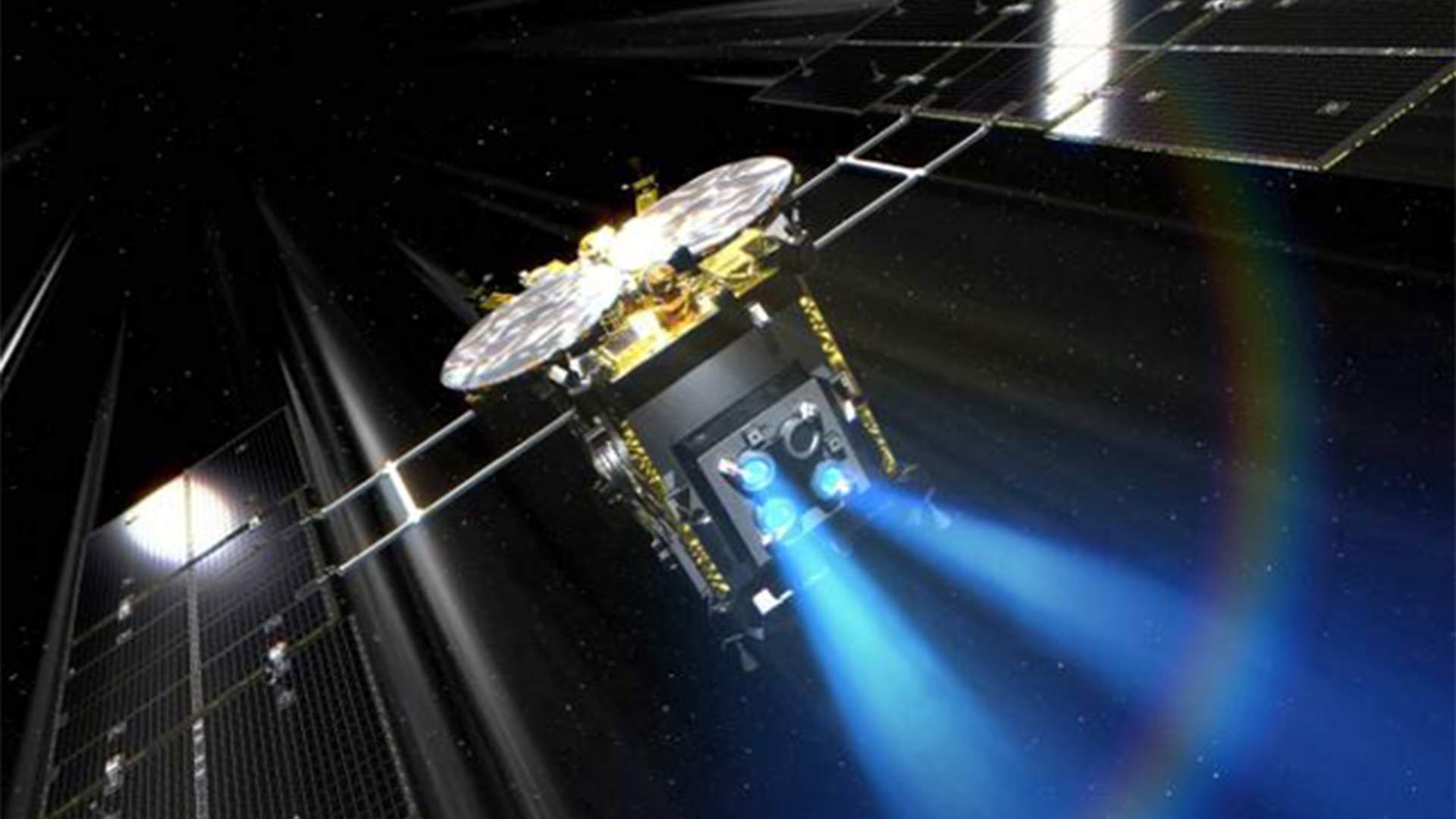
Russian scientists have announced the launch of a project to create high-precision 3D models of the Moon and Mars. For its implementation, the efforts of both public and private enterprises of the space industry will be combined. It is already known that in the course of the work it is planned to use domestic scientific developments — small spacecraft with plasma engines, optical navigation systems, high-resolution optoelectronic cameras, programs for building 3D images from photographs and others. According to experts, the project will allow for the development of a whole range of promising areas, but its full implementation in reality may be hindered by the lack of a number of key technologies.
Which satellites will fly to the Moon and Mars
Launching satellites is becoming more and more affordable: even for small research teams and private companies, this idea no longer seems unrealistic. This was stated by the participants of the project to create high-precision 3D models of the Moon and Mars, which was presented at a recent conference in Moscow.

The program involves specialists from the Keldysh Institute of Applied Mathematics (IPM) of the Russian Academy of Sciences, the Keldysh Research Center and a number of companies specializing in the development of space equipment and services.
According to the developers, the main objectives of the mission are to obtain a three—dimensional model of the Moon with a resolution of 0.3 m per pixel and Mars with a resolution of 2.5 m per pixel. At the moment, these are the best parameters in the world. The authors of the project also aim to develop competencies for the exploration of other planets. In particular, one of the interesting directions in this regard is the search for helium-3 deposits on the Earth's satellite. This isotope is promising for thermonuclear reactions, which can become the basis for deep space flights.

— Preparing for a flight to the moon, for example, is a complex process. It includes many aspects, from designing satellites to providing vehicles with communications, control systems, and an on—board instrument complex. An important stage is the creation of equipment that will reliably operate for a long time in conditions of extreme temperatures and radiation outside the Earth's magnetic field," Alexey Semenov, one of the initiators of the project, Chairman of the Board of Directors of Geoscan Group, told Izvestia.
According to him, the minimum period for satellite preparation will be about one and a half years. The further timing of the project largely depends on the satellite launch capabilities provided by Roscosmos.

As a basic means to achieve their goals, the developers consider small spacecraft weighing 150-200 kg, of which about 60 kg is accounted for by xenon fuel reserves, noted Alexander Semenov.
What engines are capable of delivering a spacecraft to the moon?
The authors of the project said that the new Russian plasma electrostatic engine MK-35 will be used as the basis of the propulsion system. Its main principle of operation is ionization in the electric field of the working fluid, which uses xenon.
— Russia occupies a leading position in the development of plasma engines. The innovations created in the country not only meet international standards, but also often exceed them. The MK-35 has passed firing and docking tests and demonstrated a high degree of experimental development," said Mikhail Selivanov, Head of the Plasma Engine Development Department at SSC Keldysh Center.

Hall engine KM-75
He specified that the propulsion system will include several elements: a storage unit, a working fluid supply unit and a power supply system. All of them are currently under active development: in particular, the equipment is being adapted for lunar missions.

According to the developers, small spacecraft will be able to reach the Earth's satellite on their own. To do this, they must launch from a near-Earth sun-synchronized orbit (at an altitude of 500 km). But to deliver satellites to the vicinity of the Red Planet, a cargo ship will be required.
— When launching spacecraft, heavy rockets with liquid engines are often used. However, they require significant fuel consumption. Among the alternative options are plasma engines, which suggest a more economical way to achieve high speeds, but with less thrust," explained Mikhail Ovchinnikov, Head of the Department of Space System Dynamics at the IPM RAS.

Hall engine KM-35
According to him, when flying to the Moon, small spacecraft will first be sent in the opposite direction — to the Sun, where they will gain additional energy due to a gravitational maneuver, and then, having approached the Moon, they will be captured by its attraction, which will help them slow down. The travel time along this trajectory will be about six months.
Which space systems will be involved in the project
The project has been thoroughly developed from the point of view of management and communication, the developers said. In particular, according to Vladimir Agapov, Chief Designer of Astronomical Research Center JSC, tracking devices on the lunar route will be provided using ground-based optical navigation systems. They represent an economical alternative to radio engineering systems. According to the expert, the existing network of telescopes will allow observing objects up to 5 cm in size in near-Earth orbits and up to 20 m in geostationary (at an altitude of 36 thousand km).
The project will involve high-resolution optoelectronic cameras, which are currently mass-produced in Russia, explained Oleg Kazantsev, CEO of JSC Lepton. Domestic software will also help create high-quality 3D images of celestial bodies, said Vitaly Kokhanovsky, head of the Geoscan Group of Software and Equipment.

Optical-electronic camera for the lunar project
He added that, according to calculations, to build a 3D model of the Moon in the required resolution, it will be necessary to photograph its surface from orbit at an altitude of 60 km for 197 days. A similar study of Mars with the declared quality parameters will require 74 Earth days of spacecraft operation in a 150-kilometer orbit above the surface of the planet. The amount of information that the satellites will collect on the Moon will be 122 terabytes, and on the Red Planet — 10 terabytes.
— There are many technologies in Russia for exploration of both the Moon and Mars. However, they are dispersed and located in different research and production organizations. The importance of such large—scale projects lies in combining the competencies of the participants, thereby achieving more significant results," Alexander Senkevich, General Director of the Zvezda enterprise, told Izvestia.

Another important problem is the lack of ambitious goals for inventive teams, said Ivan Saenko, cosmonautics expert and head of the 435nm project. Thanks to the presented initiative, a large group of developers will have the opportunity to realize their scientific and creative potential. At the same time, the reserves available in Russian space organizations give confidence that they can carry out interplanetary missions.
— There are already many investors and companies in our country who want to develop technologies for deep space. However, there are no mechanisms for such work and project protection in case of failures. Space exploration requires experiments and the chance for mistakes, which increase the risks of investors," added Ilya Cech, co—founder of the Frontiers of Science Guild.

At the same time, the president of the Moscow Space Club, Sergei Zhukov, believes that at the moment the presented plan is only partially feasible. In his opinion, the Moon is achievable for small spacecraft using small tugboats or its own propulsion system. As for Mars, the expert says, you need to be more careful in your forecasts, since there is no Russian module for flights to this planet yet.
Переведено сервисом «Яндекс Переводчик»
