
Leave protection: Trump's tariffs will not harm China, Russia and other countries

US President Donald Trump's import duties are a serious mistake that will primarily harm the United States, American economist Jeffrey Sachs told Izvestia on the sidelines of the open dialogue "The Future of the World: a new platform for global Growth." He is confident that import tariffs will not hit China, Russia and other countries hard if the rest of the countries maintain a free trade zone among themselves. In modern conditions, it is more important how quickly states adapt to new conditions, and the Russian Federation already has such experience after the introduction of sanctions, experts say. What future Jeffrey Sachs predicts for the Russian economy is in the Izvestia article.
"Trump believes that tariffs will help the US economy. This is a serious mistake."
The United States is isolating its economy from the products of other suppliers. However, US protectionism is a serious mistake, a wrong political decision that will harm America in the first place, economist Jeffrey Sachs told Izvestia on the sidelines of the open dialogue "The Future of the World: a new platform for Global Growth", which is taking place in Russia from April 28 to 30.
— President Trump believes that tariffs will help the US economy. I disagree with this — it's a serious mistake. At the same time, I do not think that it will greatly harm Russia, China and other countries. And I assume that the rest of the world can continue to develop and prosper, despite such a mistake by the United States," he stressed.

American economist Jeffrey Sachs during an interview with the Izvestia newspaper
According to the expert, if the rest of the countries continue mutual trade in accordance with international law and the rules of the World Trade Organization (WTO), the impact on the global economy will not be strong.
On April 2, the American president announced the introduction of import duties against 185 countries: the base rate is 10%, but it is higher for individual countries. However, on April 9, he postponed the entry into force of increased fees for some states for 90 days, as they turned to him for negotiations. China is the only one that has taken a tough stance in such relations. Since then, China and the United States have repeatedly announced an increase in mutual tariffs. By April 11, the United States had increased duties to 145%, and China to 125%. However, Donald Trump nevertheless decided to soften his overly protectionist policy and exempt electronics and smartphones from fees.
From the beginning, American duties did not have the goal of harming other countries — according to Trump, they are needed in order to promote the development of national industry and make production in the United States more competitive compared to competitors whose products are imported into the United States, Kirill Kononov, an analyst at BCS World Investments, agrees.
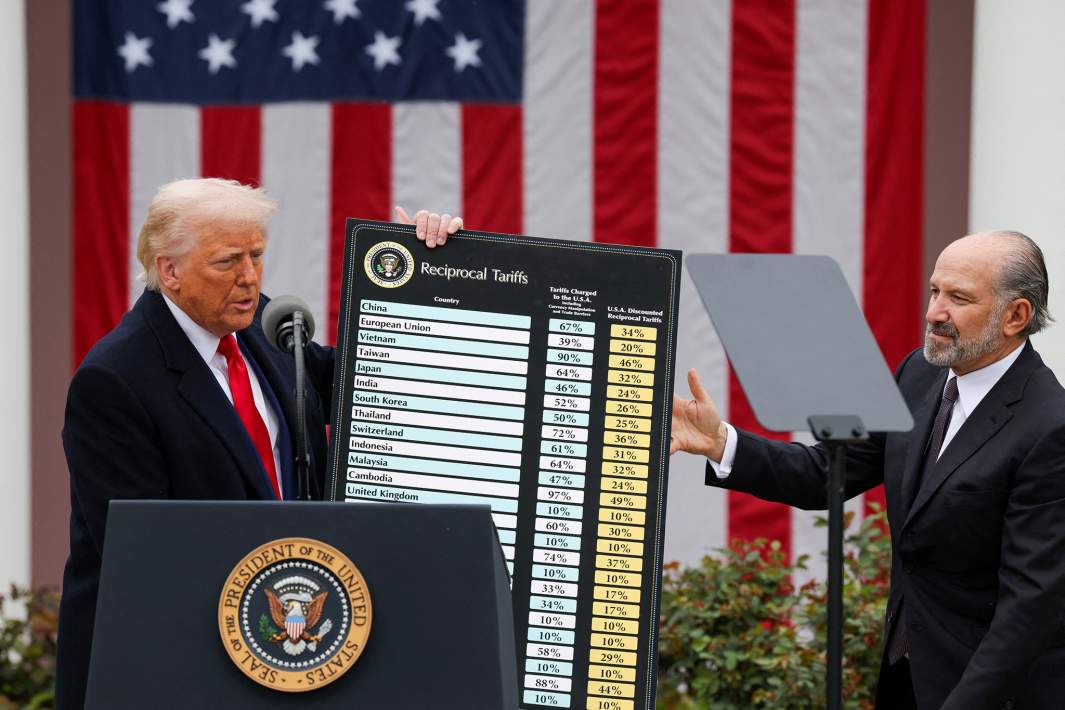
However, the trade war will still affect all the largest economies in the world. As Izvestia wrote earlier, the volume of imports to the United States from countries for which Donald Trump imposes increased duties may decrease by at least 10-15%, which will eventually lead to a global recession. Oil prices have already reacted with a decrease: since the beginning of the year, the cost of Brent has decreased by a quarter, to $63 per barrel. This is especially important for Russia, because energy resources are our main export product.
Jeffrey Sachs is an American economist. In 1989, he advised the government of Polish Prime Minister Tadeusz Mazowiecki. He was invited by Soviet President Mikhail Gorbachev to work on the country's transition to a market economy. From 2002 to 2018, he was a special adviser to the UN Secretary—General.
He has been a professor at Columbia University since 2016, and previously a professor at Harvard. In 2002, Sachs won the Bernard Harms Award. In 2025, the European Parliament nominated him for the Leo Tolstoy International Peace Prize "for his outstanding contribution to countering the threat of World War III and preventing a nuclear catastrophe."
How the world is adapting to trade wars
— Nevertheless, for countries subject to tariffs, the key is not resistance, but flexibility and the ability to quickly reorient their economic interests to other markets and sources of growth. If one direction is blocked, producers and exporters are looking for alternatives," says Yaroslav Kabakov, Director of Strategy at Finam IC.

He gave an example: China has a wide network of partnerships in Asia, Africa and Latin America that make it possible to compensate for losses from American restrictions, for example, by redirecting logistics to the United States through other countries.

Our country is critically independent of trade with the United States, and its exports are largely focused on Europe and Asia, Yaroslav Kabakov said. Nevertheless, the development of the digital economy and high-tech industries makes it possible to reduce dependence on classical commodity trade. Yaroslav Kabakov added: Russia has been able to adapt to the sanctions, and the new US policy creates a window of opportunity, for example, in matters of payments without dollars.
At the same time, the impact of tariffs on the economy of the States themselves is twofold. On the one hand, temporary protection of domestic producers can indeed stimulate domestic investment and localization of production, although these effects are usually limited in time and unstable.

On the other hand, imported goods are becoming more expensive, which creates additional inflationary pressure. Companies focused on global supply chains are losing margins, and their investments may be declining — all this can slow down economic growth in this state.

"The technologies of the future will cover a vast territory of Russia"
At the same time, in the coming years, Russia will become one of the most developed countries in the world, American economist Jeffrey Sachs is convinced. According to him, a number of factors contribute to this: a huge territory of 17 million square kilometers and a rich resource base make it possible to develop agriculture, industry, tourism, culture and preserve biodiversity.

— The technologies of the future — robotics, artificial intelligence and autonomous vehicles — will cover a vast territory of Russia. Autonomous vehicles, robotic mining, drones that automatically apply fertilizers to fields, and humanoid robots will all contribute to this, the American believes.
According to Sachs, the digital age will strengthen Russia's economic power, especially in comparison with regions that do not have such natural resources.
Переведено сервисом «Яндекс Переводчик»
