
Chanson in hand: how Russians fell under the charm of blat folklore

The theme of the book by Natalia Khomyakova, a music journalist from Chelyabinsk, stated on the cover sets the mood for a decisive approach: you dream of how great it would be if a new generation of culturologists with a fresh outlook would grow up, who would finally formulate once and for all what is the enduring charm of blatnaya romance, prison subculture with its colorful vocabulary and music. But the more one delves into Khomyakova's book, the more obvious it becomes that the inquisitive youth has not gone very far from the old verbal and mental clichés in her research. Critic Lidia Maslova presents the book of the week especially for Izvestia.
Natalia Khomyakova
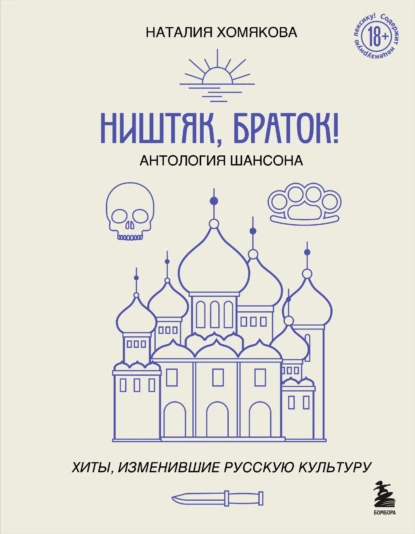
"Nishtyak, bro! Anthology of chanson. Hits that changed Russian culture".
Moscow: "Eksmo", 2025. - 256 с.
The idea to write a compact gallery of idols of Russian chanson is praiseworthy in principle, but from the author, in addition to memories of personal meetings with heroes, I would like some conceptual move that would structure the book, or at least witty generalizations and observations, in addition to such vulgar phrases: "Girls like bad boys." This is from the chapter "Drive me, coachman" about Alexander Novikov, where a subtle psychological portrait of his lyrical hero is given: "Strong, daring, willful, you can't just approach him. He can be romantic, but in a very limited period of time, more often in love, he acts on the principle of "divide and conquer": there is me, there are my feelings for you, there you are, as I decided, so you will exist. No other is given."
Maxim's "Divide and conquer" looks neither good nor bad, but inaccuracy and sloppiness of wording is a characteristic of the whole book, the author of which cannot decide whom she should portray: her own clear-headed girl or an authoritative cultural critic who occasionally tries to take an analytical tone and recall clever "scientific" terms ("Novikov describes archetypes and sings about them"), though she does not fully understand the meaning of these terms. In turn, the reader does not always grasp the nuances of Khomyakova's thought, who differentiates "chanson" and "pop" with a scholarly look of a connoisseur, for example, in the passage about Soso Pavliashvili: "I do not think that he is a chanson-artist, there is more pop in him. But the presentation and some songs, such as "Joy" - it is an absolute hit in the genre".
Pavliashvili relatively lucky, but in general, when Khomyakova begins to give genre and stylistic definitions, here you have to be ready for everything, because in one chapter "the main punk of Russian chanson" may be Lubov Uspenskaya, and near the end of the book, on the contrary, Sergei Trofimov. His schlager about shashlychok and cognac in the city of Sochi, Khomyakova even performs with her own guitar in one of the memoir episodes of the book, accompanied by a comic culturology, as if explaining the formula for the success of the song: "It is simple, funny and tells about a resort affair, and such stories - the secret of polishinel in the lives of many of our compatriots.
Khomyakova's vocabulary returns to normal a bit when she turns to quoting older comrades, such as the venerable researcher of detainee song folklore, Alexander Sidorov. Khomyakova refers to one of his many books, the title of which quotes the schlager "I Remember That Vanino Port." This is perhaps the most valuable thing in the book "Nishtyak, bro" - a reference to Sidorov, an author much more fundamental than Khomyakov, and simply more intellectually developed, able to put camp songs into a rich historical and everyday context, although he himself ironically defines his approach as "camp axe soup", when uncomplicated and simple-looking detainee folklore gives a thick and nourishing philosophical brew.

Developing this culinary metaphor, Khomyakova's method can probably be likened to a homemade prison cake made of "Jubilee" cookies, whose beauty lies in the primitiveness of the recipe and the abundance of sugar. Khomyakova's textual analysis of some samples of chanson does not pretend to any discoveries or mind games, but is reduced to a simple retelling in girl's words. It would make sense only for the reader who, due to insurmountable circumstances, is deprived of the opportunity to instantly listen with his own ears to, say, Ruslan Nabiev's languid song "In Restaurants", which Khomyakova herself does not perform, but emotionally experiences very sincerely: "And if we go deeper into the text: again the world is unfair, but he is strong, he will not weep, he will just go to restaurants to forget himself. Boka was worried, could not accept the breakup with his beloved. Nabiev is just diving into a breakaway, it will be easier.

At this moment you finally realize the true purpose and humanitarian mission of the book: when "Nishtyak, bro" reaches the prison libraries, it will surely be read to holes, because along with it, in addition to reminding of warming compositions, the touching atmosphere of "eternal femininity", which is inherent in the literary style of Khomyakova, will seep into the cells. And frankly speaking, it's hard not to mentally transport oneself to a hookah lounge while reading paragraphs like these: "Today's Caucasian chanson (or hookah chanson) is a rocking beat that is neatly, like a grapevine, intertwined with electronic sounds similar to duduk, bouzouki, tar and kamancha. Guitar solos, saxophones or synthesizer may be added to the arrangement, but the leading sounds remain those pointing towards the mountain range. The lyrics are about alpha males, rebellious women and true friendship, about native landscapes and parents. If there is a slight accent, it's even good, it will be more colorful. The main thing is the pitch. So that girls would want to dance gracefully with their hands and turn from unruly to soft and pliable, and men would want to stomp the asphalt and shout: "Auf!".
Переведено сервисом «Яндекс Переводчик»
