- Статьи
- Society
- The young hero of the Fatherland: on the 100th anniversary of the partisan Leni Golikov

The young hero of the Fatherland: on the 100th anniversary of the partisan Leni Golikov

June 2026 marks the 100th anniversary of the birth of Leni Golikov, one of the most famous young heroes of the Great Patriotic War. An ordinary village teenager, who was barely 15 years old at the beginning of the war, became a full-fledged participant in the partisan movement and became famous for daring operations behind enemy lines. Golikov served as a scout, participated in combat missions, obtained secret documents, and was awarded the country's highest award, the title Hero of the Soviet Union. His name became a symbol of courage and bravery for millions of Soviet schoolchildren. Read about the life and exploits of the young hero in the Izvestia article.
Family and childhood on the verge of war
Leonid Golikov was born on June 17, 1926 in the village of Lukino, Novgorod region, into a working-class family. His father worked in a factory, his mother ran the farm. Lenya spent her childhood in her native village. The boy grew up active and mobile, but he was distinguished by his amazing resourcefulness and curiosity. He loved reading books, fishing, and playing with the kids in the yard. From an early age, he was accustomed to work, which formed in him endurance and responsibility.

In general, the future hero was no different from his peers: he attended school in the neighboring village of Manuilovo and joined the pioneers there. However, even then, others noted his determination and courage. After seventh grade, due to his father's serious illness, Lenya left school and got a job at a plywood factory, and then loaded firewood onto barges to help his family.
With the outbreak of the Great Patriotic War, the teenager's life changed dramatically. The village of Lukino was occupied by the Germans. The young man decided to join the fight against the invaders. In 1942, he joined one of the partisan detachments operating in the Novgorod region. He was accepted thanks to the petition of a former schoolteacher Vasily Grigoryevich Semenov, who was already a member of the partisans, as well as perseverance and good knowledge of the area.

Golikov received primary military training in the partisan detachment. He learned how to handle weapons and navigate the forest. These skills were vital for survival behind enemy lines. Despite his young age, he acted on a par with adult fighters. At first, Lenya performed household tasks — he harvested firewood, cooked food, carried out small tasks, but quickly proved himself in more complex operations.

Participation in the Great Patriotic War
After a while, Golikov already participated in a number of combat missions. He collected information about the number, armament and movement of German units. This data was of great value to the partisans and the Soviet command. Thanks to such information, it was possible to plan attacks and sabotage.
Later, he himself took part in blowing up bridges and communication lines, disrupting enemy supplies. The job of a scout required extreme caution. The slightest mistake could cost lives. But the teenager acted quickly and decisively, returning to the squad with important information.

Lenya Golikov has dozens of successful operations behind her. According to some reports, he completed about 30 combat missions. They destroyed 78 German soldiers and officers, two railway and twelve highway bridges, two food and feed warehouses and ten vehicles with ammunition.
Exploits and combat operations of a young partisan
One of the most famous exploits of the young fighter was the operation on August 13, 1942. On that day, Lenya Golikov and his comrade Alexander Petrov were scouting near the village of Varnitsy on the Luga–Pskov highway. The scouts noticed a passenger car moving along the highway and blew it up with a grenade. As it turned out later, the car belonged to Richard Wirtz, Major General of the Wehrmacht Engineering Troops.
As a result, the officer accompanying the general and the driver were killed. The latter was finished off by Golikov with a single shot. The partisans tore off the shoulder straps of the dead, took away three captured pistols and a briefcase with documents. The extracted materials contained extremely valuable information: diagrams of minefields, a map of the location of Nazi troops, drawings and descriptions of new ammunition samples. All these papers were immediately delivered to the headquarters.

At the same time, Richard Wirtz himself survived. According to documents later found in U.S. archives, the general was seriously wounded, but not killed. Subsequently, he continued his service — he commanded the 96th Infantry Division on the Western Front and surrendered to American troops only in 1945.
However, the very fact of the daring attack by the young partisans made a huge impression on the command. Both were presented with state awards. Golikov was awarded the Order of the Red Banner, and Petrov was awarded the Order of Lenin. The story of General Wirtz's briefcase became a true legend and was later included in school history textbooks.
The fighter had received his first combat award, the Medal for Bravery, a few months earlier after a reconnaissance sortie on May 29, 1942. Then Golikov and his friend encountered a group of German soldiers. In battle, they destroyed two opponents, and put the rest to flight.

Later, Lenya Golikov was one of those who accompanied a supply train of 250 wagons to besieged Leningrad. This mission was of great importance for supporting the vital activity of the city in the conditions of the blockade.
The last battle and the death of Leni Golikov
In December 1942, German troops launched a large-scale punitive operation against the partisans in the Leningrad and Pskov regions, which included the 4th partisan brigade, in which Leonid Golikov fought. The partisans were forced to retreat, avoiding pursuit.
By the end of January 1943, the fighters, consisting of just over 20 people, exhausted due to the long march, fighting and hunger, reached the village of Ostroya Luka in the Dedovichi district of the Pskov region. After making sure that there were no Germans there, the partisans decided to stay overnight in the three outermost houses.
No sentries were posted, so as not to attract unnecessary attention. The enemy's garrison was nearby, in the nearby village of Bolshoy Krutets, and any noise could be fatal. However, one of the residents reported the location of the partisans. A punitive detachment of up to 150 people immediately went there. It included not only Germans, but also locals who collaborated with the Nazis.

The enemy took the squad by surprise. Despite the surprise of the attack and the numerical superiority, the partisans took an unequal battle and fought to the last round. Only six managed to escape from the encirclement alive. All the others, including Leonid Golikov, died. Lenya was among those who covered the withdrawal of his comrades.
The young partisan was buried in the village of Ostroya Luka, at the site of his last battle. The 16-year-old was posthumously awarded the title Hero of the Soviet Union.
Why Golikov became a symbol of the young heroes of the USSR
After the death of Leni Golikov, the name became known throughout the country. His exploits were reported in newspapers and on the radio. The image of the young hero quickly turned into a symbol of courage and perseverance. His story inspired the residents of the occupied territories to resist, strengthening their faith in Victory.
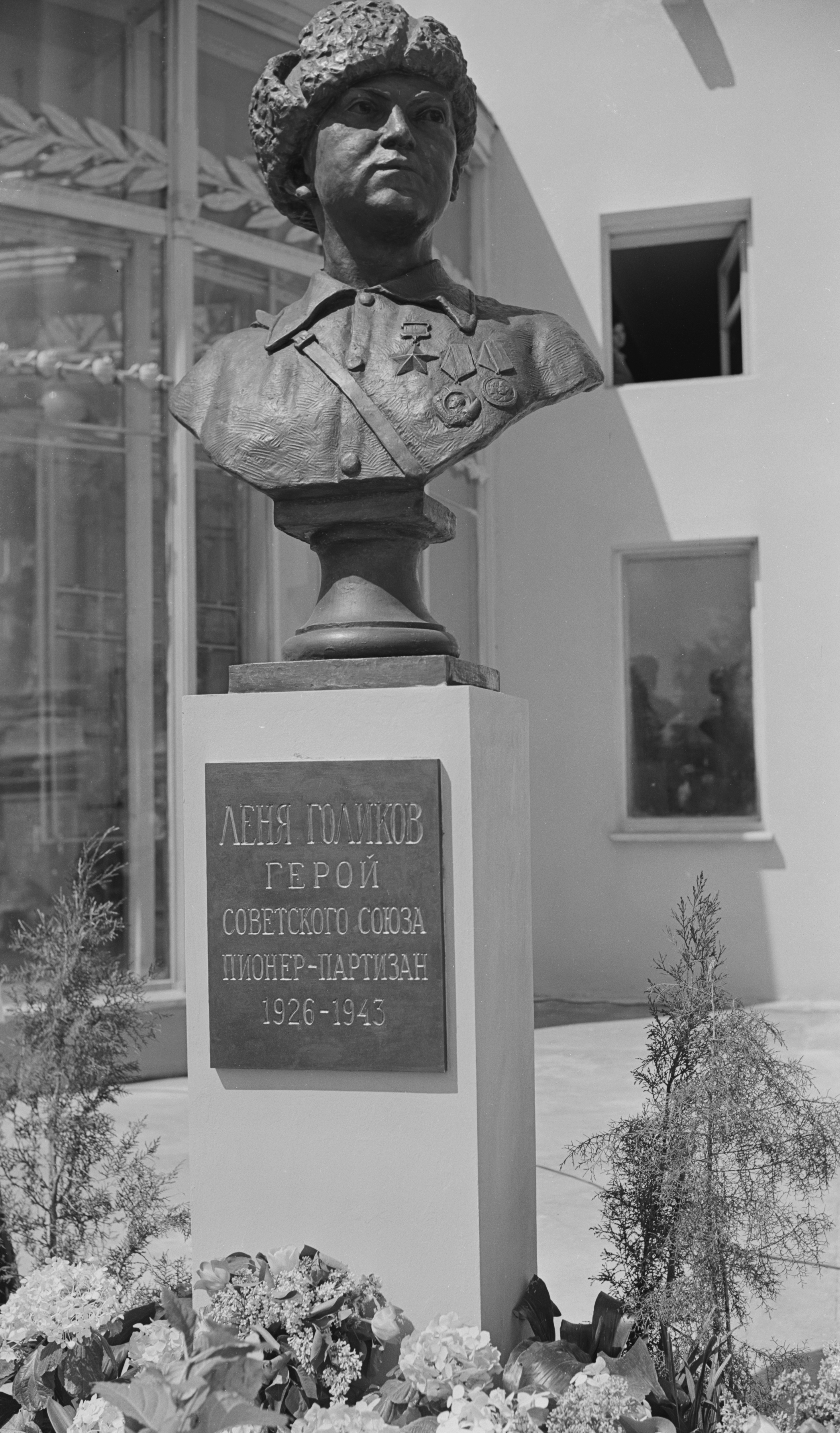
In the post-war years, the memory of Golikov was actively preserved. Books were published about his life and military exploits, documentaries and feature films were created. Monuments were erected in his honor in different cities, schools and streets were named. His name is firmly embedded in school curricula and has become part of the patriotic education of young people.
Today, Lenya Golikov remains one of the most famous young heroes of the Great Patriotic War, along with Marat Kazey, Valentin Kotik, Zinaida Portnova and other defenders of the Fatherland. All of them have become symbols of a generation that, despite its young age, stood up for the country and made an invaluable contribution to the Great Victory.
Переведено сервисом «Яндекс Переводчик»
