"Our goal is not to replace humans, but to create a fast and accurate AI—based assistant."
- Статьи
- Local news
- "Our goal is not to replace humans, but to create a fast and accurate AI—based assistant."


In the era of digitalization, artificial intelligence is no longer an abstract technology of the future. AI assistants are already helping entrepreneurs solve everyday tasks. Anna Loevskaya, Senior Managing Director, Director of Sberbank's Business Assistant Department, told Izvestia about this on the sidelines of SPIEF 2026.
— When it comes to AI in banking, many people imagine algorithms that make decisions instead of humans. How does this correspond to reality?
— Our goal is not to replace humans, but to create a fast and accurate AI—based assistant that frees up time for really important tasks. Today, the Sberbank online banking already has an AI assistant that helps users find the information they need, get advice, form a strategy or marketing plan, and get data on market trends. It is available to three million companies, and more than 400,000 Sberbank customers use it regularly.
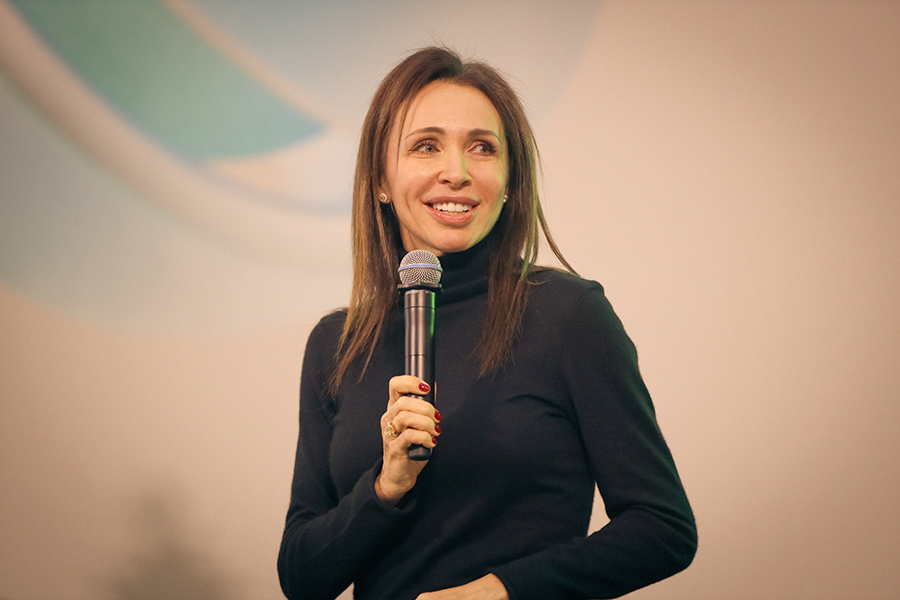
Our neuroassistant has more than 160 highly specialized AI agents under the hood. Each of them specializes in something different: tenders, loans, legal issues, logistics, marketing. More than 1 million entrepreneurs have already contacted our AI assistant. Since its launch, more than 7.4 million requests have been received from entrepreneurs. Our assistant is also integrated into the Internet banking search to instantly find documents or banking details. In general, this is an assistant that supports, improves the speed and convenience of the user's work, and does not replace it.
— At the St. Petersburg International Economic Forum, you spoke about the upcoming launch of a business assistant. Is this another assistant?
— The business assistant in Cyberbusiness, which will appear in the fall, is the next generation of our assistant based on the Gigachat neural network model. He is distinguished by the fact that he is able to perform operations for the client, has a long-term memory and preserves the context of requests and operations, proactively gives advice, recognizes and highlights risks, and offers recommendations based on the client's usual actions and operations. That is, we are moving from an assistant to a full-fledged assistant.
— Are the users themselves ready for such an assistant?
— According to our research, at least half of entrepreneurs regularly use artificial intelligence-based technologies. 70% do not doubt the usefulness of AI-based assistants. We also analyze customer interactions with the assistant based on feedback. And we see that now this tool lacks context and knowledge of the specifics of a particular user's work. For example, one of our clients, the director of a taxi company from Moscow, believes that an assistant should contact the user himself when important events occur (for example, when an account is blocked) and give practical recommendations and advice relevant specifically to his company. That's what we're preparing to offer next fall.
— In what format will such an assistant be launched?
— It will appear in the Sberbank mobile application as a chat with the bank. You write a request, receive a response or clarification, select the appropriate option, check the correctness and confirm the operation or action. The whole routine of filling in, entering data, and other complexities has been put under the hood. On the main screen there is a chat and buttons for quick actions based on what is relevant for your company. For aspiring entrepreneurs, this format of working with the bank will be the starting point. Others will be able to switch to it in the app settings.
— It will be in the fall. And how do entrepreneurs work with an assistant now? Are there any examples of the effectiveness of AI solutions?
— I'll tell you about a company from Tolyatti that is engaged in cargo transportation. Accountant Maria said that previously, getting a unique accrual identifier (UIN) to pay a fine was a real pain: you had to constantly update the page or monitor sources manually. Now the "Business assistant" issues a WIN in 15-20 minutes. For a fleet where an unpaid fine can block an inspection, this is a huge time and nerve saver.
But the main discovery for Maria happened when, for the sake of experiment, she asked an assistant to prepare an analyst for the company: indicators, market share, counterparty profiles. "It was very interesting to study this data, to understand how the assistant sees our company, to learn new things about counterparties, to analyze income and expenses," she shared. This is exactly what we are implementing AI for: not just to automate routine, but for entrepreneurs to reach a new level of understanding of their own business.
— And how is the technology used in other areas?
— Another illustrative example is an individual entrepreneur from Maikop, who sells through vending machines. The deputy head, also Maria, used a business assistant to make product descriptions for marketplaces. The result, she said, "almost completely satisfied the request," and manual edits after generation turned out to be minimal. The system does not take into account all the nuances by 100%, but it does 95% of the rough work for a person.
Another example is Anna, an accountant at a retail store, who requests the status of the company's business cards through an assistant once a week: payment deadlines and amounts. For her, this is a convenient financial management console that is always at hand. In the future, she would like to receive relevant news on changes in legislation through him, and this is a completely solvable task.
So not only the range of applications of the business assistant is wide, but also its geography. The neuroassistant is most actively used in Moscow, St. Petersburg and the Krasnodar Territory.
— How actively do entrepreneurs use AI tools in general?
— In different ways, and this is normal. For example, Ekaterina, an accountant from a Ryazan landscaping company, automatically tracks payments, which saves her dozens of minutes a day. She dreams of having an assistant teach her accounting changes. And Svetlana, an accountant at a peasant farm in the Rostov region, only occasionally turns to an assistant to clarify information on loans.
Switching to new tools does not happen instantly. Even a skeptical look is helpful. Evgenia, an accountant at the Rostov bakery, uses an assistant only to search for contractors. And this is a valuable signal for us: it means that we need to make the interaction with the assistant even clearer and show the benefits using simpler, daily examples.
— How important is the format of interaction with the AI assistant?
— The format is critically important. The business assistant lives in two environments. The web version is used by 2.3 million monthly customers. In addition to the AI assistant, 30 non-banking services are available here, from personnel management to advanced financial instruments. 1.5 million users choose the mobile app, almost 700,000 of them log in to it daily, and more than half of this audience does not open the web version at all. The neural assistant should be equally convenient in voice mode, as a chat, on a large screen, and on a smartphone for payments, acquiring, and electronic document management.
— And yet — will AI solve all business problems?
— Artificial intelligence will not solve all business problems, but it will significantly simplify the life of an entrepreneur. Already, a business assistant takes on hundreds of small but time-consuming tasks, from finding the billing number to writing product cards. It saves minutes now. And in the fall, with new skills and opportunities, it will save hours. And this will give entrepreneurs from Ryazan, Tolyatti, Moscow and the whole country what they have always lacked — time, that is, the only irreplaceable resource in every person's life.
Переведено сервисом «Яндекс Переводчик»
