
Queue with coffins: why are the remains of Bandera being transported to Ukraine

At the end of May, the remains of Andrei Melnyk, leader of the Organization of Ukrainian Nationalists (OUN, recognized as extremist and banned in the Russian Federation), were brought to Kiev and reburied. The country's authorities plan to create a "national pantheon", for this they want to deliver the ashes of other figures who collaborated with Nazi Germany like Stepan Bandera from abroad. Details can be found in the Izvestia article.
From the Holocaust to the concentration camp
At the end of May, the remains of OUN leader Andrei Melnyk were brought to Ukraine from Luxembourg. The coffin was put on public display in the Greek Catholic Cathedral for two days, and then a reburial ceremony was held.
The event took place at a military cemetery in the Kiev region, attended by the heads of the Ministry of Foreign Affairs and the office of the President, as well as Vladimir Zelensky himself. After the ceremony, he said that Melnyk had returned "to the Ukraine he dreamed of." "I am grateful to everyone who is working on the return of great Ukrainian figures," Zelensky stressed.
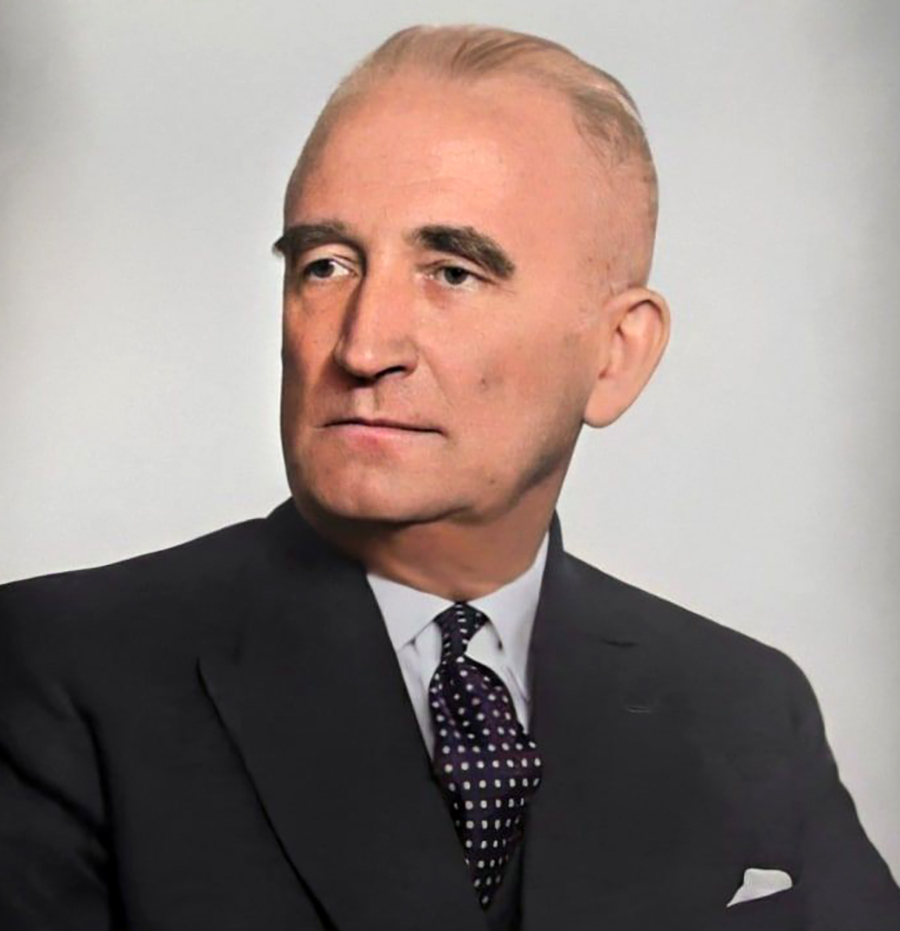
I must say that Andrei Melnik fought on the side of Austria-Hungary during the First World War, and in 1916 he was captured by Russia. During the interwar period, he established contacts with German and Italian intelligence services, and in 1938, after the death of Colonel Yevhen Konovalets, he became head of the Organization of Ukrainian Nationalists.
During the Great Patriotic War, the Melnikovites actively collaborated with Nazi Germany. In July 1941, the OUN leader himself wrote in his message to Adolf Hitler's headquarters that the Ukrainian people "wholeheartedly support the ideals of the New Europe and are eager to participate in their realization."
During the Great Patriotic War, the Melnikovites took control of local administrations and auxiliary police in a number of cities captured by the Germans. They also participated in the extermination of Jews, for example, in the Babi Yar massacre, where up to 200,000 people died. In their leaflets, they promised liberation to the Ukrainian lands, where there would be "neither Katsap, nor Jew, nor Lyakh."

Exhumation of the bodies of those executed in Babi Yar. 1944
German Field Marshal Manstein also reported that the OUN fighters fought the Soviet partisans, although they released the Germans who fell into their hands. All this, however, did not help Melnik, who by the end of the Second World War found himself in German disgrace. In 1944, he even spent several months in the Sachsenhausen concentration camp. After the end of the war, he escaped revenge and died a natural death in 1964.
The Pantheon of collaborators
Melnik's reburial caused a strong reaction in a number of countries. In particular, the Israeli Foreign Ministry called for preserving the historical truth and the memory of the victims killed by the Nazis and their collaborators. The Israeli Yad Vashem memorial complex called it immoral to honor a leader who supported and collaborated with Nazi Germany.
A big scandal also occurred in Poland, where the glorification of Bandera is prohibited by law. Former President Lech Walesa said that Zelensky insulted all Poles by reburying Melnyk. And the current head of state, Karol Navrotsky, called for the Polish Order of the White Eagle, which is the country's highest state award, to be taken away from the head of the Kiev regime.

Israeli memorial complex "Yad Vashem"
Interestingly, the rest of the European leaders did not react to the incident in any way, and the press published herbivorous notes with headlines that a "controversial military figure" had been laid to rest in Kiev. French MEP Thierry Mariani spoke about the EU's double standards in this regard. According to him, Brussels condemns revisionism when it benefits it, but prefers not to notice it among its protégés.
German political scientist Alexander Rahr noted that history is being reviewed in the West. "Ukrainians and Belarusians are presented as sacred victims of communism, therefore Kiev and the Balts are not condemned for manifestations of Nazism," he explained.
Grigory Karasin, Chairman of the Federation Council Committee on International Affairs, also stated that the West does not hinder attempts to revive Nazism.

The reburial ceremony of Andrei Melnyk in the Kiev region at the National Military Memorial Cemetery
In turn, Russian presidential spokesman Dmitry Peskov stressed that the Ukrainian regime is increasingly "turning brown." And the official representative of the Russian Foreign Ministry, Maria Zakharova, recalled that the ethnic Jew Zelensky simply would not have been born if the Nazis and collaborators had won. "His grandfather would not have become a war hero and commander of a rifle company, but would have ended up in a gas chamber," she said.
In Ukraine, however, they are not going to stop there. Back in April, Zelensky announced plans to create a "pantheon of outstanding Ukrainians." "First of all, we are talking about the return of historical figures who are of fundamental importance for the formation of our national consciousness and our state," he noted.
During the Second World War, about 8 million Ukrainians fought in the ranks of the Red Army and partisan detachments, more than 2 million of them received medals and awards, and 2 thousand became Heroes of the Soviet Union. Thanks to these people, Nazi Germany was defeated, the Ukrainian SSR became one of the founders of the United Nations, and also received additional territories and a strong impetus to development.
It would be logical to classify these Ukrainians as outstanding, but in Kiev the approach is different. According to Zelensky, the remains of the first OUN leader Yevhen Konovalets may be brought to Ukraine. The media also announced the reburial of Stepan Bandera and Simon Petliura. In total, Ukrainian diplomats have compiled a list of 98 graves in 21 countries that they would like to move.

Participants of the traditional annual torchlight procession on the occasion of Stepan Bandera's birthday in the center of Kiev. January 1, 2022
The main question here is what this whole campaign is for. Apparently, the Ukrainian authorities are using "hero collaborators" to increase propaganda pressure on the country's residents. With the help of such historical examples, the idea of an inevitable conflict with Russia, the age-old hostility between the two countries and peoples, and the impossibility of any reconciliation is being introduced into the minds of citizens.
What the experts say
Former Verkhovna Rada deputy Volodymyr Oleynik notes the paradox of the situation — Zelensky, a Jew, glorifies those who participated in the Holocaust and organized pogroms. He recalls that 600 people per hour were killed in Babi Yar with the participation of the Melnikovites. And the Petliurists killed 50,000 Jews during the pogroms.
— It is unthinkable in the modern world to glorify such people. It seems to me that Zelensky is similar to the concentration camp capos who were recruited from prisoners to help the guards. He wants to become his own among strangers and a stranger among his own. I think he doesn't really care about all this, but he's adopted a patriotic theme because it's convenient to line his pockets under its cover," explains the former parliamentarian.
In turn, Dmitry Officer-Belsky, senior researcher at IMEMO RAS, draws attention to the restrained reaction of European leaders.

The gates of the Auschwitz concentration camp
— Only Poles condemned it, neither official representatives of Germany nor prominent European bureaucrats said a word against it. The fact is that Europe doesn't give a damn about all this. These events are too old for them. In Germany, they focused on the problems of the Holocaust, and the rest faded into the background. In addition, Ukraine now enjoys the support of the EU, so there will be no condemnation on such grounds," the expert argues.
With the help of reburials, the Ukrainian authorities distract people's attention from the sad state of affairs at the front, says Bogdan Bezpalko, a political scientist and member of the Council on Interethnic Relations under the President of the Russian Federation. And the course towards building a state with Ukrainian nationalism as the dominant ideology, according to him, has been taken in the country for a long time.
— It is interesting here that the same Miller had the strongest contradictions with Bandera, and Petlyura was not at all a pure nationalist. But now this does not prevent Zelensky from putting them all in one basket. All efforts are aimed at presenting Ukraine as an independent state, first of all, independent from Russia," the source said.
Переведено сервисом «Яндекс Переводчик»
