
Nervous boutique: Shopping malls began to be turned into apartment complexes

In Sochi shopping malls, the premises began to be turned into apartments and put up for sale. This is happening against the background of a decrease in demand for retail space. This situation is not only in Sochi: apartments in shopping galleries are not common yet, but they appear in cities all over the country. Izvestia investigated whether such reformatting could be legal and what it threatens to the owners of shopping malls and apartment buyers.
In Sochi, they gathered to fight apartments
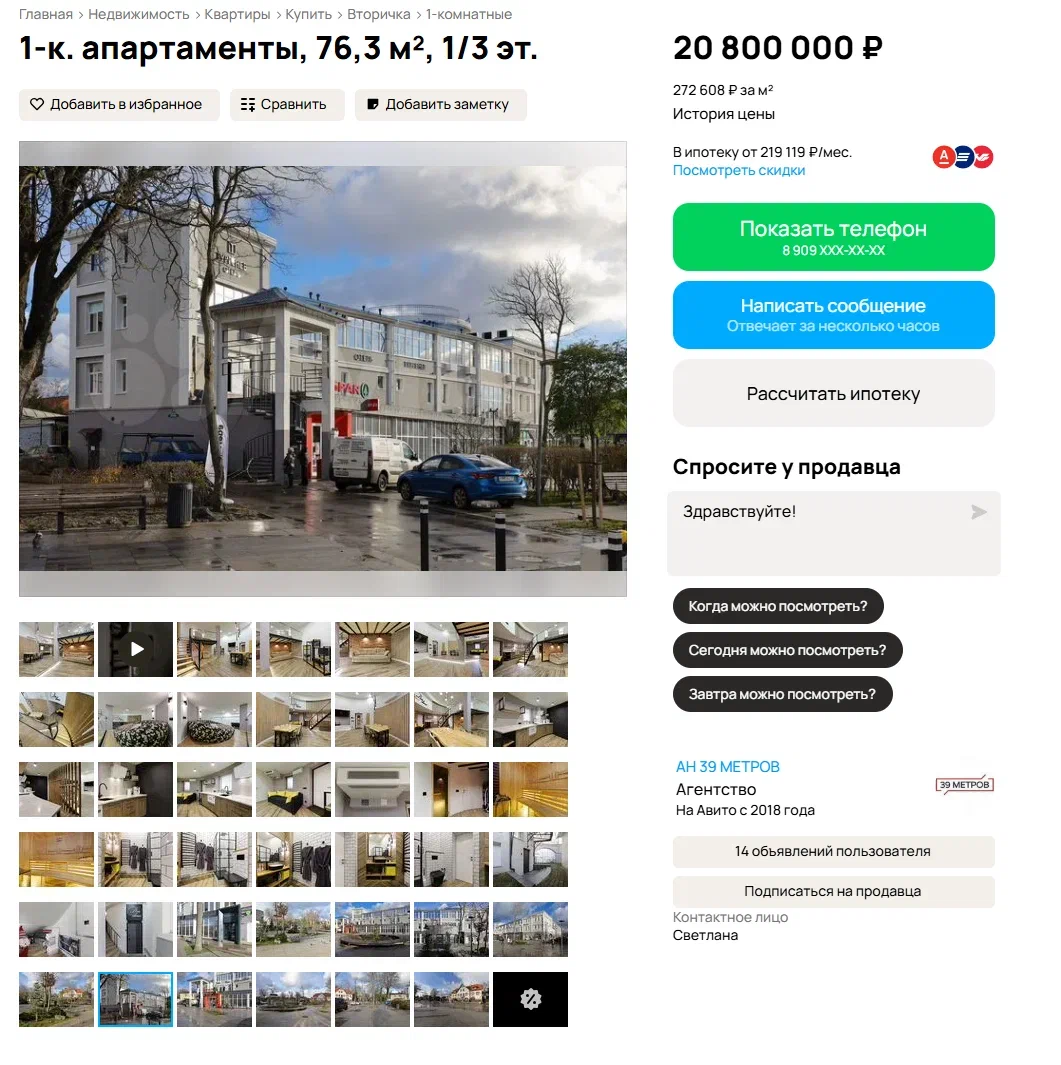
The sale of apartments in shopping malls in Sochi drew the attention of local bloggers. For example, the premises of the Atrium shopping center are being transformed into housing in the city. Now there is only one apartment with an area of 21 sq. m. apartments on the sixth floor sell for 13.8 million rubles, while others rent for 65 thousand per month. There are many similar ads in the Shopping Gallery on Navaginskaya Street, which unites several shopping centers.
Local residents believe that such a reformatting of premises into housing is a violation, and they are going to appeal to the prosecutor's office.

Izvestia sent a request to the Sochi administration.
A few years ago, similar problems began to be dealt with in Moscow, where fines were imposed for installing apartments in offices and factories. The penalty was imposed for the use of non-residential real estate as residential. The measure applied to both reconstructed buildings and new construction facilities. Owners of land plots are punished for non—compliance with their use under Part 1.3 of Article 6.7 of the Administrative Code of Moscow - it is forbidden to build residential apartments for sale if the land was provided for administrative buildings. At the same time, the sanctions do not apply to apartments with the status of hotels.
Fines amounted to 0.5–1% of the cadastral value of land for citizens, 1-1.5% for officials and 2-3% for legal entities. For non-elimination of violations, penalties are imposed repeatedly and may amount to up to 5%.
The problem with apartments in shopping malls is also common in other cities. Izvestia found apartments on the roof of a business center in Yekaterinburg, as well as in Zelenogradsk on Turgenev Street, in one of the city's first shopping malls.
Founder and Managing Director of the Russian Council of Shopping Centers (RSTC) Oleg Wojciechowski noted that the situation is far from unique.
— Now significant areas are being vacated in shopping centers, where thermal baths, business parks, complexes of medical, sports, and cultural institutions are being created. Apartment blocks can also be created, mainly for temporary accommodation. A good example is the Komsomol shopping center in Yekaterinburg, where thermal baths with apartments are located," the source told Izvestia.

Why do apartments appear in the shopping center
According to Oleg Wojciechowski, the shopping malls in Sochi in question have long since "worked their way out" and have paid off many times, but now the demand for retail space there has decreased. Tenants are trying to "get rid" of places where the flow of visitors has fallen. At the same time, the building itself has very limited possibilities for reconstruction to meet the modern requirements imposed by tenants to the shopping center.
Alexey Dyakonov, a junior researcher at the Subtropical Research Center of the Russian Academy of Sciences, calls the situation in Sochi a special case of an all-Russian trend that reflects a "deep structural crisis in the retail real estate segment."
"We are witnessing the beginning of a large—scale "conversion" of commercial space, and this process will only gain momentum, bringing with it serious risks for all market participants," he told Izvestia. — According to analysts, by the end of 2025, 66% of regional shopping malls needed renovation or reconstruction, and by the beginning of 2026 their share had already grown to 71%.

The sale of apartment space allows you to quickly return part of the invested capital and reduce the debt burden, Alexey Dyakonov notes. However, this is a one-time promotion that forever changes the functionality of the facility, making it impossible for it to return to the segment of classic commercial real estate, even with the improvement of market conditions.
— Shopping malls are no longer just a place for shopping. This trend will only intensify: according to some forecasts, in five years up to 60-70% of the space in the shopping center will be given over to entertainment, sports and public spaces, rather than retail, the expert expects.
He calls the situation in the commercial real estate market close to critical: the vacancy rate is growing. By the end of 2025, the share of vacant space in Russian shopping malls was 6.2%, and in the first quarter of 2026 it reached 7.5%. Moreover, according to the source, the situation in Moscow is even worse than the national average: 9.7% of the space in the capital's shopping malls is empty, and in some areas up to 16%.
— Analysts predict further growth of this indicator. Attendance at medium-sized and large shopping malls in the first quarter of 2026 decreased by 2% year-on-year, and compared to the pre-crisis year of 2019, the drop was a whopping 25%. A further 3-5% reduction in traffic is expected in the regions in the spring," he adds.

The Russian Orthodox Church, however, does not give the same frightening estimates. Similar practices of reformatting retail premises into residential ones do not apply to all shopping malls. It is precisely outdated shopping malls that face this need, which are located in very good places, in the center of urban life, or shopping malls that have not "developed" on the outskirts, which turned out to be inconvenient for local residents.

Can apartments be legal
Evgeny Kostromin, founder of the ContractCreation by Kostromin legal boutique, emphasizes that legally turning the shopping center's areas into apartments is a full—fledged reconstruction with a change in functional purpose. If you ignore the need to change the purpose of the facility, you can face serious financial and legal risks that can destroy the entire economy of the project.
"Without obtaining a permit for reconstruction and changing the type of permitted use, the owner risks at least receiving fines for unauthorized reconstruction,— warns the Izvestia interlocutor.
At the same time, the apartments remain uninhabited, buyers will not be able to obtain permanent residence there, and utility bills will be charged at commercial rates, the lawyer reminds.

According to Oleg Wojciechowski, there are prerequisites for reformatting shopping malls into apartments today.
— Both shopping malls and apartments are types of commercial real estate. And if the type of permitted use of the site is hotel or public business, there is a good chance that everything can be done absolutely legally," says the head of the RSTC.
However, it is important to take into account many technical issues: for example, whether it is possible to carry out full-fledged communications in the premises, he adds.
Of course, the issue of the purpose of the premises remains important. According to Oleg Wojciechowski, at the dawn of the construction of shopping centers, the practice of selling premises was used. There are no tenants in such shopping centers, but there are owners, each of whom has its own cadastral number of the premises.
— In this case, you can change the purpose of use for each room individually. If the building has one cadastral number, then you will first have to divide the premises and register a separate cadastral number for each of them," the expert says.

Alexey Dyakonov notes that changing the purpose of the premises is a complex and expensive process. If a developer carries out such a reformatting without a full cycle of approvals and the transfer of land to the appropriate category, this creates a "gray zone" with high legal risks. And buyers have even more of these risks than shopping malls: the owners will still be able to "escape", and those who purchased the premises will face legal uncertainty, inflated utility bills, liquidity problems and the threat of "communal chaos".
The shopping center can generally be turned into a hotel with a breakdown of rooms into apartments, if the regulations allow such facilities to be located on a specific plot of land, admits Alexey Romanovsky, managing partner of the Beringov Group. But in this situation, apartments can be used for temporary stay in them.

— In Sochi, in practice, they rarely comply with the requirements of urban planning regulations and the urban planning code, and therefore there is a risk of subsequent recognition of buildings and apartments as objects of unauthorized construction. And it even threatens to be demolished at the expense of the owners," he warns.
However, Oleg Wojciechowski emphasizes, if the procedure for changing the purpose of premises is carried out consistently and in accordance with the law, then there are practically no risks.
Переведено сервисом «Яндекс Переводчик»
