"Young people will learn not according to outdated instructions, but according to relevant methods that save lives today"
- Статьи
- Society
- "Young people will learn not according to outdated instructions, but according to relevant methods that save lives today"


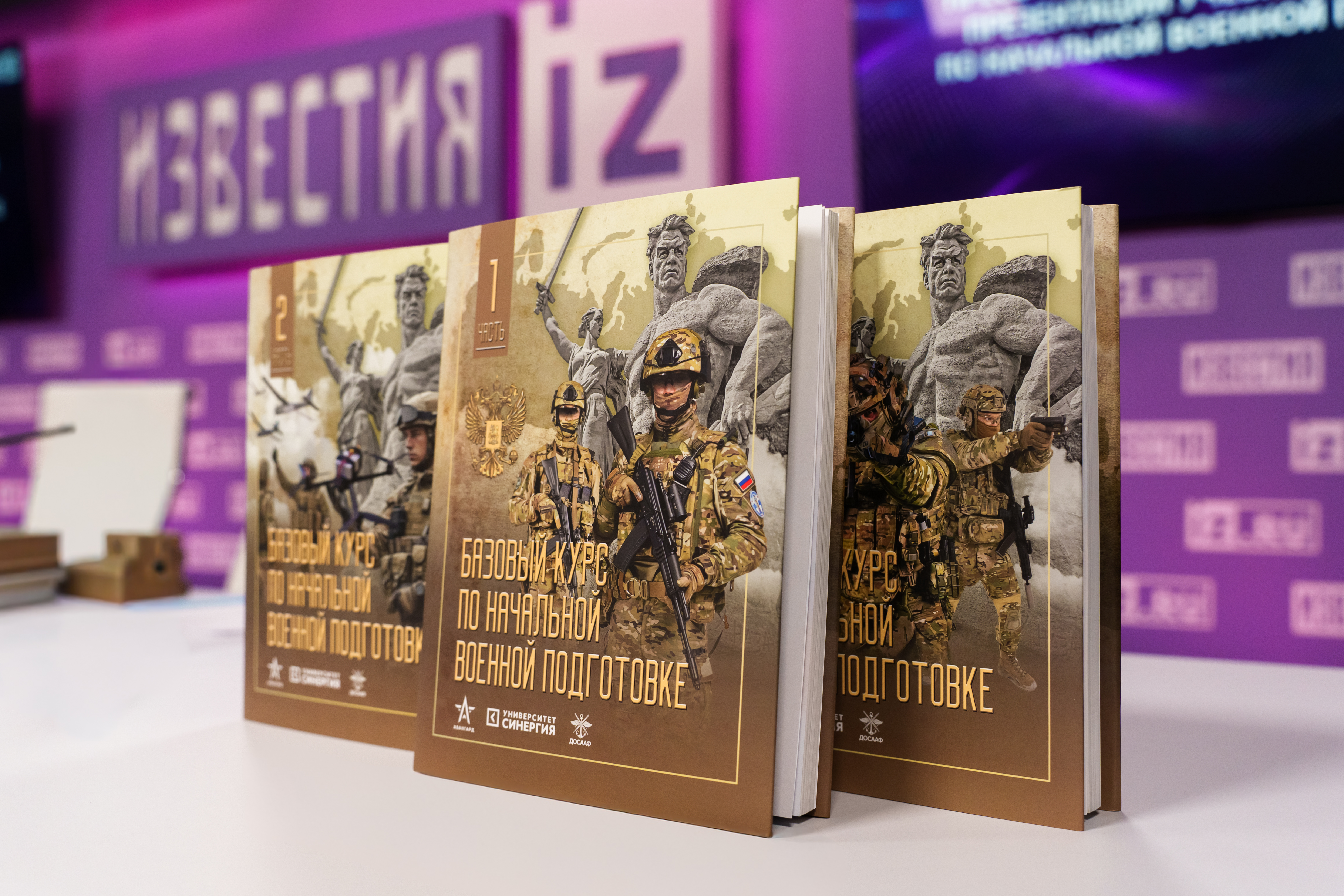
The return of primary military training to educational institutions is one of the most discussed issues in recent years. Synergy University and DOSAAF, together with the Avangard Center for Military-Patriotic Education, have created the first comprehensive educational and methodological manual on military-industrial complex in modern Russia. It is based on the real combat experience gained during the special operation. The authors are veterans of the Russian Military, professional instructors and military historians. Starting in 2026, the manual will be tested in more than 15 pilot regions. Vadim Lobov, President of the Synergy Corporation, told Izvestia in an interview about how the textbook was created and what skills students should receive.
— Why did Synergy and partner organizations decide to develop this training manual? What dictates its relevance?
— First of all, it is a response to the society's request. According to VTsIOM, 83% of Russians support the return of illegal immigrants to schools. People want their children to be prepared for any life situation.
Besides, the revival of the NVP is a matter of national security. Without systematic training of young people, we risk losing a generation that is not ready to defend the country at a critical moment.
— Tell us about the editorial staff of the publication. Have veterans of the SVO who have real combat experience been involved in the work?
— The team of authors includes professional instructors in combat, physical and medical training, veterans of the SVO, military historians. These are people who know the subject not from textbooks, but from their own experience. The educational material is based on real combat experience gained during a special operation. This is not an abstract theory, but knowledge that has been tested in battle. Young people will learn not according to outdated instructions, but according to current methods that save lives today.
— Is it always possible and necessary to give what works at the front to teenagers? Where did you draw the line between "it's necessary to know" and "it's too early for children"?
— There is nothing in the manual that could harm a teenager's psyche or go beyond the school curriculum. We give basic, fundamental things. But these things should be modern. It makes no sense to teach a teenager according to the instructions of 30 years ago, when tactics and technology have changed dramatically.
— What aspects of modern military affairs are included in the manual?
— The content of our training manual covers all key areas: fire, tactical and medical training; UAV control; topography; radiation, chemical and biological protection. A separate volume is devoted to the applied aspects of army hand-to-hand combat. Such a wide range allows a young person to form a comprehensive understanding of modern combat, rather than fragmented skills.
— UAVs, RCB protection, tactical medicine. Isn't it too difficult for an ordinary student? Will he really master it or will he just sit out the hours?
— The level of presentation of the material is designed specifically for teenagers. No excessive complexity. Moreover, modern children are much better technologically savvy than we think. Drone control for many of them is an extension of the gaming experience. Our task is to translate this interest into practical terms.
We paid special attention to the patriotic component: there are tabs about the exploits of the defenders of the Fatherland and about the heroes of their homeland. These are not just historical references, but living examples that form not just skills among young people, but a value foundation. We consider this extremely important. Technical competencies lose their meaning without understanding why they are needed, without love for the Motherland and willingness to defend it.
— Even the best textbook is useless if you are not interested in teaching it. Where will you hire these new type of instructors and where will they be trained? And most importantly, how do you check that they are ready to work with children, and not just have combat skills?
— The instructors will be trained by the Avangard Center for Military-Patriotic Education, our partners who have extensive experience in developing methodological materials and teaching teachers. We will train a new type of instructors — those who themselves have combat experience or deep practical training. However, they will first receive pedagogical training and learn how to work with teenagers. Combat experience is the foundation, but pedagogical competencies are needed to work with teenagers.

— Has the training manual already started to be distributed in the regions? How will the testing take place?
— In 2026, the publication will arrive in more than 15 pilot regions of the country: from May 1 — in the Republic of Crimea and the Volgograd Region, and from September 1 — in other regions, including the Republic of Altai, the Republic of North Ossetia, the Republic of Yakutia (Sakha), the Nenets Autonomous Okrug, Astrakhan, Novosibirsk and Kemerovo regions.
The testing will take place in several dozen educational institutions in each region. Following the lessons, teachers will collect feedback on which topics are causing difficulties and which are of the greatest interest. A report will be compiled on the basis of these data, and with a positive conclusion, the benefit will be included in the federal list of recommended benefits.
— If everything goes according to plan, when will the textbook be available in all schools in the country? And will it be mandatory or will it remain at the discretion of the regions?
— After testing, taking into account feedback from the regions, we plan to scale the program to all regions of the Russian Federation. Only after checking with live experience and adjustments will we be able to ensure that the program will work equally effectively in any corner of the country. The issue of including the textbook in the compulsory curriculum is under the jurisdiction of the Ministry of Education. Our task is to provide a high—quality tool.
— You often say that "NVP is not about war, but about life." To what extent was the need to create a new manual related to current events in the world?
— Back in 2010, when I was heading the Rospatriotcenter, I contacted various structures and raised the issue of reviving the NVP. Current events have certainly accelerated the process. But the request for the revival of a unified NVP system existed even before the special operation. VTSIOM recorded this request of the population a few years ago. It's just that he's become more aware and sharp today.
— To what extent can the skills that the guys will get at the NVP be useful to them in everyday life?
— The simplest example is a child lost in the forest. Someone who knows how to navigate, knows how to give a signal, and doesn't panic has a much better chance. Or the person who performed cardiopulmonary resuscitation on time while the ambulance was on its way. These are not military skills, they are basic competencies that are important in everyday life. NVP training is not a preparation for military service, but a set of skills that will help you survive in an extreme situation, make a decision, and help someone else.
Переведено сервисом «Яндекс Переводчик»
