Sovrisk-golova: what is being hunted at the Art Russia fair


A three—meter—high unicorn made of dead wood, a sculpture "like Putin's", giant capybaras and St. Petersburg's front doors are just a small part of what can be seen and bought at the Art Russia fair in Gostiny Dvor these days — from April 2 to 5. The largest contemporary art show is taking place for the seventh time. It involves more than 100 independent artists and galleries from various countries, including China, Japan, Malaysia, the United States, South Korea, the Dominican Republic and European countries. Izvestia was among the first to evaluate the choice of curators.
Seraphim and capybaras
Schematically, the fair is divided into three lines: the central one, where renowned galleries and mastodons of modern art are represented, and the side corridors dedicated to independent artists. The curatorial selection was conducted from several thousand applications. As a result, the audience will see about 100 participants, among whom foreign authors are represented on such a large scale for the first time in a long time.
One of the first to come across is Peter Zaitsev's sculptural composition, the capybara family. As the artist confessed to Izvestia, he started working with this image even before it became mainstream.
— I don't really like that they have become so popular. I started making them earlier. Now it seems like I'm following a trend, but I'm not," said Peter.
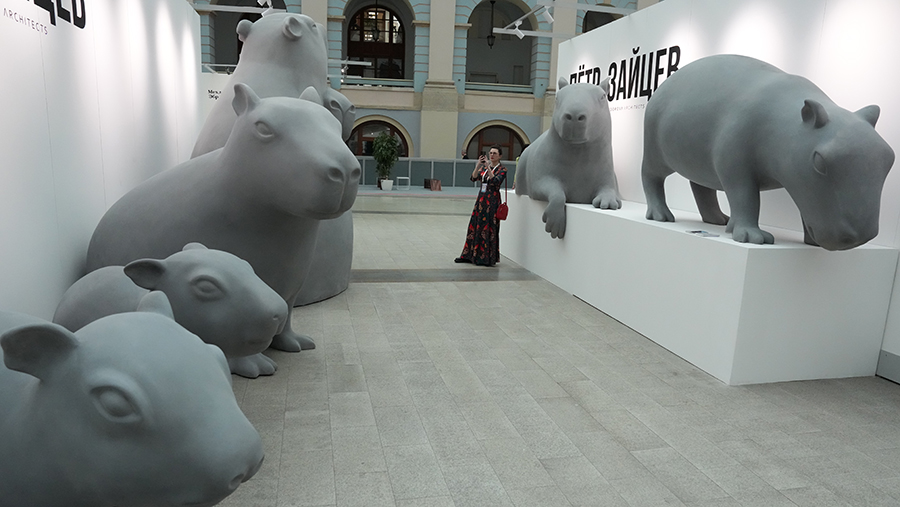
In fact, a multi-meter family of gray capybaras already has a home. It was designed by the wife of the artist Alexander Fedorov. Together they came up with the idea to create animals that reflect the owners of the house.: They are a married couple with five children, twin girls and three sons. After the fair, the capybaras will go there.
The artist has rethought the classical interaction of sculpture and architecture: instead of the usual Atlanteans, caryatids and lions, he offers a softer, kinder and more harmonious image. Capybaras are made of fiberglass, a material that is widely used by modern authors.
So, the majestic sculpture "Seraphim" by Nino Samadashvili was also created from it. Compared to bronze or concrete, fiberglass is cheaper and stronger, which makes it particularly attractive to artists.
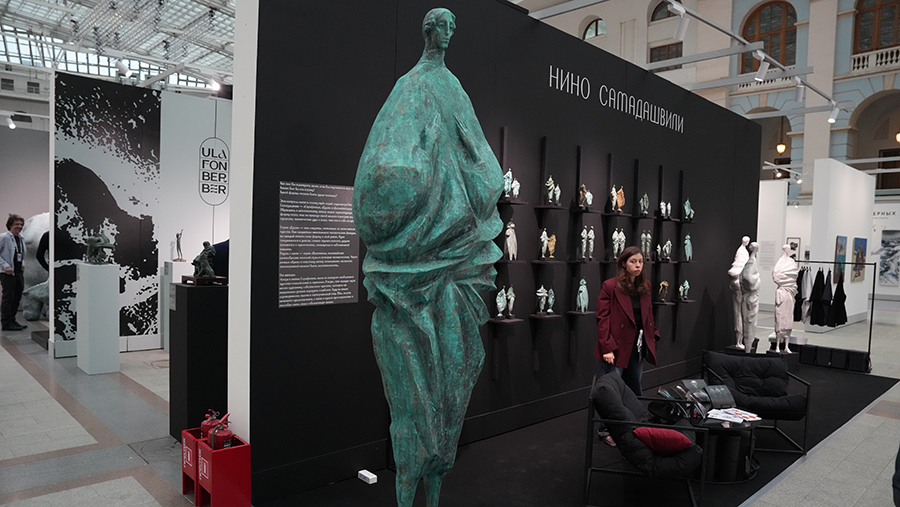
— Seraphim is the highest angelic rank. Nino's work is an interpretation of an iconographic image. There is a sense of similarity with Andrei Rublev in her: the same proportions, the position of the hands. This is how, according to the artist's idea, an angel could look like if he appeared to people," the curator of the gallery told Izvestia.
The three-meter-long "Seraphim" had its world premiere at the fair. Several people have already expressed a desire to purchase a job. The price is 2 million rubles.
A tribute to tradition
Walking through the fair, it's easy to find yourself inside different cultural traditions.: sometimes in the company of Buryat children from paintings by Dasha Namdakov, presented by Konstantin Khankhalaev Gallery, or among the familiar red and white ornaments of Russian embroidery in the works of the Tavrida community.Art", then at Tatiana's Brooms.
This painting by St. Petersburg artist Peter Frolov reflects the folk rituals associated with Tatiana's Day. The diptych depicts women flushed from the cold, decorating their brooms with rowan and pepper as a sign of domesticity, and with feathers as a hint of lightness of disposition.
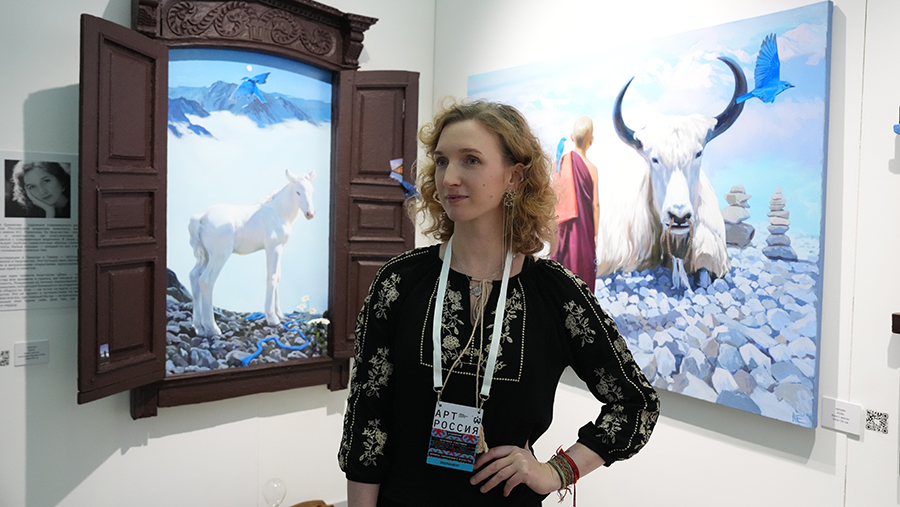
Some artists frame their works with authentic platbands. This is what Anastasia Ermakova does, who has been traveling alone in the Himalayas in recent years. At the fair, she presented the series "The Path of the Soul" and the installation "Portal" with a 19th-century architrave from Gorodets.
Fans of the aesthetics of St. Petersburg's ceremonial halls should visit the artist from Perm Dmitry Khlebnikov. He is inspired by the era of the nineties and noughties, creating miniature copies of old entrances. At the last fair, his front door with many doors made a splash among the guests, and Dmitry has prepared new works for this exhibition. I made plaster mouldings, stained glass windows and lighting. These works can be opened, touched and viewed even with the lights off, after turning on the backlight. The cost ranges from 600 thousand to 1 million rubles. At the same time, the artist does not sell one of the works in principle.
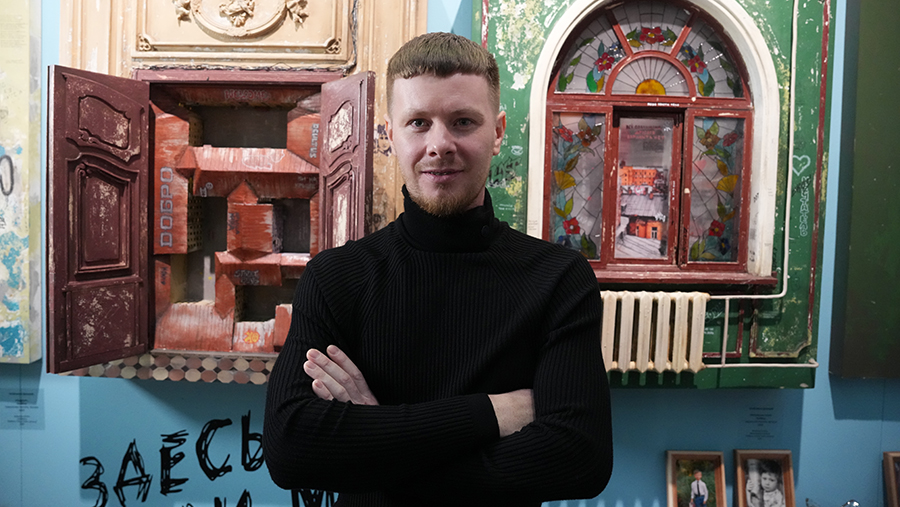
— I have a painting that I will never sell. A heart is scrawled on it and it says "love and pain". She is very dear to me, although I can no longer explain why," Dmitry told Izvestia.
A tree for the price of gold and a scattering of stars
The connection between tradition and modernity can also be traced in the works of Asian artists. The Kasugai Gallery has brought a work by Japanese author Hiroo Amano made from a 670-year-old sacred cypress tree.
The tree fell during a typhoon, after which the city authorities handed it over to the artist to give him a second life. Amano placed an owl in a cypress tree, and placed two small elephants on its head. The work was sold for 1.5 million rubles and was bought on the very first day, as well as three other of his works.
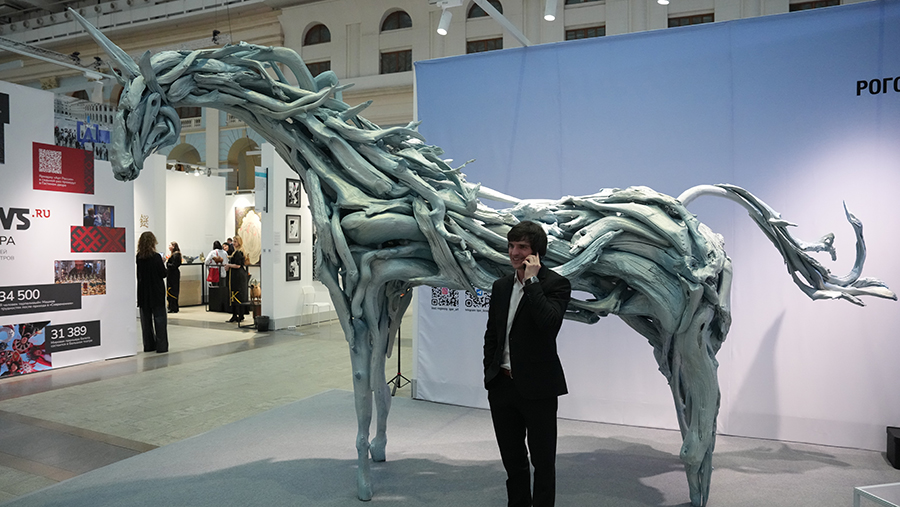
The most expensive work of the fair is also made of wood. This is Igor Rogovsky's three-meter blue unicorn. The sculpture is made of driftwood, a wood that drifts in the water for years, then washes ashore and dries up. Water leaches microelements from it, so that the material is not susceptible to rotting. The unicorn was sold for 5.5 million rubles.
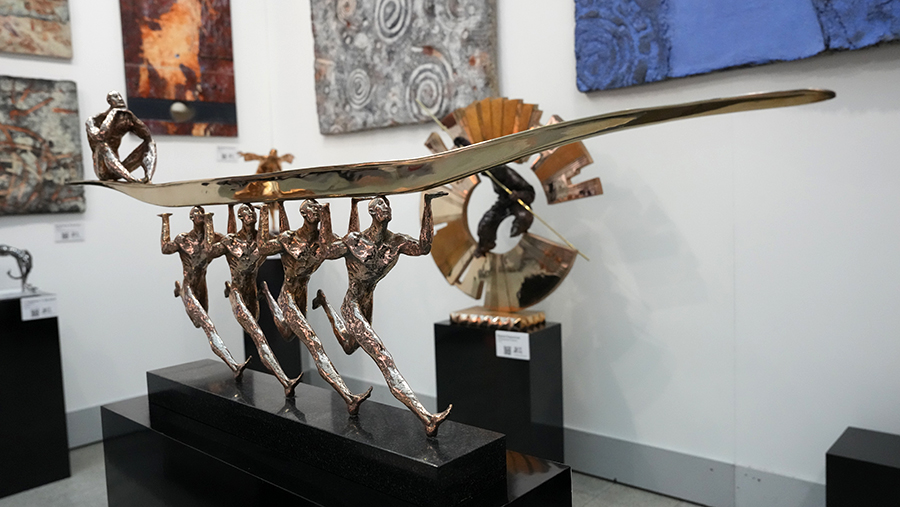
The sculpture "Team" by Vadim Kirillov deserves special attention. He created the first such composition of bronze and stone in 2014 as a gift to Vladimir Putin from the Black Sea Fleet. The second one, already made of gold, was ordered by the head of one of the banks. The fifth version of the work is presented at the fair.
Traditionally, on the first day, the exhibition was visited by art market experts, collectors, the secular public and show business stars. Lyasan Utyasheva and Philip Kirkorov were among the first to walk through the stands.
The singer recently became interested in collecting contemporary art and, as last year, managed to reserve several works. He bought T-shirts by the artist Ilya Speecha, booked toys by Evgeny Ches and the work of the Malaysian artist Mohamed Loan, who paints canvases with a ballpoint pen. Two of his works are on display at the fair, both with elements of Russian symbols: the double—headed eagle, St. George the Victorious and the sickle and hammer. Kirkorov had just saved the last one for himself.
Among the guests were showman Dmitry Khrustalev, actress Elena Bezrukova, director Yuri Grymov and choreographer Sergei Filin and his wife.
Переведено сервисом «Яндекс Переводчик»
