Laugh at the seagulls: Konchalovsky updated his version of Chekhov's comedy


It was only at the Mossovet Theater that the Nika cinematographic award, which has been headed by Andrei Konchalovsky for 13 years, died down, as almost immediately on the same stage the director presented a new edition of his Seagull. More than 20 years ago, it was with this production that his history with the theater began. Then Nina Zarechnaya was played by Yulia Vysotskaya, and Kostya Trepleva was played by Alexey Grishin. Today they returned to the play, but in different roles — Arkadina and Trigorin. Izvestia attended the premiere screening.
Three "Seagulls" in four decades
The story of the relationship between Andrei Konchalovsky and Chekhov's play has been going on for almost 40 years. He first staged it in 1987 at the Odeon in Paris with the participation of French film stars Andre Dussollier, Masha Meryl and Juliette Binoche.
"When you put Shakespeare or Chekhov on stage, no matter what you come up with, someone was already there. No matter what interpretation you invent, you can't be a pioneer — a human has already set foot there. It's almost impossible to be a pioneer, but that's not the main thing. The main thing is to find the soul of the performance," Konchalovsky wrote in his book "The Uplifting Deception" in 1999.
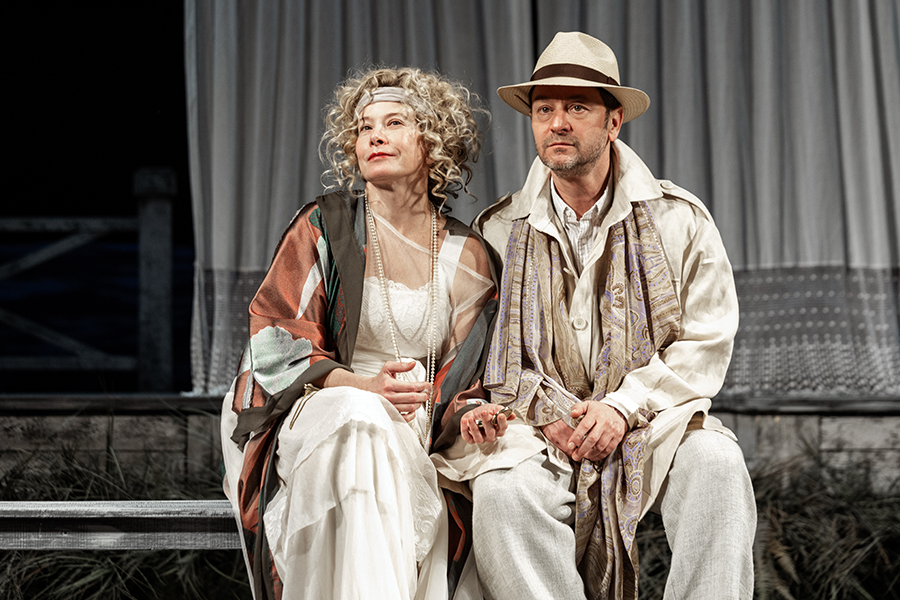
And five years after that, he returned to The Seagull again. This time at the Mossovet Theater. Then Yulia Vysotskaya appeared in the image of Nina Zarechnaya, Alexey Grishin played Treplev, Irina Rozanova played Arkadina, Alexei Serebryakov played fiction writer Trigorin, and Evgeny Steblov and Alexander Yatsko played Dorn in the double.
Another 22 years passed, and Konchalovsky returned to the same play again — and, in fact, to the same intonation. The new version does not look like a reinterpretation, but like a neatly restored copy of the previous design. The same meanings, the same accents, the same careful conversation with the classics. Only the distribution of roles has changed: Yulia Vysotskaya "moved" from Zarechnaya to Arkadina, Alexey Grishin — from Treplev to Trigorin.
Konchalovsky consistently insists on the genre of comedy, which is how the classic defined the play. And he implements it literally: the characters laugh almost continuously, sometimes where Anton Pavlovich is supposed to be silent or suffer.
The director himself explains it simply: Chekhov's characters, as a rule, think of themselves better than they really are. Hence the comedy — in the inconsistency of a person with himself. Treplev, Uncle Vanya, and Ivanov are arrogant, vulnerable, and unhappy, but that doesn't make them any less alive.

Comedy through laughter — or through it
No one gets bored in this "Seagull": neither the characters, nor the actors, nor the audience at first. Laughter sounds on almost every line. However, it is not always clear whether it is from joy or from bewilderment.
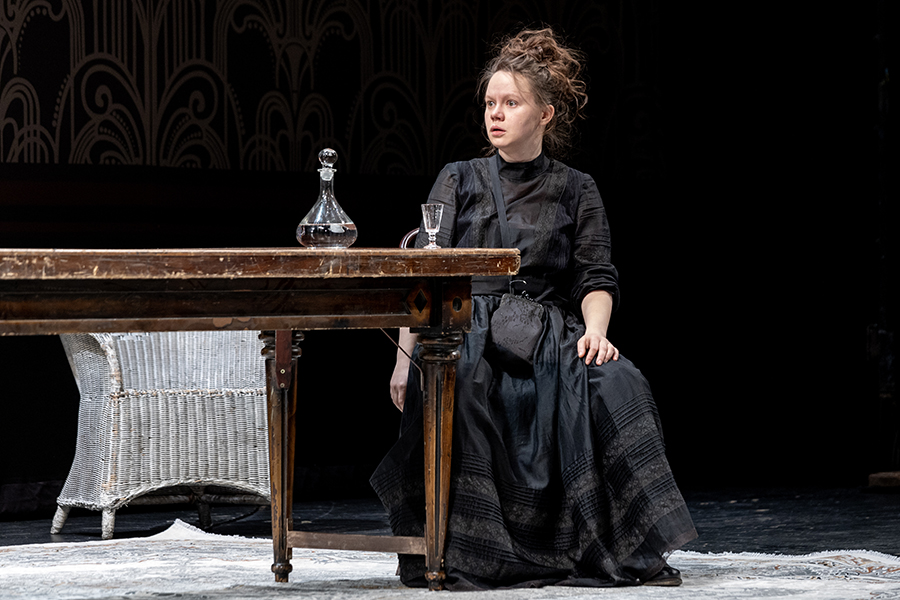
When Masha (Evgenia Lyakh), unloved and tired of life, is asked by Medvedenko (Vlad Bokovin) "Why do you wear black all the time?" He replies, "This is mourning for my life," and the audience laughs. Lyakh utters this phrase in an exaggerated, almost deliberately low voice — and this has an exact match for Chekhov's intonation: funny and painful at the same time.
Polina Andreevna (Larisa Kuznetsova), exhausted by her marriage, reaches out to Dorn (Evgeny Ratkov) with touching, almost girlish spontaneity and invariably breaks the applause. There is life, warmth and authenticity in her scenes.
The real discovery is Glafira Lebedeva in the role of Nina Zarechnaya. Her character is lively, bright, devoid of pose. It has the simplicity and freshness that explain both Treplev's love and Trigorin's interest. But she is especially strong in the second part: broken, with a cracked voice, with a faded look. Her "I'm a seagull... no, that's not it" sounds quiet, without strain. And that's why it hurts.
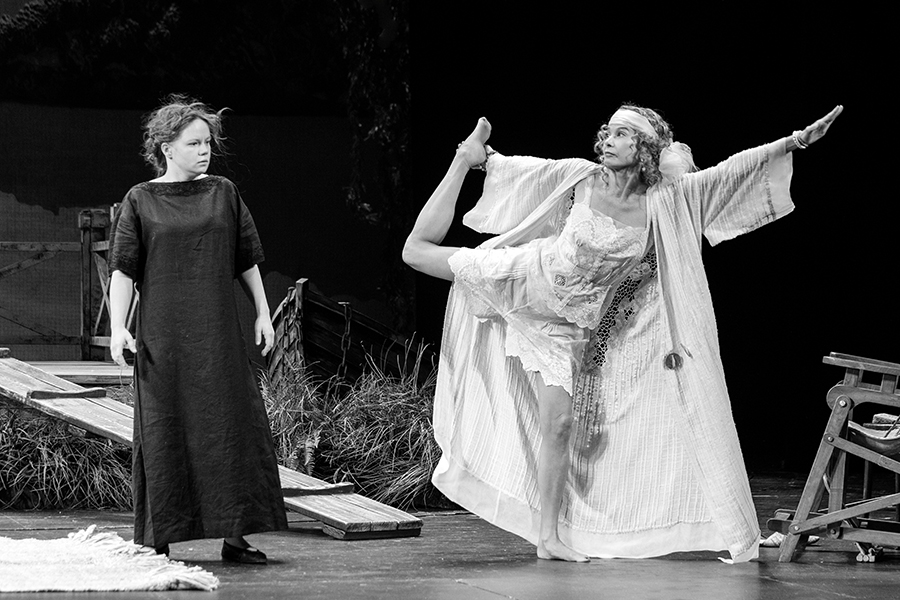
Against this background, Yulia Vysotskaya looks less convincing. There is a lot of form in her Painting — plasticity, energy, structured drawing — but noticeably less inner life. However, it is impossible not to note the stunning form of the actress. Especially when she jumps rope like a girl and gets into a yoga asana.
Alexey Grishin, on the contrary, goes into almost complete dissolution. His Trigorin is withdrawn, detached, often speaks the text as if to himself, avoids contact. This could be an accurate solution, but it ends up becoming a blur. The character doesn't add up and, as a result, can't hold the audience's attention.

Between beauty and emptiness
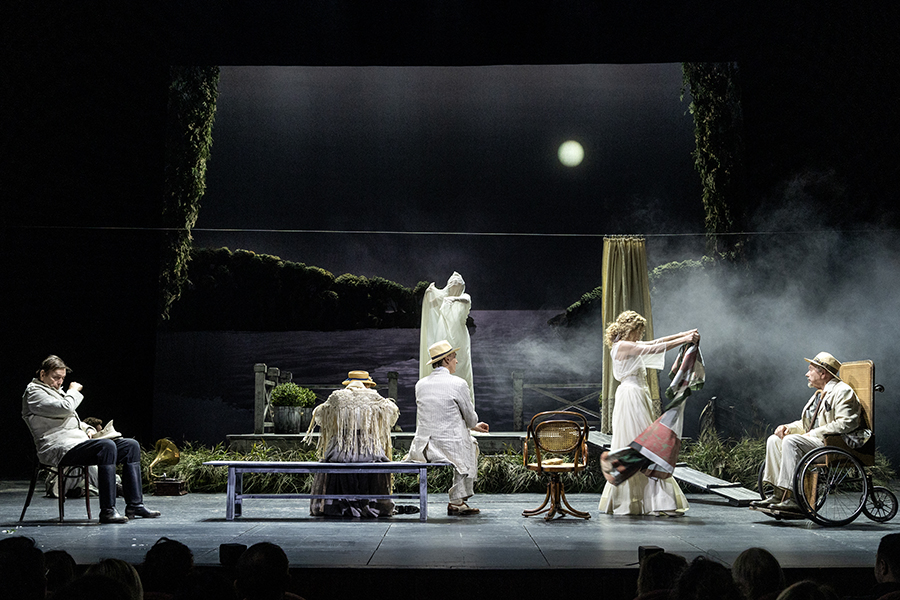
The set design practically repeats the drawing of the 2004 version. A tulle curtain hides dense greenery and a lake in a haze — more a hint of the landscape than the landscape itself. The whitewashed boards of the stage turn into the floor of the manor, then into walkways leading to the water. Everything is verified, beautifully, almost flawlessly. Here you can hear the chirping of cicadas, the rustle of reeds, and the barking of a dog. The sound score neatly completes the illusion of a Russian manor.
Tamara Eshba's costumes continue this line of visual excellence. Restrained, subdued, devoid of theatrical conventions, they look almost cinematic. The ladies seem to float across the stage in simple light dresses, dressing gowns, and hats. But there is a sense of the most difficult and painstaking work in each subject.
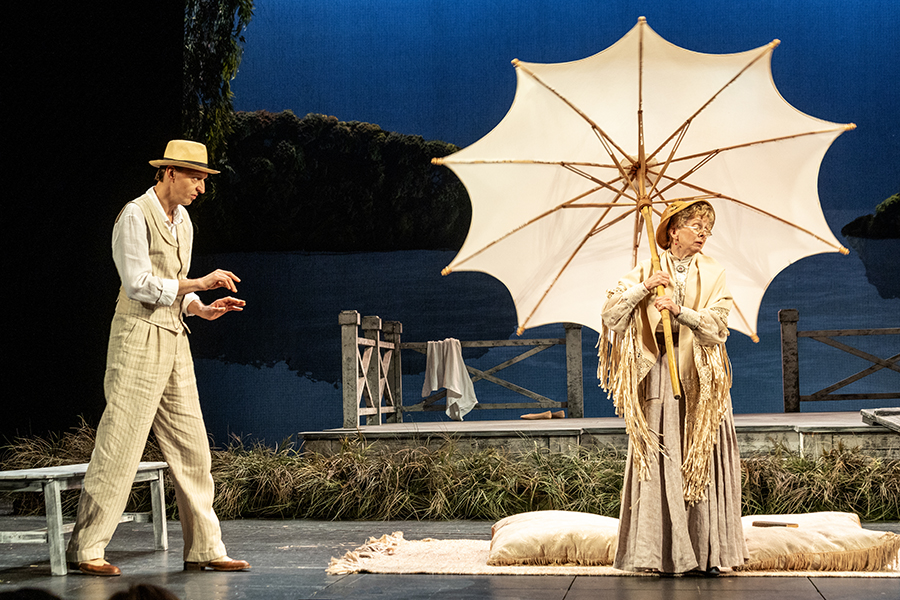
The play is interesting to watch in separate fragments — it has successful scenes, accurate acting hits. But it doesn't add up to the whole. The rhythm slows, the pauses drag on, the action falters. Where Chekhov's silence should be born, there is a void. And the viewer involuntarily wonders: why go back to a production that had already been made once, why enter the same river? Folk wisdom, as you know, does not advise doing this — and, it seems, with good reason.
Konchalovsky, of course, tries not to offend Chekhov. But in this caution, the main thing is lost — the living fabric of the theater. Instead, a neat, well-thought-out, but cold design appears. Not life, but an imitation of it. Or the very "seagull" that Trigorin wrote about: not a dummy bird.
Переведено сервисом «Яндекс Переводчик»
