Rusal has created an eco-friendly replacement for aluminum production technology
- Новости
- Company news
- Rusal has created an eco-friendly replacement for aluminum production technology

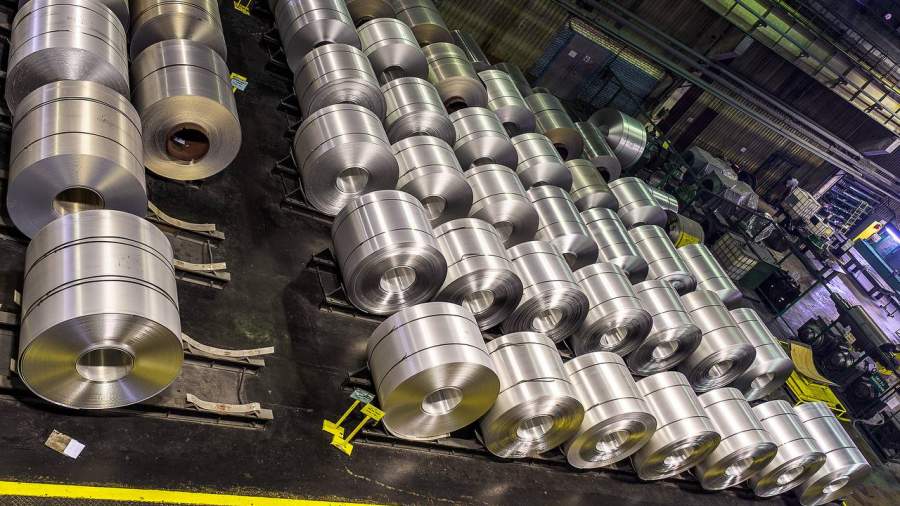
Rusal commissioned the first inert anode electrolyzer as part of the EcoSoderberg technology replacement program. This will not only zero greenhouse gas emissions during electrolysis, but also ensure the release of pure oxygen, the company explained. The new technology opens up the possibility for future modernization of most of the Russian aluminum production, experts interviewed by Izvestia believe.
The technologies used in aluminum production — EcoSoderberg and annealed anodes — are based on the use of carbon anodes, therefore the industry is a major source of greenhouse gases. The revolutionary technology of inert anodes makes it possible to zero out the formation of CO2 during aluminum electrolysis. Rusal has been testing it since 2017, has achieved stable production of commercial grade aluminum (A7 or P1020 according to the international classification, the most in—demand grade in the world) and is starting industrial implementation this year.
Victor Mann, the company's technical director, called the new technology a breakthrough solution. "It combines modern science and industrial efficiency. We are developing and starting to implement technologies that form the basis of the aluminum industry of the future," he said.
Evgeny Antipov, Head of the Department of Electrochemistry at the Moscow State University Faculty of Chemistry, Doctor of Chemical Sciences, Academician of the Russian Academy of Sciences, said that the industrial implementation of inert anode technology is "a serious success of Russian science and a Russian company." He recalled that Moscow State University and Rusal began cooperating in this project in 2003. In 2006, Moscow State University Rector Viktor Sadovnichy and Rusal founder Oleg Deripaska opened a laboratory for basic research on aluminum production, which was the first joint laboratory between Moscow State University and a large business.
"Creating a commercially viable inert anode technology has been the dream of the entire aluminum industry for more than a hundred years, and it is an interesting scientific task. The path was difficult, the task often seemed unsolvable, naturally, Oleg Vladimirovich's business environment often expressed doubts about the expediency of further financing. But he never lost faith in the project and infected his technical team, Viktor Mann, Alexander Gusev, and others with it," Antipov said.
He stressed that Rusal had never suspended work on inert anodes, neither during the global economic crisis of 2008-2010, nor during the crisis of the global aluminum industry in the first half of 2010. MSU, the Department of Electrochemistry of the Faculty of Chemistry provided the fundamental basis and scientific support for the project.
The launch of the first inert anode electrolyzer to replace Ecosoderberg is, in fact, Rusal's application for technological reformatting of the entire Russian aluminum sector as part of the decarbonization agenda, says Pavel Gamov, an expert on the mining and metallurgical industry at the Stolypin Institute of Growth Economics. "For the global aluminum market, this is a step towards forming a separate premium segment of the green metal," he said.
Already, consumers from the automotive and packaging industries are ready to pay a premium for products with a reduced carbon footprint, Gamov stressed. And the technology, which releases about a ton of oxygen per ton of aluminum instead of several tons of CO2, according to his estimates, "looks as convenient as possible in terms of European CBAM and corporate ESG metrics."
"Of course, the issue of priorities is important: Rusal is currently conducting a major eco-modernization of the Krasnoyarsk and Bratsk aluminum plants, the cost of which the company estimates at 200 billion rubles. Deploying inert anode technology at the same time as such a project is most likely impossible for the company in the current situation. At the same time, inert anodes are the most promising technology at the moment," Gamov noted.
He added that from the point of view of the industry, the launch of a single bath is not yet a revolution, but a demonstration of the concept's operability on industrial equipment. In his opinion, the key test will begin when Rusal switches from pilot lines to serial modernization of buildings at large plants in Eastern Siberia and tries to integrate inert anodes into the existing power grid, gas purification and repair infrastructure.
All important news is on the Izvestia channel in the MAX messenger.
Переведено сервисом «Яндекс Переводчик»
