He stands aside: Ozone has given way to Camus


A film about a sociopath as an accusation against the colonial policy of France. This is how one can characterize the new work of the festival enfant terrible by Francois Ozon. However, in this film, the famous provocateur departs from previous hooliganism and behaves as correctly as possible in relation to the literary source — Albert Camus's novel "The Outsider". The result is an exemplary film adaptation that can be perceived without any context. But it is the time of its release in Russia that fills it with new meanings.
Following in the footsteps of Visconti
Surprisingly, in the more than 80 years since the release of The Outsider, this crucial text has never been filmed in the author's homeland. In 1967, seven years after Camus' death and under the strict supervision of his widow, the novel was translated into the language of cinema by Luchino Visconti, with Marcello Mastroianni playing the main role. But despite formally following the text, it is impossible to call the Italian's work an accurate hit — primarily because of the casting. Mastroiani is too charismatic, individual, expressive for a character who should be faceless. Nothing. To outsiders.

Of course, this tape is far from the main one in Visconti's filmography. Most likely, film historians will say the same thing about Ozon. But not at all because the film is bad — it is just much more in line with the spirit of the original. And even the black-and-white picture does not seem to be a swagger and a retro game, but the most adequate embodiment of Camus' restrained, detached, as if discolored narrative. But what is almost absent here is the Ozone itself.
The main character, a cold, indifferent young man Meursault (Benjamin Voisin), goes to bury his mother, who died in a nursing home, then, without shedding a tear, returns to the city and has fun with his girlfriend. But a chain of coincidences leads him to the murder of an Arab and, consequently, behind bars. The court might have acquitted Mersault, because the deceased had a knife, but the accused refuses to protect himself and show off. He does not repent, he does not care about all people, he considers the world absurd and meaningless.
Ozone vs. Camus
The novel "The Outsider" became a literary manifesto of existentialism. According to Camus, the main and only value is life here and now, momentary existence as such, no matter how meaningless it may seem. In the climactic scene with the prison priest, Meursault rejects hopes for salvation and demands only respect for his honesty, unwillingness to conform to public expectations and stereotypes. The hero, who throughout the story caused us only rejection, mixed with curiosity ("why is he so apathetic?"), appears as a stoic and a rebel of the Nietzschean kind.
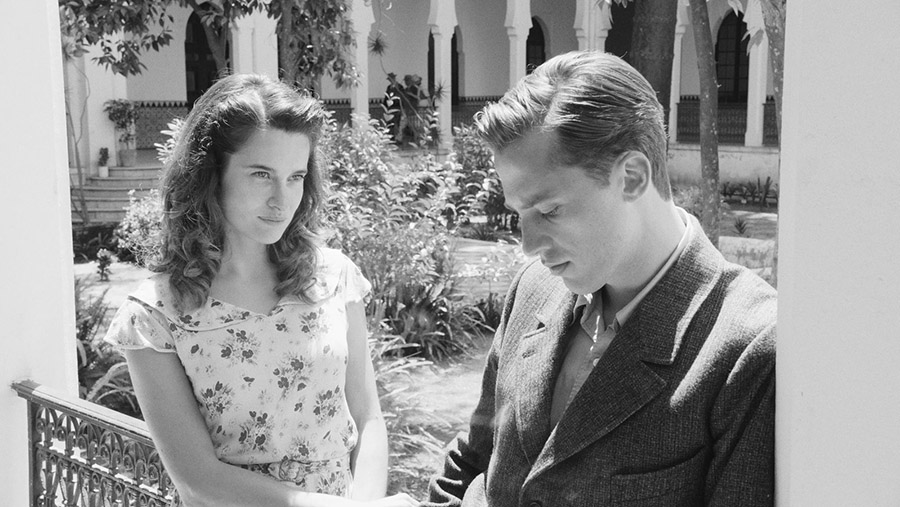
Ozon shows this transformation with all the conviction, although in the finale he allows himself the only significant deviation from Camus: in a pathetic monologue, Mersault inserts a shot with the sister of the murdered Arab standing at his grave. And the plot acquires an anticolonial pathos.
Camus hails from Algeria, which was under French rule in the first half of the 20th century. The theme of national contradictions is more or less heard in many of his works, but specifically in the "Outsider" another thing is more important to the writer: the willingness of society to turn a blind eye to crime if a person "plays by the rules" and behaves as he should. Ozon, in fact, is polemicizing with Camus, asking the question: what is the value of reasoning about freedom and being if they entail the death of an innocent person? However, the original literary message is also very ambivalent and open to interpretation. The Ozone version can be considered one of them.
The Eternal Buzzer
The film's world premiere took place back in September, at the Venice Film Festival, but the film is only being released in Russia this week. And, it seems, there is no better moment for the release. The murder of an Arab committed by Mersault is involuntarily perceived as a metaphor for the confrontation between the United States and Iran, the eternal disregard of white people for the lives of all others. Of course, the director did not put this meaning into it, he has recently generally avoided a straightforward message, especially a political one, but that's what distinguishes art, which often has prophetic power.

The "Outsider" also has another unexpected overlap with modernity. The main character, devoid of ambition, indifferent to obligations and social norms, looks like the embodiment of stereotypes about zoomers. And here we find ourselves thinking that nothing is new under the moon: Meursault is both Franz from "Raindrops on Hot Rocks", a film shot by Ozone a quarter of a century ago based on the play by Rainer Werner Fassbinder (and this is the 1960s), and Kafka characters (1920s), repeatedly embodied in the cinema…
In other words, Ozon did not have to update the novel. It was enough just to film it quite accurately in order to highlight the modernity that it has from the beginning to this day. He was helped in this by excellent actors (although there is not a single star among them), and the secondary roles here turn out to be much brighter than the main one — they seem to compensate for the conscious anti-charisma of Meursault-Voisin. But this work says much less about Ozone himself than about all the other participants, starting with Camus. However, in such directorial detachment, readiness to become, like Meursault, faceless, one can see a conceptual gesture. "You take pictures here, do everything right. And I'll stand next to you. On the sidelines."
Переведено сервисом «Яндекс Переводчик»
