Everything will be jockey: AI will help horse breeders raise racing champions
- Статьи
- Science and technology
- Everything will be jockey: AI will help horse breeders raise racing champions


Russian horse breeders use artificial intelligence methods to select racehorses that will produce the strongest offspring capable of taking first place in competitions. Thanks to its computing power, a machine can find hidden signs of a better parent in a stallion that are not obvious to humans. Calculations have already shown that the children of middle-distance race winners grow up to be excellent sprinters and stayers. According to experts, new technologies can speed up the analysis of horse pedigrees, but without human talent, it will not be possible to bring out a racing champion.
Choosing the best manufacturers
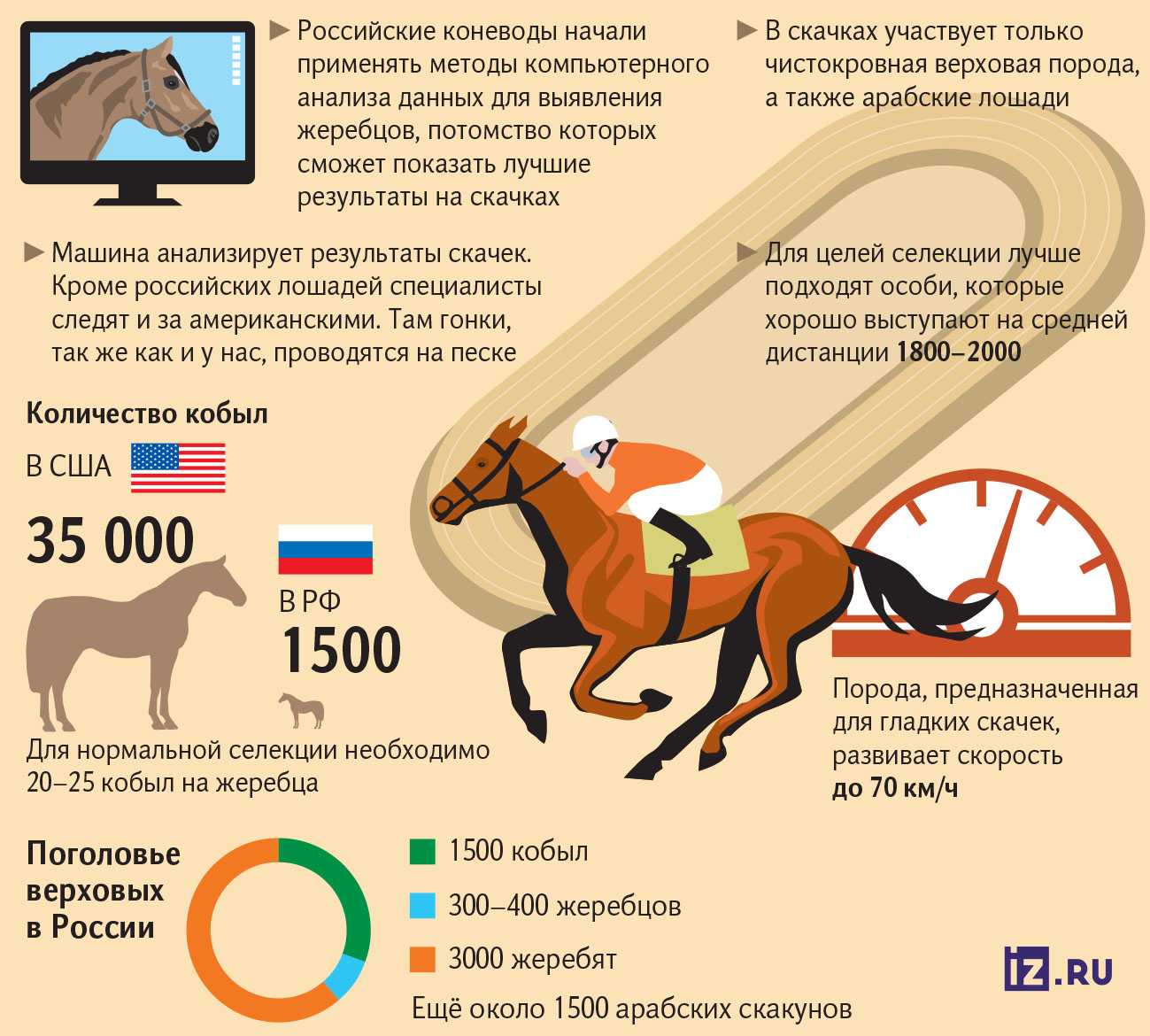
Russian horse breeders have begun using computer analysis methods of big data to identify stallions whose offspring will be able to show the best results at the races. Information about all the sports results shown by the candidates is uploaded to the database. And the machine does the analysis. At the first stage, the task of specialists is to identify the signs by which the parent of future champions can be guaranteed. The first calculations show that individuals who perform well at a distance of 1800-2000 m are better suited for breeding purposes. Their heredity gives significant advantages to both sprinters and stayers.
— We put the parameters that we need into the machine. For example, in horse racing, not only agility is important, but also endurance. Pure agility is good, but it is inherited up to a certain limit. And without endurance, the animal will not be able to demonstrate the desired result. This is true even in a sprint. Moreover, these signs are inherited non—linearly," said Alyona Akimova, head of the production department of the Pyatigorsk Racetrack.
The combination of agility and endurance was formed in horses evolutionarily. To protect themselves from predators, they had to run not only fast, but also long enough, the specialist explained. Calculations also confirmed that stallions who win competitions at the highest level, that is, the so—called group races, which, in turn, are divided into three groups, become good parents.
Only representatives of purebred horse and Arabian breeds participate in the races, while crossing is allowed only within each of them. In Russia, the number of purebred horse breeds is relatively small — about 5 thousand heads, including 1.6 thousand mares, 400 stallions and about 3 thousand foals. The number of Arabian horses is about 1.5 thousand more. The machine analyzes the results of races, data on which is available in open sources. In addition to Russian horses, experts also track American horses: in the United States, as in Russia, races are held on sandy tracks, which allows you to correctly compare the indicators. In addition, breeders are often purchased abroad — about 200 foals are purchased annually in the Russian Federation.
Statistics in the service of breeders
When breeding racehorses, breeders are not interested in external features such as height and weight. They take into account, for example, the animal's ability to show good results already at the beginning of performances, that is, at the age of two. And if the success continues in three or four years, this indicates its strength and endurance. The big data analysis technique came to equestrian sports from animal husbandry, where it is used to breed milk producers. However, the approach to analyzing horses needs to be greatly modified, taking into account the fact that sports performance is greatly influenced by humans.
— Dairy production is easier. They have annual data on how much milk they have received. But it's more difficult here, because a lot depends on people. Let's say a horse shows certain results or makings, but then the question is in which hands it ended up. It may be a super champion, but it so happened that someone overlooked, the horse was injured, she did not perform to her maximum potential. Statistics are statistics, but a lot of things come from a specialist here," said Alyona Akimova.
In addition, it is more difficult to achieve the desired results using data analysis in Russia than in other countries where livestock numbers in the tens of thousands. After all, with a larger amount of information, calculations are more reliable. In order to confirm the benefits of statistical methods in practice, horse breeders will need several years until the first horses bred with their help show themselves in sports.
AI allows processing large amounts of data, which is also relevant for breeding tasks, said Egor Melentyev, General Director of the Rosplemkonzavod Association. This is necessary to select the pairs to produce the strongest offspring, and computer methods help automate this process. However, horse breeding is conservative, so it is unlikely that this transition will happen instantly. The machine could make a preliminary selection, the final decision on which should be made by a human.
— We could ask the AI to select the most productive manufacturers and analyze the lines. It would be a good help for breeders. A combination with human intelligence would be beneficial, but you can't rely entirely on artificial intelligence. He will certainly offer to cross the best with the best, but athletic inclinations, racing, jumping and motor qualities are always difficult to deduce. These are complex signs, and human talent is needed to obtain them," the specialist said.
As Vladimir Tishkin, coach of the Russian national equestrian team, noted in a conversation with Izvestia, with the help of AI, breeders could quickly analyze pedigrees and form a primary idea of a horse for themselves to make further decisions about crossing.
Переведено сервисом «Яндекс Переводчик»
