
Home preparation: how chefs experiment with family recipes

Today, the masters of haute cuisine are increasingly turning to simple dishes familiar to many of us since childhood. At the same time, they sometimes rely on their own experience and offer guests interesting versions of the treats that were prepared at their home. Izvestia found out what these dishes are and how they change in restaurant execution, using the example of the menus of various Russian gastronomic projects.
Dumplings
One of the main gastronomic trends that finally took shape in our country last year is related to the appeal to Russian cuisine in its broadest sense. Thanks to this process, many traditional homemade dishes began to appear on the menus of restaurants of various orientations. Predictably, Russian dumplings turned out to be among the most popular and frequently reproduced family dishes.
— For me, dumplings are directly associated with a family feast, — the brand chef of the Moscow restaurant Buro told Izvestia.Tsum Egor Makarov. — When we introduced them to the menu, it was important for us to rely on a familiar format, but to maximize its quality, stability and taste. We took a classic idea and made our own interpretation.

Dumplings with moose meat
The main difference between dumplings and Makarov's brand chef lies in the dough, which he brews with boiling water and lets it cool, after which he begins modeling. Thanks to this technique, the dough becomes more elastic, durable and at the same time very tender. Dumplings from it do not boil, do not crack during storage and perfectly hold the filling. In addition, our expert adds butter to the dough, which makes it taste softer, creamier and more refined.
As for the filling, regardless of the filling option, our interlocutor does not recommend adding raw onions to it. It strongly marinates meat, gives a sour taste and an unpleasant aftertaste. The best option is onions fried in butter, the proportion of which in the minced meat should be about 20%. To make the filling more juicy, you should also add broth or water to it. This is especially true for beef, as the meat absorbs moisture during cooking, and the filling may turn out to be too dry.

Koymak
The return to home-cooked dishes is also characteristic of Tatar cuisine, which is currently undergoing a rapid renaissance. One example is koimak (not to be confused with the dairy product kaymak), which was recently introduced into the new breakfast section at the Umai Kazan restaurant. These are traditional pancakes that have long been cooked in Tatarstan in ovens.
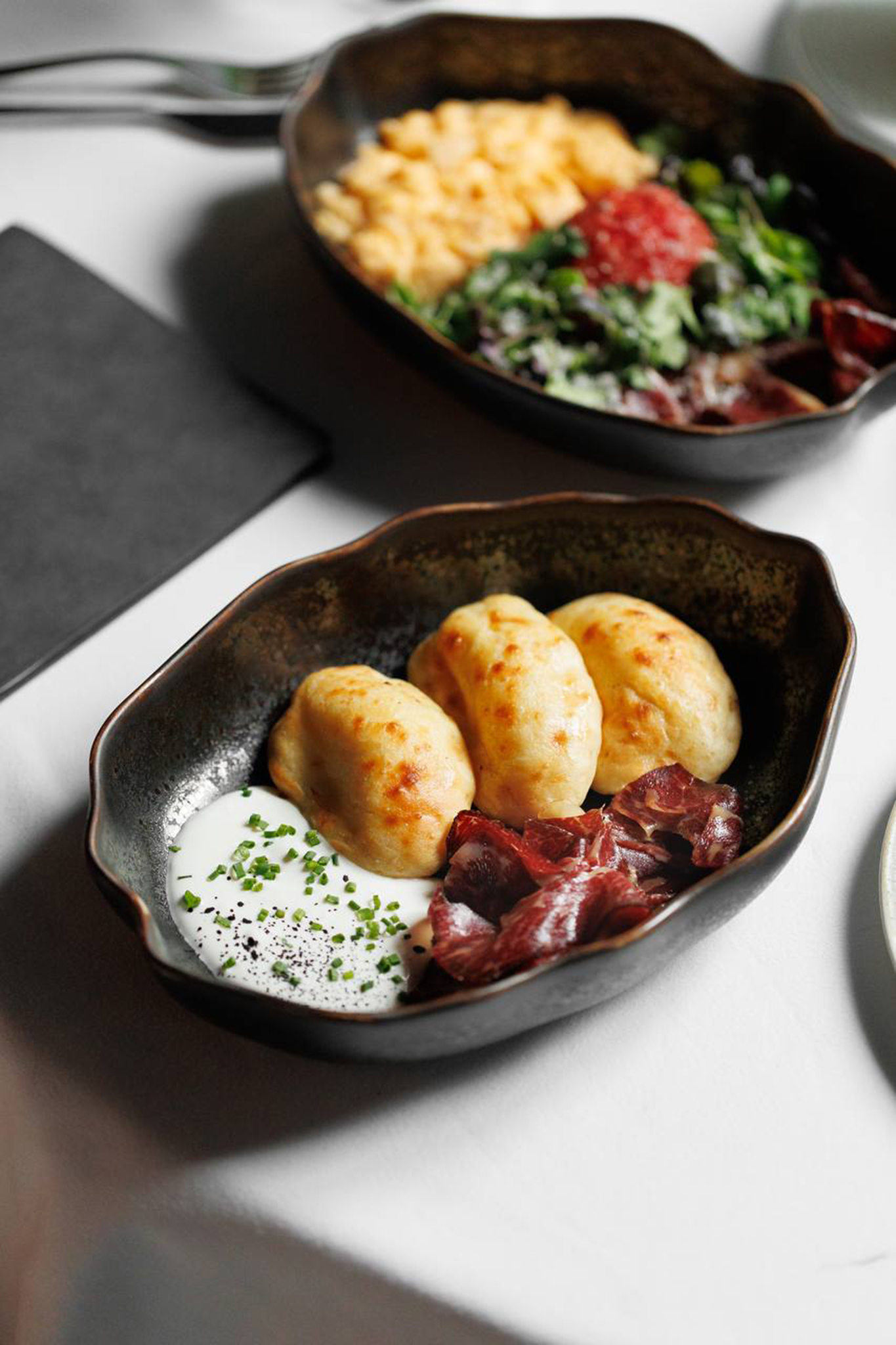
"My grandmother on my father's side often cooked koimak for breakfast," recalls the restaurant's brand chef, Rustam Rakhimov. — She kneaded the dough on a roll, — this is a fermented fermented milk product that made their taste more memorable. In general, the taste of pancakes is neutral, and they can be eaten with sweet jam, as well as with homemade sausage or cured meat.
In her project, our interlocutor made the koimak look as much like a home as possible. He puts the dough in the evening and lets it ripen well, and in the morning he roasts the pancakes in the oven at high temperature without turning them over, as the heat evenly bakes the pastries. Koimak is served with black currant jam, black caviar or boiled and smoked horse meat.
Pasta genovese
The tradition of referring to homemade recipes and dishes is very common in Italian restaurants. So the chef of the Moscow Assunta Madre project, Katello Sansone, added pasta a la Genovese to his menu, with which he has many family memories. He hails from Naples, where it is customary to cook this dish at home. In his family, it was served only for lunch.
"The peculiarity of Genovese is its slow cooking and large amounts of onions, which languish until soft and sweet," Chef Sansone explained to our publication. — Other base elements are olive oil and genovese sauce with onion and beef. The choice of pasta is also important — it is better to opt for pakkeri or ziti.

Pasta genovese
In the restaurant version, our interlocutor retained the base and character of the dish, but made it lighter. He adds a little wine sauce on top to add extra depth and light acidity to the taste (at home, this component was not mixed into the pasta, but served separately). Another innovation is butter, which makes the texture more delicate and light, and balances the saturation of the sauce. The finishing touches are finely grated pecorino and parmesan cheeses, as well as fresh parsley.
When preparing to cook genovese, you need to reserve time and patience: onions should languish slowly, without strong heat, in order to become soft and sweet, and not toasted. It is also very important to use high-quality olive oil and a large paste. And, of course, you should not overload the recipe with other ingredients, since genovese is appreciated precisely for its simplicity, depth of taste and the feeling of homely comfort that it creates.

Kurnik
The domed layered pie with chicken filling is also one of the archetypal dishes of Russian cuisine. Due to the relative simplicity of cooking, it often ends up on the tables of our compatriots on holidays. Recently, it has often been found in restaurants. He also appeared on a special New Year's menu at the Norman bistro Pomme Verte in Moscow, which seemed to be completely out of character for Kurnik.
— I was born in the Krasnodar Territory and have known kurnik since childhood, — says the brand chef of Pomme Verte Renat Tsaritsansky. — My aunt cooked it the best of all. It looked, to put it mildly, imperfect, but it tasted absolutely outstanding.

Chicken coop with confit duck, chicken and creamy mushroom sauce
Our interlocutor always prepares a chicken coop at home for the New Year and always adheres to the family recipe, which he has refined in his own way over the years. For the version for the New Year's Holiday in the restaurant, he added confit duck, fragrant creamy mushroom sauce to the filling as a French accent, and made the appearance of the pie more elegant. The secret of a delicious chicken coop lies in observing several important details. The mushrooms need to be fried well, take a juicy chicken thigh for the filling, prepare thin pancakes for the layers and assemble the pie correctly so that the juice does not come out of it. For a bundle inside the dish, our interlocutor advises using an egg and cheese.
Baked potatoes
The concept of some restaurants directly echoes those dishes that are usually prepared at home by their creators. One of these is the Moscow gastrobistros Multiculture, whose menu reflects the culinary habits of the multinational family of the author of the project, Maxim Polzikov. Together with brand chef Anton Tikhy, they have assembled a collection of signature dishes combining elements of the gastronomic traditions of Russia, Israel, Spain and Azerbaijan.
— My childhood was spent in the 1990s in Vladimir in conditions of a not very diverse diet, like many at that time, - says brand chef Tikhy. — But at home we always had potatoes, which we cooked in every possible way. My favorite option was potatoes baked in coals, and we decided to return to it in Multiculture.

Potatoes in coals
It is best to cook potatoes in charcoal on the grill, but at home you can bake them in the oven until they are ready, and then burn them with a charcoal burner, advises our expert. To serve, cut the warm tubers in half and put the potato pulp in a bowl so that part of the charred peel also gets there. Add the melted butter, chopped parsley and salt to the potatoes. And if you add sour cream to such potatoes and pour a small amount of olive oil, it will turn out almost the same as in "Multiculture".

Chocolate sausage
Simple folk sweets are also increasingly coming to the attention of restaurant confectioners. For example, the chocolate sausage beloved by many has become an important nostalgic part of the dessert set "Tea Party at Grandma's" in the Moscow restaurant of modern Siberian cuisine Manul.
— In my family, chocolate sausage has always been a harbinger of a holiday, and I still have a homely feeling about it, — says Polina Antonova, pastry chef at Manul. — These are the familiar and understandable delicacies and tastes that I want to bring to the restaurant.

Chocolate sausage
The restaurant version of the chocolate sausage, of course, has become more refined from a gastronomic point of view. It is made from dark chocolate, adding butter, cream, sugar and cocoa. Salt is used to balance the taste, and crunchy shortbread cookies and walnuts, which are not used in the traditional homemade version, are responsible for the texture.
At home, chocolate is best heated in a water bath, so as not to overheat the mass and avoid its stratification, advises our interlocutor. And for the filling, she recommends using a large cookie crumb, broken by hand, and not through a blender. Then the texture of the dessert will turn out better, and the sausage slice will become more expressive.
Переведено сервисом «Яндекс Переводчик»
