In blood with milk: a simple calcium test predicts the risk of heart disease
- Статьи
- Science and technology
- In blood with milk: a simple calcium test predicts the risk of heart disease


Russian scientists have developed easy-to-manufacture and sensitive sensors to detect the calcium content in complex solutions, including seawater and blood. The analogues used today are either not accurate enough and inconvenient to use, or they are highly expensive. Calcium concentration is an important marker in various fields, from the dairy industry and environmental monitoring to medicine, where analysis of this indicator is regularly prescribed for cardiovascular and other diseases. According to experts, the new technology will significantly reduce the cost of such research.
Simple calcium sensors
ITMO specialists have developed compact, inexpensive and sensitive sensors for detecting calcium ions in complex environments, including seawater, milk and blood. The devices are easy to use and can be used in areas where traditional laboratory testing is difficult, such as in the field. In addition, the technology makes it possible to eliminate the complex pre-preparation of samples, which is now required for a number of medical tests, including the diagnosis of cardiovascular diseases.
— Calcium determination is an important task. Firstly, it is necessary for constant environmental monitoring, since this substance is one of the main cations of seawater, which is key for the formation of calcium carbonate in corals, mollusks and plankton. The growth of skeletons and the stability of reefs under oceanic acidity depend on its availability and balance with the carbonate system. Secondly, it is important for integrated food quality control right in the production lines. For medical purposes, the balance of calcium and magnesium in the blood serves as an important marker of human health, determining the quality and duration of his life," said Evgeny Smirnov, head of the study and a leading researcher at the ITMO Scientific and Educational Center for Infochemistry.
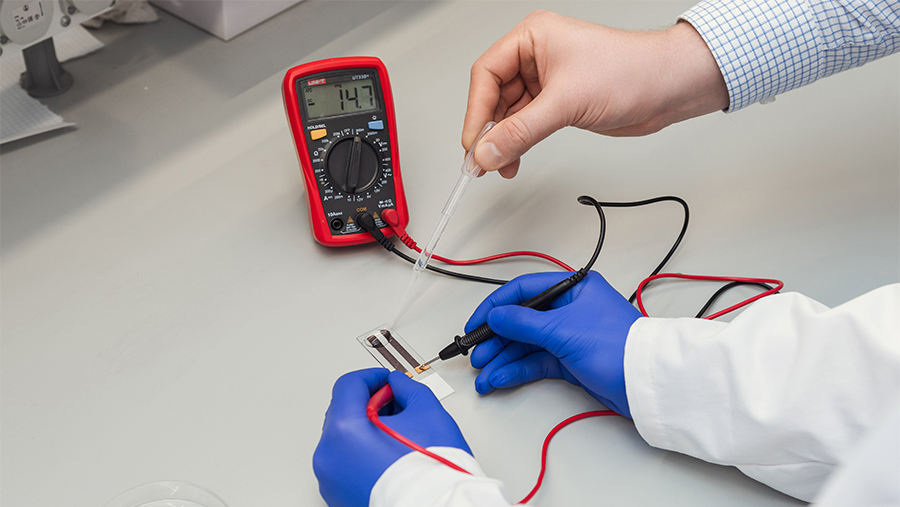
Currently, standard electrodes made of metal (for example, platinum) or carbon are mainly used to measure this parameter, however, such devices often have low sensitivity and may not work accurately enough due to impurities of other substances. Another option is to create sensors using complex structures based on nanoparticles, polymers, and other materials. But they require complex and expensive modification.

ITMO has developed a new type of sensor with the simplest possible design based on MXene, a two—dimensional titanium carbide material. Its size does not exceed 1 cm in length and 3-4 mm in thickness. Due to their composition and size, the sensors are highly sensitive. 100 microliters is enough to detect calcium, which is just a few drops of liquid. At the same time, most analogues have larger dimensions, due to which they require a larger volume of liquid for analysis.
Application in different fields
The scientists presented two samples of electrodes: solid on a glass substrate and flexible, printed on plastic. The first one is suitable for laboratory tests, while the second one can be used in wearable electronics, Internet of Things devices, and other fields. In the future, similar sensors can be placed on paper and textiles. Both types of sensors selectively and accurately detect calcium ions in solution. At the same time, extraneous ions practically do not affect the result.
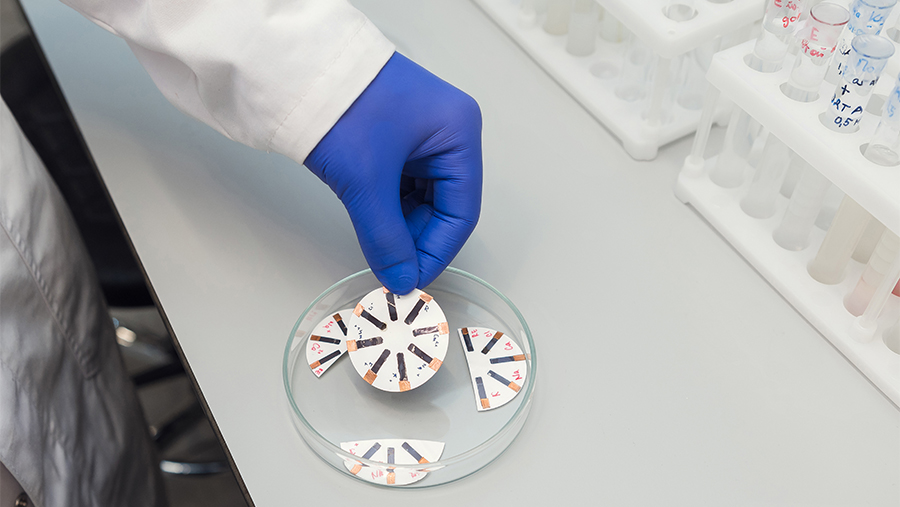
— In our work, we have shown that MXene is a promising material for a new generation of inexpensive, flexible and highly sensitive sensors. Our sensors can be adapted to detect any other ions by simply changing the membrane. Due to its miniature size, the development will be of interest to commercial customers, for example, manufacturers of water filters and food industries," said Evgeny Smirnov.
According to Evgeny Alexandrov, Director of the NTI Center for Digital Materials Science: New Materials and Substances at Bauman Moscow State Technical University, new sensors can be used in a wide variety of fields.

— Such technology is needed, for example, when implementing the concepts of Internet of things consumption, environmental monitoring and telemedicine. The cost of analysis in the laboratory is very high. The proposed sensors can make it more accessible if, for example, they are sold through pharmacies. You can make a preliminary test and only if you reject it, contact a specialized institution to eliminate hypercalcemia or hypocalcemia. For remote areas, it can be important to determine the hardness of the water (calcium and magnesium content) in order to choose the most useful source, the expert believes.
In medical practice, a calcium test is necessary for a large number of pathologies, added Mikhail Bolkov, a researcher at the Institute for the Study of Aging at the Russian Gerontological Research and Clinical Center at Pirogov University.
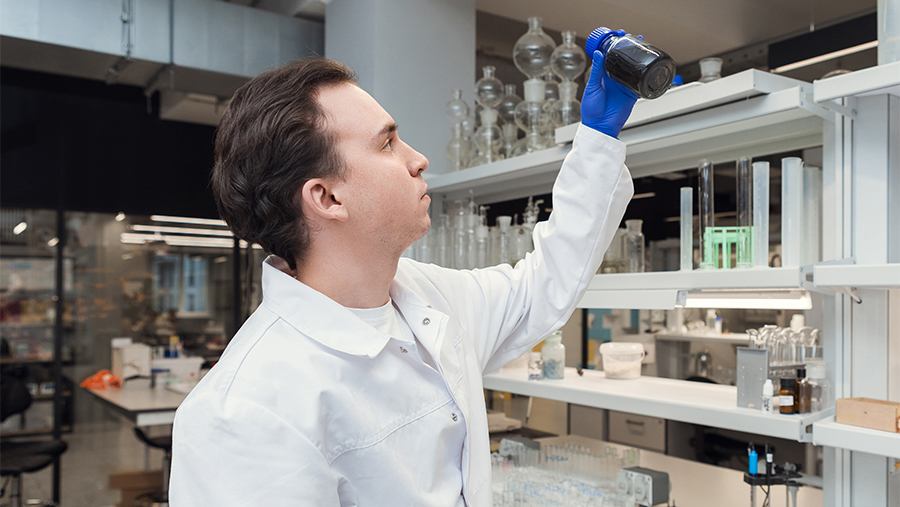
— A normal level of calcium in the body is important for the proper functioning of bones, heart and muscles. This substance also affects hormones. In elderly patients, it is associated with osteoporosis. Doctors prescribe this test regularly," he told Izvestia.
In the near future, the authors plan to make a tool for multiplex ion analysis, which will allow detecting ions of various substances from one drop: sodium, potassium, ammonium, calcium, magnesium, iodine, chlorine and others. Scientists expect that the system will be suitable for solutions with a substance content from 0.1 mol per liter (a concentrated solution comparable to brine) to 0.00001 mol (a highly diluted solution an order of magnitude lower than physiological concentrations.
The research was supported by the Russian Science Foundation.
Переведено сервисом «Яндекс Переводчик»
