Rescuers in uniform


Traffic police inspectors not only monitor compliance with traffic rules, stop offenses and bring violators to justice. They are often the first to come to the aid of victims of car accidents, those who feel unwell on the road, injured in some kind of emergency. About how traffic police officers save people's lives — in the material of Izvestia.
A task of national importance
In mid-November, Russian President Vladimir Putin signed a decree "Approving the Strategy for Improving Road Safety in the Russian Federation for the period up to 2030 and for the future up to 2036." According to this document, over the next four years, the number of people killed in road accidents should decrease by one and a half times (compared to 2023), and in ten years it will decrease by half. Along with measures to prevent and prevent car accidents, a separate section of the strategy is devoted to rescuing victims of road accidents if accidents on the road could not be avoided. It includes several areas, from increasing the speed of arrival of emergency services at the scene of an emergency and expanding the network of emergency points along the roads to optimizing the routes of delivery of victims to medical institutions and the development of air ambulance for their transportation.
— World experience shows that about a quarter of all those killed in car accidents could have been saved if they had received emergency assistance. These are thousands of lives saved," Leonid Dezhurny, chief freelance first aid specialist at the Russian Ministry of Health, told Izvestia.
"They were the first to break out into the cities"
According to statistics, it is often the employees of the State Traffic Inspectorate who arrive first at the scene of an accident from the operational services. In such situations, they are assigned the role of rescuers who provide first aid to victims before professional doctors arrive at the scene. Therefore, along with the knowledge and skills they need to monitor compliance with law and order on the roads, traffic police inspectors are trained in emergency assistance techniques.
— A special role is assigned to the issues of first aid to victims of road accidents — a separate section is devoted to them in the recently adopted Strategy for Improving Road Safety in the Russian Federation for the period up to 2030 and for the future up to 2036. This is one of the key areas of work of the State Traffic Inspectorate and other departments: without this, it will be quite difficult to achieve the goals set by the head of state to reduce deaths on the roads. Therefore, special attention is being paid to training the personnel of the State Traffic Inspectorate in first aid skills and equipping units with special stowage with an expanded set of tools for its provision," said the Deputy head of the Main Directorate for Road Safety The Ministry of Internal Affairs of Russia is Police Major General Alexey Kuznetsov.
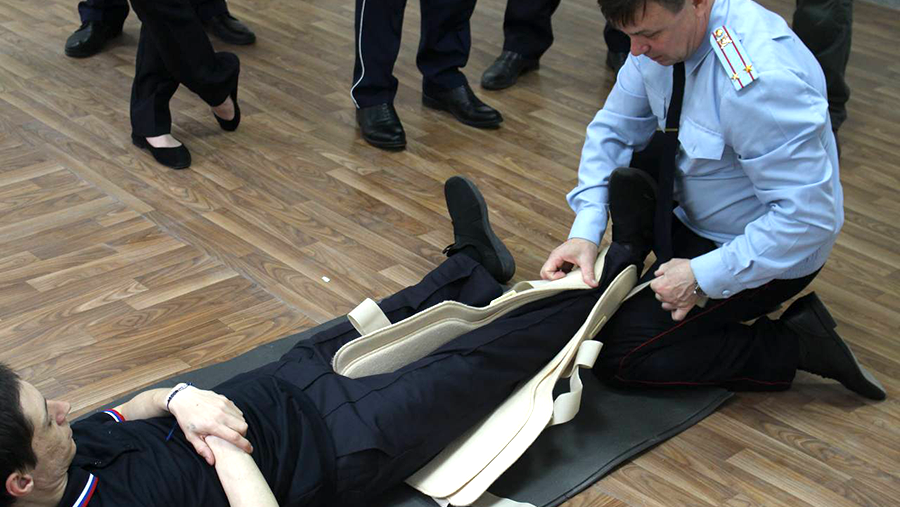
As the State Traffic Inspectorate told Izvestia, classes where employees receive such knowledge and skills are constantly held on the basis of both the departments of the State Traffic Inspectorate themselves, as well as departmental educational organizations, as well as training centers for emergency medicine and disaster medicine, including with the involvement of professional doctors and rescuers. The vast majority of traffic police inspectors have already completed such courses, the department stressed.
More than three years ago, the State Traffic Inspectorate, the Ministry of Health and the Ministry of Emergency Situations of Russia developed an illustrated atlas to train traffic police personnel in first aid skills not only as part of a training course, but also for self-study. Special briefings with slides on emergency assistance techniques, which are conducted when traffic police units are on duty, help to refresh the knowledge gained by traffic police officers.
The rescue case
The knowledge and first aid skills that car inspectors possess are certainly important. However, it is equally important that patrolmen have special devices at hand that greatly simplify the provision of such assistance and make it more effective, Leonid Dezhurny emphasizes. To do this, traffic police patrol cars are equipped with specialized first aid kits. They include several sets of splints for fixing damaged limbs, additional hemostatic tourniquets, neck collars for both children and adults, an expanded set of bandages, special insulated blankets and a number of other devices and means of assistance. The State Traffic Inspectorate of the Ministry of Internal Affairs of Russia said that in recent years, several tens of thousands of such packages have been received by regional units.
— To stop the bleeding, you can use, for example, a belt. But it is much easier to use special hemostatic tourniquets for this. And artificial respiration is more convenient and efficient to perform with a breathing bag, rather than mouth to mouth. The presence of such a specialized installation in a patrol car will allow traffic police to help victims of accidents faster, if necessary, and will give them more confidence that they will be able to provide assistance," Leonid Dezhurny notes.
Road accidents and more
The effectiveness of the knowledge and first aid skills possessed by traffic police officers has been proven by practice. According to the State Traffic Inspectorate of the Ministry of Internal Affairs of Russia, since the beginning of the year, traffic inspectors have helped victims in almost 2.3 thousand accidents. And the number of such cases is only growing: in 11 months of 2024, first aid was provided by the staff of the State Traffic Inspectorate in about 1,9 thousand car accidents.
So, last summer in the Rostov region, traffic police inspectors were the first to be at the scene of a car accident in which a motorcyclist collided with a car and was seriously injured. Using a tourniquet from a special lining, the police stopped the biker's heavy bleeding and stabilized his condition until the ambulance crew arrived.
In early November, Sakhalin traffic police helped the victim in a car accident, as well as those who were at the scene of the collision of two cars before other operational services. One of the drivers seriously injured his head on impact — the inspectors applied a bandage, stopped the blood and handed the victim over to the doctors.
Traffic police officers provide first aid not only to injured participants in an accident. For example, recently in the Belgorod region, it was traffic police inspectors who, using special styling, were the first to come to the aid of a man who was seriously injured after a drone attack. In the Moscow region, a woman who suffered a serious hand injury after being attacked by a dog turned to traffic police with a request for help. After bandaging the wounds, the police officers quickly took the victim to the hospital in a patrol car.
Eyewitnesses are asked to respond
In medicine, there is a concept of the so—called golden hour, the time from the moment of the incident, during which the victim must be taken to a medical facility for qualified medical care, Leonid Dezhurny said. However, in some cases, saving lives is literally a matter of minutes, he noted.
— Severe bleeding, respiratory and palpitation arrest, unconsciousness of the victim lying on his back with tongue occlusion blocking the airway — all this requires emergency assistance. If it is not provided within a few minutes, then no matter who arrives first at the scene of the accident — traffic police or an ambulance crew, they will have no one to save. In such situations, other drivers should help the victims. However, as practice shows, often eyewitnesses are simply afraid to approach the victims," he stressed.
That is why, along with training traffic police inspectors and equipping patrol cars with specialized stowage, first aid work will continue with road users, according to the State Traffic Inspectorate of the Ministry of Internal Affairs of Russia. It is not only about teaching them the necessary skills and techniques, but also about informing them about the legal safety of first aid. In addition, it is planned to increase the motivation of the perpetrators of road accidents in providing first aid to victims. This circumstance is a mitigating punishment when considering in court the issue of harm to life or health, the department emphasizes.
The material was created as part of the implementation of the federal project "Road Safety" of the national project "Infrastructure for Life".
Переведено сервисом «Яндекс Переводчик»
