- Статьи
- Science and technology
- Martian past: scientists have discovered a dangerous effect for the colonists of the Red Planet

Martian past: scientists have discovered a dangerous effect for the colonists of the Red Planet

For the first time, Russian researchers have experimentally studied a phenomenon that poses a danger to complex technical devices on Mars. We are talking about static electricity, which occurs when dust particles collide in the atmosphere of the planet. Especially during storms. This leads to the appearance of microscopic discharges that emit electromagnetic waves. Such radiation can disable the electronics of robots and planetary stations, which calls into question the safety of future Martian colonists. For more information, see the Izvestia article.
"Signals" of Martian dust
Scientists from the Space Research Institute of the Russian Academy of Sciences and the Moscow Institute of Physics and Technology have developed a method that will allow them to hear the "signals" of Martian dust. The Ministry of Education and Science of the Russian Federation told Izvestia about this.
We are talking about microscopic lightning, experts explained. They arise in the dry and rarefied atmosphere of the Red Planet's carbon dioxide when sand and dust particles collide with each other and exchange charges. In this case, microscopic discharges are formed, which create electromagnetic radiation. It can be captured and registered like radio waves. These discharges affect atmospheric chemistry, but also pose a potential threat to spacecraft electronics.
— For a long time, the scientific community only assumed the presence of this effect, but did not have the tools to study it and, more importantly, interpret it. The purpose of our research was to learn how to determine the properties of the particles that cause the discharge and the conditions in which it occurred by the nature of the radio signal. To do this, we applied a three-step method. He combined laboratory experiments and observations in a real environment," Mohamad Abdelaal, an employee of the Department of Space Physics at MIPT, told Izvestia.
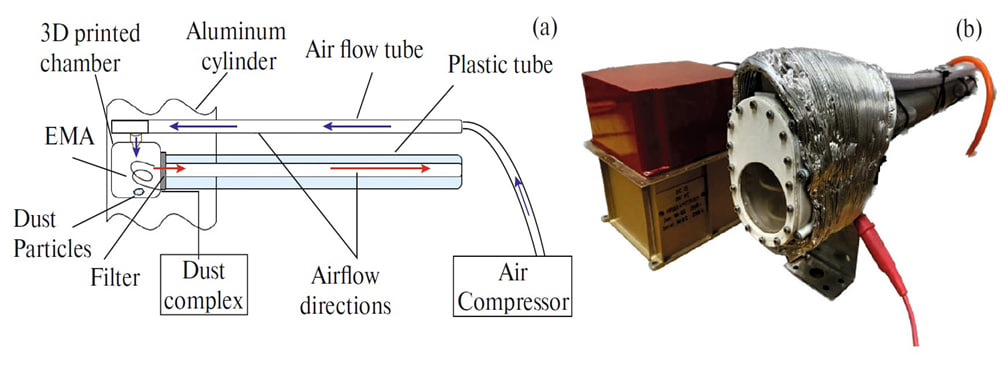
He explained that scientists first created a miniature sandstorm by placing sand particles in a chamber with a swirling air flow. At the same time, a sensitive spiral antenna picked up radio pulses from micro-discharges.
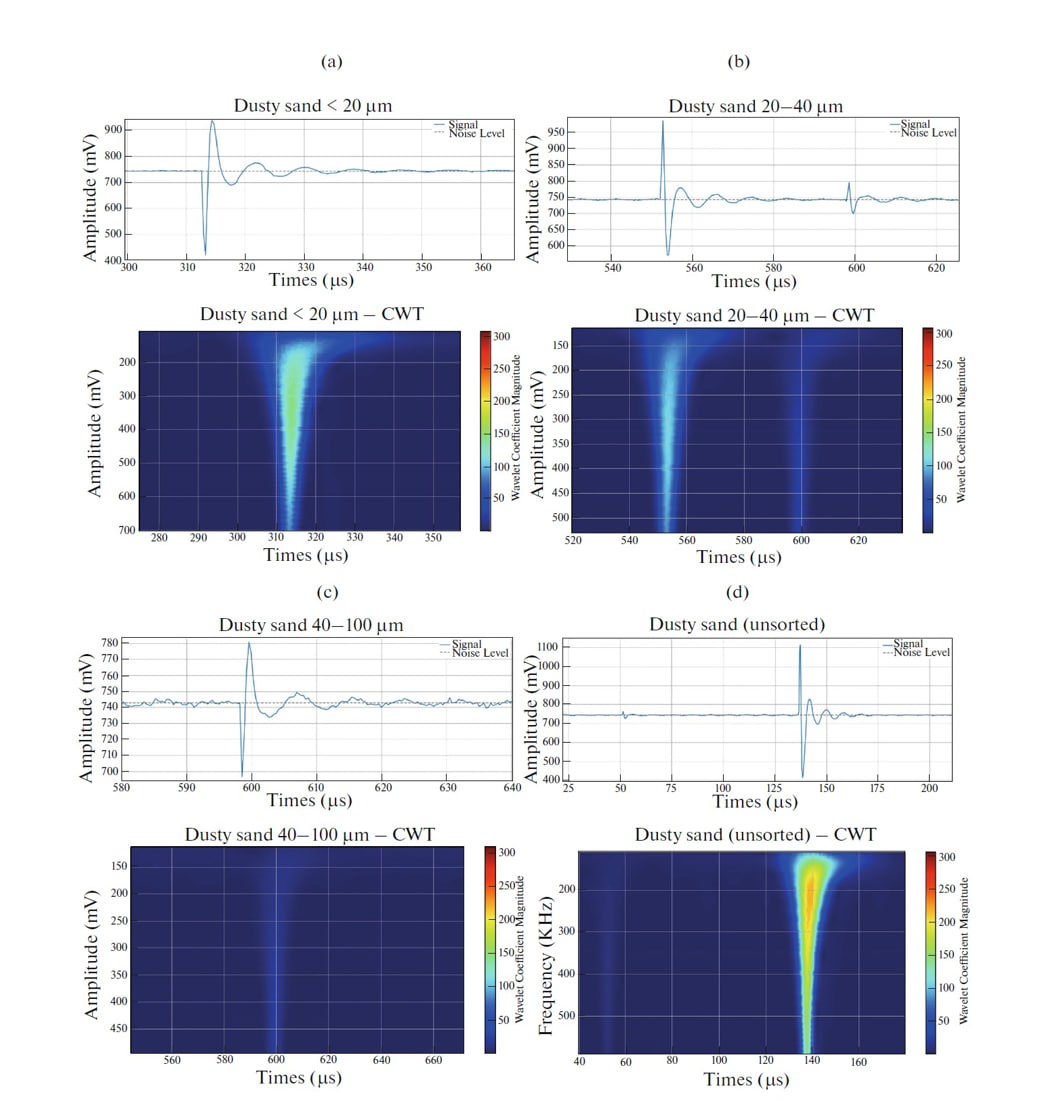
During the experiments, the team found that small particles (up to 40 microns) generate frequent complex and multicomponent signals, while larger grains of sand generate rare, powerful and clear single pulses.
"In the next step, we recreated the Martian conditions," Mohamad Abdelaal continued. — To do this, the chamber was placed in a vacuum unit and filled with carbon dioxide at low pressure. Natural terrestrial sands and synthetic analogues of Martian soil with a high content of iron oxides were used as "dust". Experiments have confirmed that the composition of the dust also affects the discharge. For example, the basalt particles characteristic of Mars dissipate the charge faster, which leads to weaker but constant electromagnetic signals.
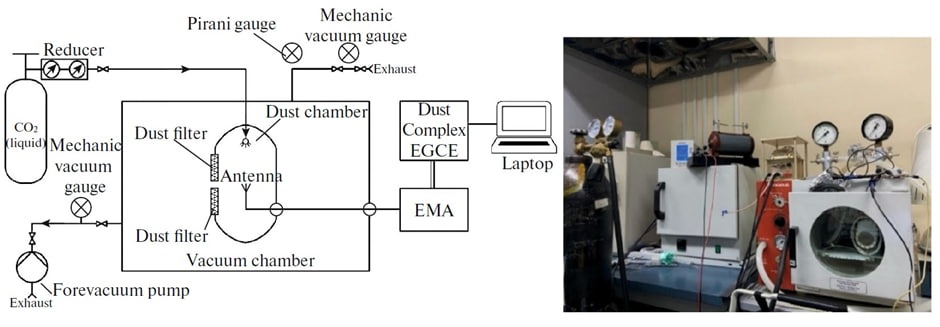
In addition, the scientist said, experiments have shown that in the simulated Martian atmosphere, electrical breakdown occurs at a much lower voltage than on Earth. This means that a spark on the Red Planet requires significantly less accumulated charge, and such phenomena occur there more often.
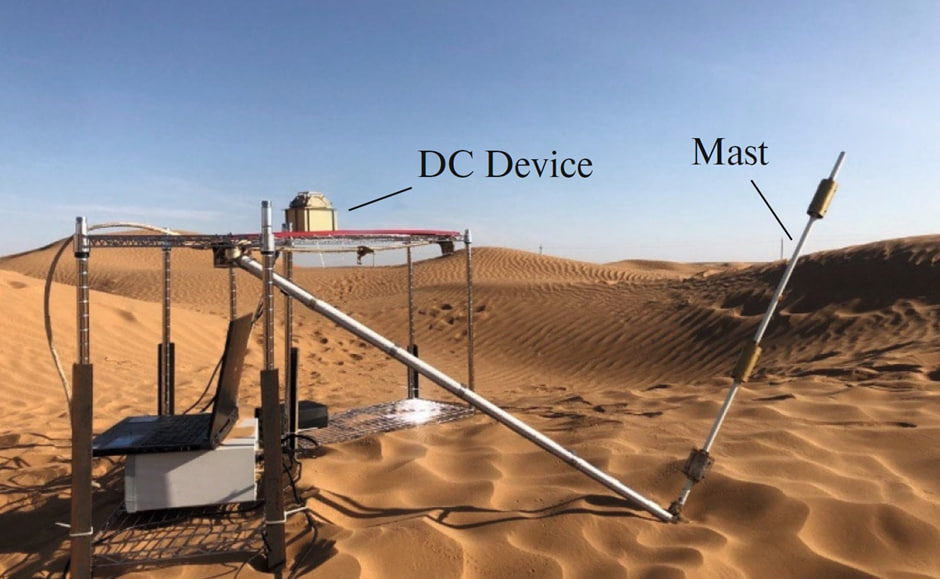
The third stage, the researchers said, was devoted to the verification and calibration of laboratory data. To do this, scientists undertook an expedition to the steppes of Kalmykia, where the arid climate and sandy landscapes serve as an earthly analogue of Mars.
During these operations, a special device recorded natural electromagnetic signals and, at the same time, wind speed, humidity, temperature and solar radiation levels. The results of the field tests confirmed the conclusions reached in the laboratory.

How dust storms will affect the colonists of Mars
— As a result, we have created an end-to-end methodology that involves the use of the same equipment both for studying artificial charges and their natural counterparts. This allows us to build reliable physical models, and also lays the foundation for research on the surface of Mars. Installing an electromagnetic analyzer on future rovers or stationary stations will allow real—time data collection on the dynamics of dust storms, particle size distribution, and even the geology of the Red Planet," said Mohamad Abdelaal.
According to him, understanding these processes is a matter of security for future colonists. After all, static discharges, harmless on Earth, can disable complex electronics in Martian conditions, depriving expeditions of technical support.
In the future, the scientist added, research can be expanded by studying electrical phenomena in the sulfuric acid clouds of Venus or in the exosphere (a thin gas shell) above the surface of the Moon.
"Dust is present on all planets of the terrestrial group, and electrostatic sticking and discharges pose a serious problem for operating mechanisms and electronics," Sergei Voropaev, senior researcher at the Galimov Laboratory of Carbon Geochemistry at the Russian Academy of Sciences, told Izvestia.
He added that charges on particles arise mainly due to friction, but they vary depending on the environment. Moreover, it is only partially possible to reproduce the conditions of the Red Planet on Earth due to the different composition of the atmosphere and the presence of a magnetic field. However, Martian meteorites can provide a clue. The samples created on their basis will help to study the features of charge accumulation and discharge on "dust" particles. But some questions can only be answered on the spot.
— The development of space technology requires consideration of harmful factors. In particular, additional negative factors arise on the surface of the Moon or Mars. For example, due to the fine dispersion and dryness of dust, electrostatic charges are formed. Since the surface of the equipment is not grounded, they can accumulate and lead to failures, distortion of signals and even equipment failure," said Evgeny Dudorov, representative of the Board of the Consortium of Robotics and Intelligent Control Systems.

Combating these factors is a difficult task, the expert noted. Nevertheless, they are taken into account in one way or another when designing devices.
— Accumulated experience shows that electrostatics on Mars is not a critical factor. And it will have little impact on future programs for the exploration of the planet," said Pavel Gaiduk, Deputy head of the Scientific and Exposition Department of the Museum of Cosmonautics.
According to the historian, significant problems related to these effects were experienced by the Mars-3 spacecraft, which made the first soft landing on the planet's surface in 1971. Similar anomalies were observed in some later missions, for example, Vikings. In order to avoid technical failures in the future, it is necessary to first study the phenomenon using drones with special equipment.
— At the same time, the colonization of Mars is still very far away, — stated the point of view of the popularizer of astronautics Nicholas Oxman. — So far, the statements of Elon Musk, who creates a stir around this topic, are primarily aimed at creating a positive background around the new developments of SpaceX.
According to the expert, this helps to attract investments. In practice, the main immediate task of the "Martian" Starship is not the colonization of the Red Planet, but the launch of Starlink communications satellites into low Earth orbits. This grouping has commercial value and increases the capitalization of the company.
Переведено сервисом «Яндекс Переводчик»
