- Статьи
- Society
- Mercury attacks: how the Ukrainian pyramid scheme withdraws tens of billions from the Russian Federation

Mercury attacks: how the Ukrainian pyramid scheme withdraws tens of billions from the Russian Federation

The organizer of the large-scale financial pyramid "Mercury", also known as CashFlow, a citizen of Ukraine Dmitry Vasadin could withdraw at least 20 billion rubles from Russia, Izvestia estimated. The money is transferred through the Money Storage payment service under his control, registered in the Netherlands, which everyone who deposits money into this "mutual assistance fund" is required to use. Vasadin's organization is actively operating in Russia, despite the fact that it does not have a legal entity here, access to the sites is blocked by Roskomnadzor, and the Bank of Russia has included all projects related to Mercury in the list of companies with signs of illegal activity. The investigation by Izvestia tells about the schemes of big deception and how a native of Ukraine and his accomplices have been able to mislead people from different countries for more than 10 years.
2 million followers
The creator of one of the largest financial pyramids in Russia, Dmitry Vasadin, a citizen of Ukraine, is also a beneficiary of the Money Storage payment service, through which tens of billions of rubles are withdrawn from the country, Izvestia found out. The service itself is registered in the Netherlands, transactions passing through Money Storage are serviced on the same servers where all the online resources of the Mercury pyramid are hosted (it also uses the names CashFlow, Cashflow, and a number of others), follows from the data obtained by the editorial staff using web analysis tools.

The use of Money Storage is strictly mandatory for all pyramid participants — this is the only way they can top up their accounts and withdraw money. Based on open data on the attendance of the service and the minimum payments of Mercury participants, Izvestia experts estimated that the lower limit of the annual turnover of the service on payments from Russian citizens alone could be almost 2 billion rubles (we will tell you more about the calculations below). Taking into account the fact that Dmitry Vasadin's pyramid scheme has existed in various versions since 2013, we can talk about the withdrawal of at least 20 billion rubles from Russia.
At the same time, it is obvious that the majority of Mercury participants are not limited to the 5 thousand rubles that must be transferred to the general cash register at the first stage. So, Izvestia talked with an ordinary "investor" of the pyramid, whose payments have already exceeded 1 million rubles. Thus, the actual amount of funds withdrawn may multiply.
According to Vasadin himself, the current audience of his mutual aid foundation is about 2 million people in more than 10 countries around the world.
Mercury versions
Mercury (also uses the names CashFlow, Cashflow, and a number of others) is a large financial pyramid scheme active mainly in Russia, the CIS countries, and Eastern Europe. Initially, it appeared in 2013 as the Mercury Mutual Fund Project and was designed mainly for the Ukrainian audience. Even in the contacts on the site, it gave out the phone numbers of Ukrainian operators, and the main currency on the site was the hryvnia.
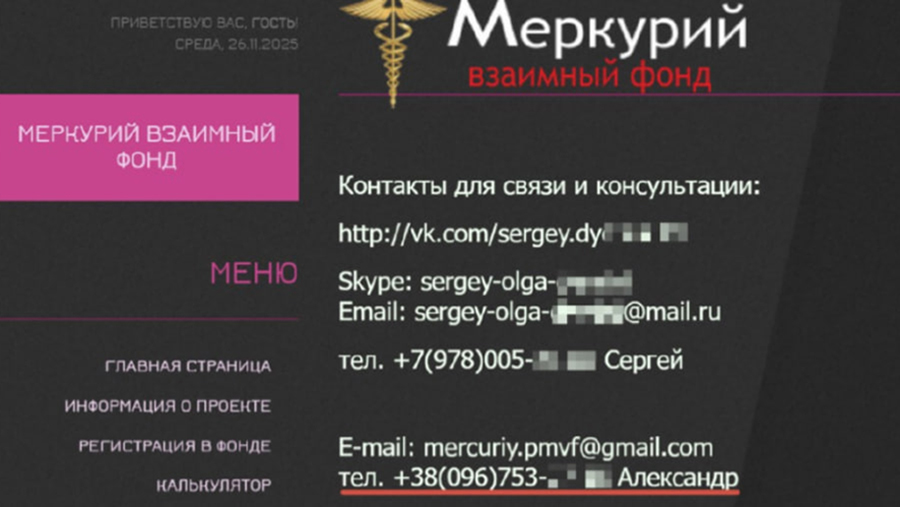
The PMDF existed until 2014, promising participants weekly payments with a yield of 0.8–1% per day, that is, about 300% per annum. New members of the foundation transferred their money to the so-called custodians, and the transfer was made as a voluntary donation, which made it impossible to file claims in court and return the money back.
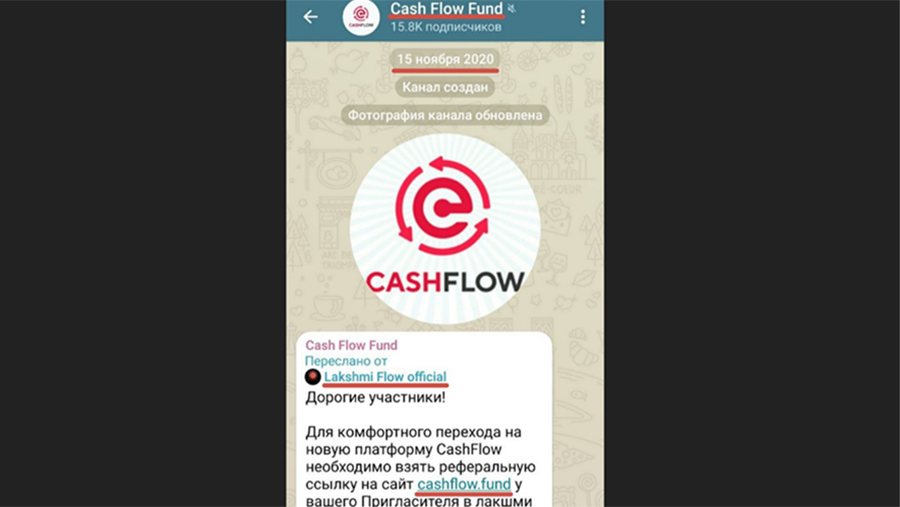
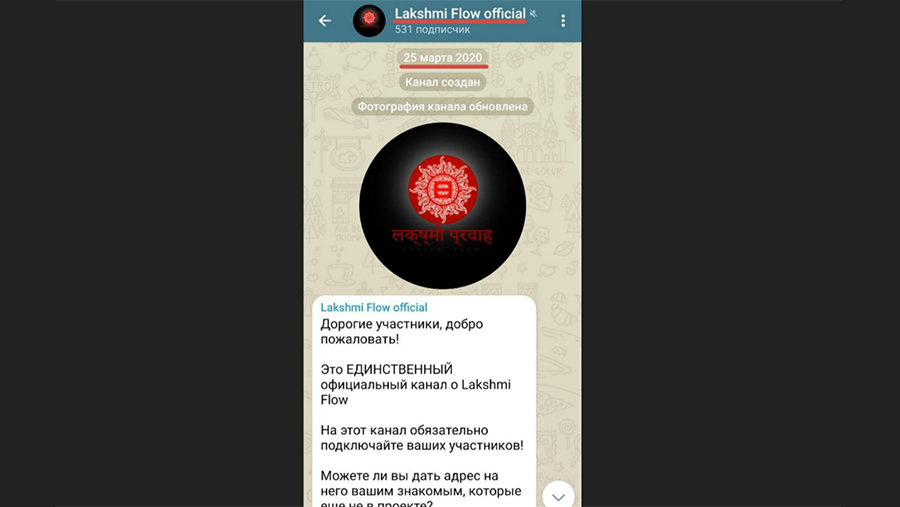
After several iterations, the pyramid was called Lakshmi. And in November 2020, the Telegram channel of the CashFlow project appeared, which is still in use today. Moreover, the first message in this channel concerned the migration of clients from Lakshmi Fund. Apparently, this was Vasadin's tactic: when the next version of his pyramid collapsed, he transferred virtual customer accounts to a new platform, which allegedly saved funds and was even more profitable. After all, as stated on the official resources of the Cash Flow Fund ("Cashflow"), this fund allows you to earn more than the previous ones.
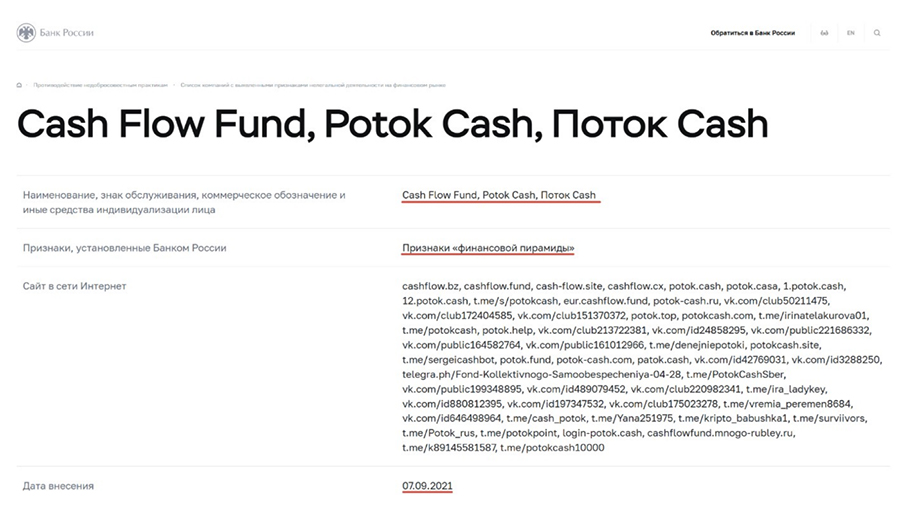
At the same time, the "depositors" are not bothered by the fact that the addresses of their fund are blocked by Roskomnadzor of the Russian Federation, the organization is not registered in Russia as a legal entity, and the pyramid servers are located abroad, as are its beneficiaries. Back in 2021, the Bank of Russia included all projects related to Mercury in the list of companies with signs of a financial pyramid. Izvestia sent a request to the Bank of Russia.
All this does not prevent Potoxash from pompously celebrating its birthday every year. For example, in January 2025, the event was held in Krasnaya Polyana. In 2026, the organizers of the foundation plan to celebrate the next anniversary in more than a dozen locations — at the Rosa Khutor resort in Krasnaya Polyana, at the Villa Barvikha 135 banquet hall in the Moscow region, in Irkutsk, Saratov, Vladivostok, Phuket, Bishkek, Prague, Florida, Venice… Participation for members of the organization is not cheap — for example, 60 thousand rubles in the capital, 650 tokens of the USDT cryptocurrency (approximately 51 thousand rubles) in Sochi.
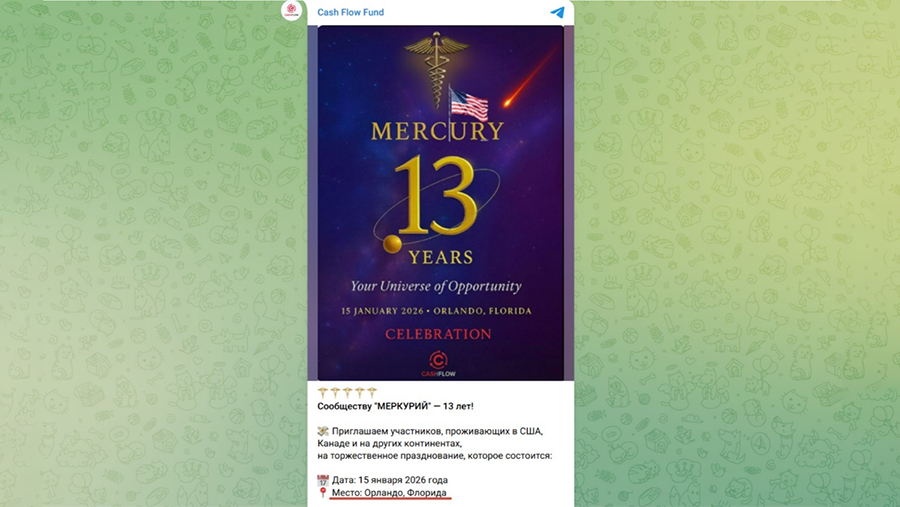
Judging by the videos from past celebrations, the events of the "mercurians" (as they call themselves) are more like religious gatherings — the culmination is a group infusion of money into the "stream" when the adherents of the pyramid demonstrate how much money they have deposited into their accounts.
Esoteric motives can also be traced in the advertisements — participants are promised "an energy field of billionaires, in which, just by being there, you already begin to change, feel this level and automatically raise the vibrations of your life."
Air Sellers
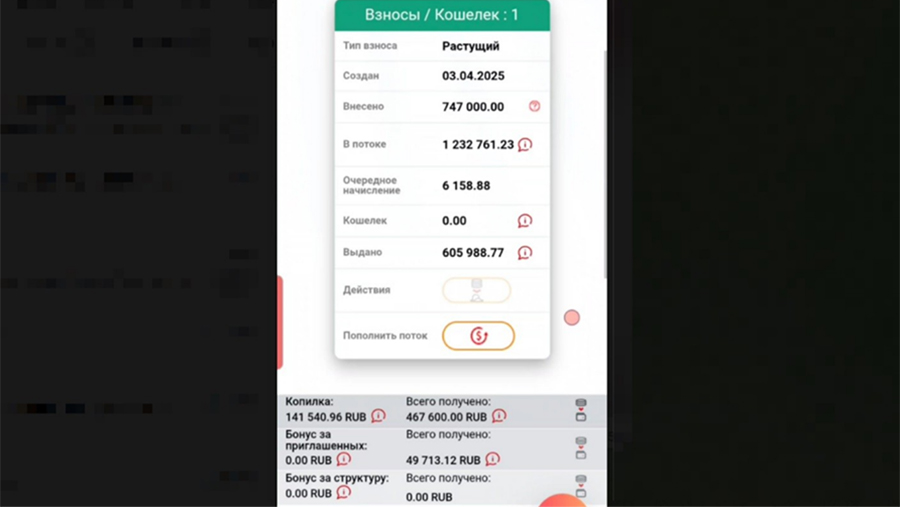
Izvestia spoke with one of the ordinary participants of the pyramid named Mikhail. He says that he has invested over 700 thousand rubles in the fund, and taking into account all expenses and interest, he has 1.2 million rubles "in the stream" in order to "make 6-7 million rubles out of them in a year." At the moment, he says, he receives this money in small portions — 5-6 thousand rubles a week, but he does not withdraw it to the card, but puts it back into the "streams".
— Yes, I honestly tell everyone that I have withdrawn only 6.5 thousand rubles for all the time, when I had to urgently pay for the restaurant. And I did it from my internal wallet to my card," Mikhail explains.
He is sure that the money earned in the "fund" should be left there to grow further. According to him, only "stupid people" withdraw money from the site, and the smart ones force them to "work there." The confusing conditions and the ambiguity of the mechanics of Mikhail's earnings do not bother him, and he considers it unnecessary to deal with these issues.
— You won't figure it out on your own. As Dmitry Vasadin says, "you sit and figure it out, think about all sorts of goals. Don't think, just do as you're told, and you'll be rich people." And he's absolutely right. Because he's really a very smart mathematician who created all these formulas. And it really works," says our interlocutor.
Mikhail showed his personal account in the pyramid. From its appearance, an absolutely confusing system of accruals and payments becomes clear.
The Izvestia correspondent has been registered in the pyramid — some "mirrors" are blocked, but there are also working ones. During the process, you must specify a phone number, but there is no verification.
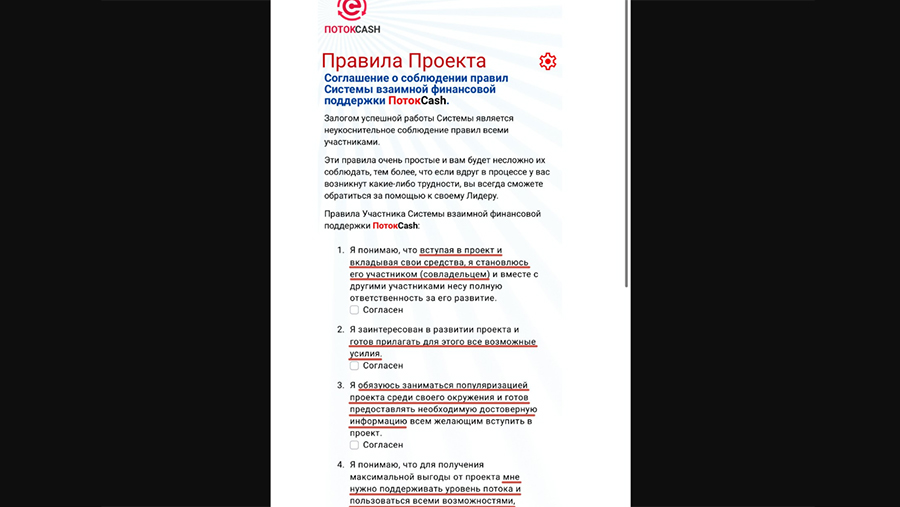
After registration, the user is greeted by a set of rules that must be accepted. It contains the typical pyramid commitment to lure other people as part of a promise to promote the project, as well as an agreement that the benefits may not be maximized if you "don't maintain the flow rate," i.e., don't contribute more and more funds.
There is a "compliance agreement" on the website, which says, for example, the following: "If for some reason, 60 days after you joined the Foundation, none of your friends became a member of the Foundation, then in the next 30 days you need to undergo special training that will help you overcome any fears when communicating with people on this topic."
Users have access to "streams" where they can invest money — starting, growing, accumulative, and the like. One of the most important points is that the system uses an internal eCurrency "cryptocurrency", which is needed in order to "restart growth flows." The value of this currency is constantly growing and at the time of publication of the material already exceeds 60 thousand rubles per unit.
Each of the "streams" has its own conditions, but the principle is similar: the amounts on virtual accounts increase, however, in order to restart the "stream", it is necessary to deposit not only the amount of money from it (or additionally), but also a certain amount of eCurrency "cryptocurrency" (for this you still need to buy it, then there is extra money to spend in the pyramid).
However, eCurrency's "cryptocurrency" is not really one — it is not backed by anything and is not traded on exchanges. The "exchange rate", as Vasadin calls the value of this currency, is thus absent in the market understanding, but in fact eCurrency is something like loyalty points, buying which participants are forced to spend extra money.
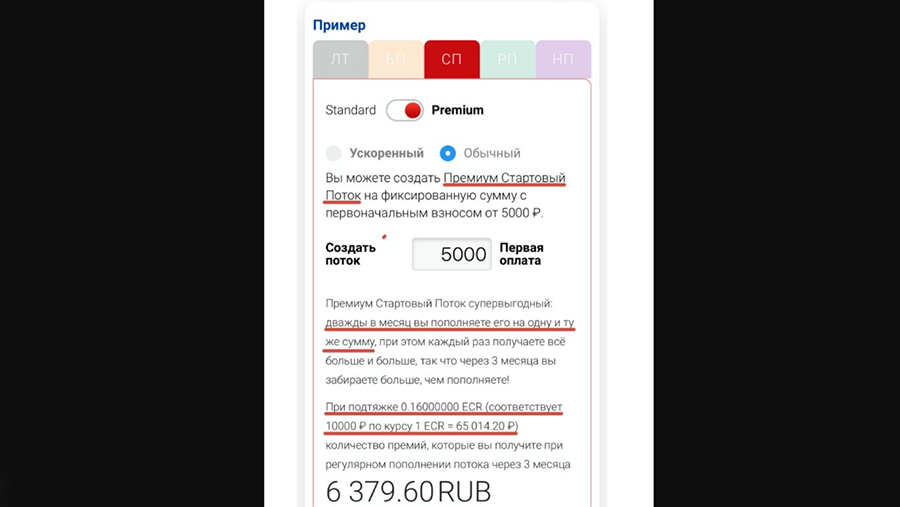
The pyramid has a hierarchy typical of MLM projects.: Participants who have brought 10 people with them become "leaders" and receive a percentage of all payments from all members of their group. The leader who builds a structure of 10 other leaders, each of whom will patronize 10 ordinary members of the structure, is called a "top leader" and receives a percentage from each replenishment of each "stream".
— It's like Herbalife, which worked according to the same scheme. You're bringing in new members and actually building a new pyramid for yourself. Accordingly, you receive a percentage from the "streams" of each participant in this pyramid. So the creators of Mercury have not invented anything new, except that they have integrated some kind of their own cryptocurrency and all these payment mechanisms," economist Denis Raksha told Izvestia.
As Izvestia has seen, Mercury has a highly developed cult of leadership.: the desire to become one and bring 10 new members to obtain the appropriate status is facilitated by the banal desire to earn more.
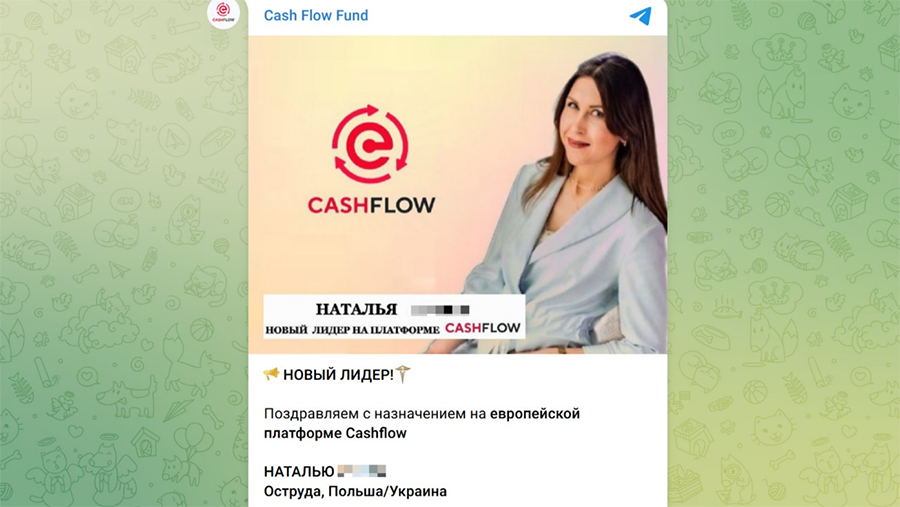
By exploiting this weakness of people, the creators of the pyramid turn the latter into ideal promoters who will impose participation in the pyramid on all their friends and acquaintances as something reliable and "personally proven," adds Raksha.
— This principle of redistributing virtual finance may give people some money at the exit, but this is the principle of any financial pyramid. It consists in using the new money to service the old contributions. But as soon as the influx of new money stops for any reason, the pyramid collapses," the economist notes.
The main feature of a pyramid scheme, according to him, is the lack of real economic activity of the company. Such structures do not have a working product, business or investments that can generate income, they do not have assets, register with regulators, do not submit financial activity reports to them (as they do not carry out such activities), and the mechanics of payments are not related to any commercial result, the expert noted.
Vasadin declares at all his speeches that his project is a "mutual aid fund", and not an investment company, so that everyone can always get money for their current needs so that they don't need anything. That is, it does not even create the appearance that the funds of the pyramid members are being invested somewhere in order to bring at least some income.
Vasadin also has assistants. One of them is a certain Irina Levchenko, who, according to a source in Izvestia, is also a citizen of Ukraine. Levchenko conducts weekly "exercises" in a live audio broadcast on Telegram. Community members continue to be actively processed there, so that they advertise the foundation as actively as possible and bring new members.
Withdrawal of billions of rubles
To replenish customer accounts, the pyramid uses the Money Storage payment service, which, at first glance, seems to be a completely third-party resource. However, as Izvestia has established, this service is located on the same server as the pyramid itself, in the Netherlands.
All other Mercury domain names are found on the same IP address, including domains created specifically for other countries (for example, cashflow.gb.fund for the UK).
The favicon (website icon) of Money Storage is the same as that of "Cash Flow".

The Mercury payment service is registered in the Netherlands with the corresponding IP address.
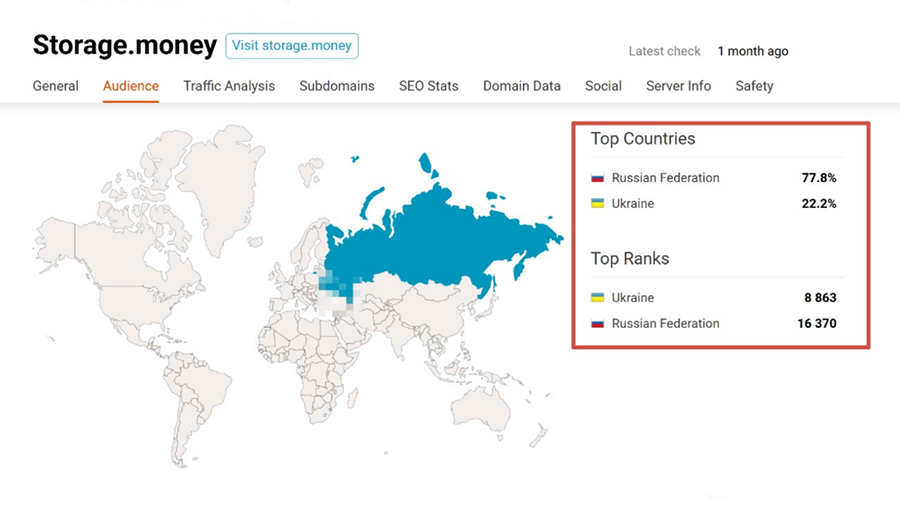
An analysis of the payment service shows that its audience is mainly represented by residents of Russia and Ukraine, since other wallets are used to replenish accounts in the pyramid not in rubles or hryvnias (located, however, on the same server in the Netherlands).
According to the analytical data of the Easy Counter service, 6940 people view the pages of the Money Storage website daily, each user looks at an average of seven pages on the resource, thus, the site has about 992 real visitors.
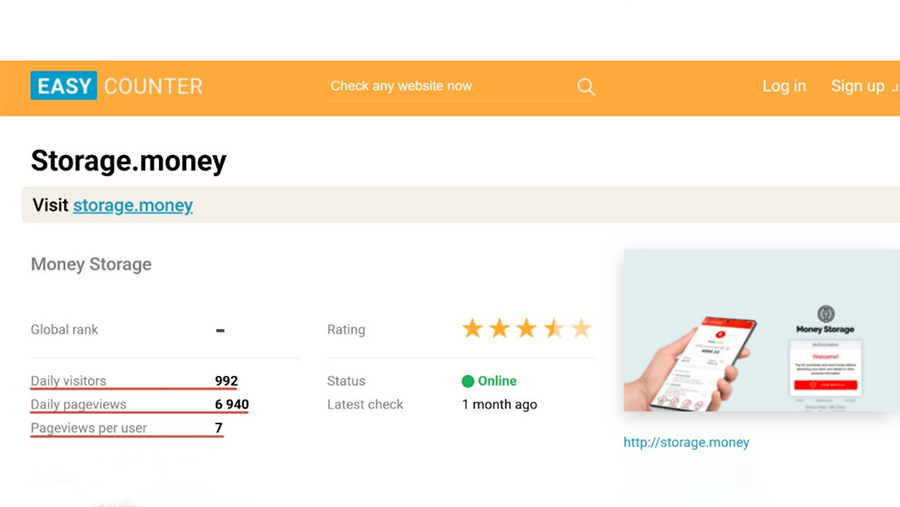
If each of the visitors visits the service to transfer at least 5 thousand rubles to the pyramid (the basic offer for most "streams"), then there may be at least 1.8 billion rubles in a year, and over 10 years, thus, more than 18 billion. However, this can be considered the lowest level, since people usually carry almost all of their savings into such projects.
"He's brilliant"
Vasadin was born in Crimea in 1970, and graduated from the Military Institute of Telecommunications and Informatization in Kiev (according to his VK page). He could have held a position at Kyivtrans until he became the founder of MLM projects, and is currently moving around different countries, spending most of his time in Lithuania and Latvia. He is registered in Yevpatoria and Kiev, and has not been assigned a Russian INN.
He appeared in the public space in 2009-2010, having started blogging on LiveJournal. There, he criticized traditional financial market institutions, promising to create a simple and "fair" way of regular income — "the desire to build a system in which people help each other and earn income." According to his own admission at one of the seminars, he learned the basis for his "philosophy" from the books of Vadim Zeland and his "Transurfing reality", a work about achieving results "through positive thinking".

Vasadin also became imbued with the ideas of the founder of the MMM financial pyramid, Sergey Mavrodi, as he wrote in his LiveJournal and spoke at seminars.
The websites of Vasadin's critics indicate that he was a "thousand-man" (that is, attracted a thousand people) in the pyramid of "Vityaz", founded by Dmitry Mazanov and Dmitry Kuragin, the creators of "MMM-2011". Vityaz collapsed in 2013, when over 10 thousand people became victims of fraud. a man from whom scammers stole over 400 million rubles.
Apparently, it was then that Vasadin decided to create his own pyramid, a more advanced one that would make contributions in the form of voluntary donations so that her work would be legally clean and people could not demand a refund in court. That's when his first "Mercury Mutual Fund Project" appeared (followed by Side by Side, CRT, Lakshmiflow, CashFlow, and Cashflow).
Vasadin apparently decided to borrow the original name from another Mercury pyramid, which was liquidated by law enforcement officers in 2006. She stopped payments, after which depositors from Nizhny Novgorod, Ivanovo and Vladimir regions contacted the police. The organizers of the pyramid were condemned.
Vasadin's organizational model has always combined offline and online seminars, a rigid hierarchy, and referral payments. Newcomers were shown the first arrivals, emphasized the "stability" of accruals, encouraged "reinvestment" and the invitation of new participants. Payments existed while the inflow of funds was growing.

There was virtually no legal record of the obligations assumed to depositors, taking away their protection tools.
Vasadin does not hide much that he created a financial pyramid, but he allegedly came up with ways to "prolong the life" of his scheme — the total spread of the Internet will accelerate and increase the reach of the project. Mercury, he said, is "a 400-year project."
In fact, Vasadin simply combined almost all the known vicious practices of financial pyramids and MLM structures in one project. The names of his projects refer to Robert Kiyosaki's book on financial literacy, Cashflow. Mercury and Lakshmi, in turn, are the gods of commerce and wealth in Greek and Indian mythology.
Promotional materials consist of general declarative phrases, internal communication in the project is reduced to slogans and affirmations "Vasadin is a genius", "PotokCash works because it works".

However, according to Izvestia, the life of the Vasadin pyramid may be coming to an end. As follows from the latest comments on the Charging with Irina Levchenko channel, participants are already facing withdrawal stops, especially on sites in yuan. The situation is explained to them by a technical malfunction.
As Denis Raksha noted, such problems indicate a fairly rapid collapse of the pyramid — the volume of payments began to exceed the amount of funds raised from new members, and in this situation, the bill goes not even for months, but for weeks and days, unless the organizers come up with a new way to dramatically increase revenue.
Переведено сервисом «Яндекс Переводчик»
