- Статьи
- Culture
- A move into history: how "Dear Willy" helped Brezhnev save the world from a nuclear catastrophe

A move into history: how "Dear Willy" helped Brezhnev save the world from a nuclear catastrophe

The world was on the verge of nuclear war — a strike on the USSR was being prepared from American military bases in Germany, and only diplomacy was able to prevent a catastrophe. On November 1, REN TV will show the detective story "Dear Willy" about the secret friendship of Leonid Brezhnev, Secretary General of the Central Committee of the CPSU, and Willy Brandt, Chancellor of Germany. And this is the most high—profile spy premiere of the season. The secret relationship between the two geopolitical rivals threatened to collapse both, but eventually changed the course of history and became an example of a brilliant way out of intractable international differences. The prototype of one of the key characters who had to establish a dialogue between the two leaders in secrecy was the journalist Valery Lednev. About this fantastic, but unimaginative and attested story on the pages of Izvestia — in our material.
The Moscow Treaty of 1970 on the pages of Izvestia
"Positive outcome," "Agreement signed between the USSR and Germany," "In honor of the German Chancellor," the headlines on the front page of the August 13, 1970 issue of the newspaper preserved in the archives of Izvestia, the day after the signing of the Moscow Treaty, rejoice in large print. In the center is a picture from the hall of the Grand Kremlin Palace, taken by our predecessor. The moment, the significance of which cannot be overestimated, was witnessed by the Izvestia photojournalist Smetanin.
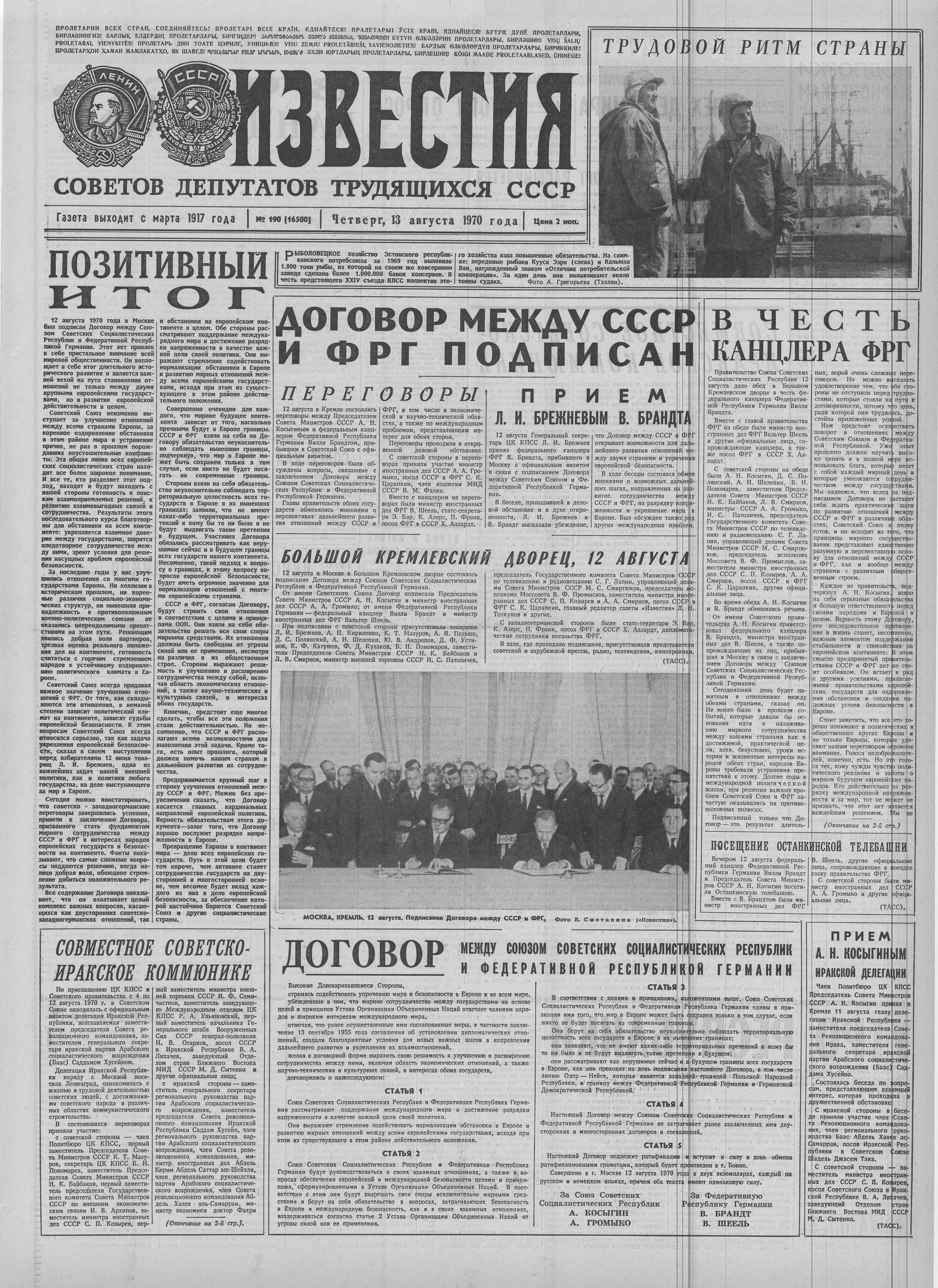
On the USSR side, Chairman of the Council of Ministers Alexei Kosygin and Minister of Foreign Affairs Andrei Gromyko, on the German side, Minister of Foreign Affairs Walter Scheel and Federal Chancellor Willy Brandt. In the presence of Secretary General Leonid Brezhnev, the meeting participants signed a document that marked the abandonment of the Cold War policy and became a historic breakthrough in relations between the USSR and Germany in the post-war period.
This event, which the press, including the world, was now openly reporting on the front pages, was preceded by a secret affair between the leaders of the USSR and Germany, a brilliantly played party where both risked condemning themselves to political death.

Post-war relations between the two countries could hardly be called warm. International tensions escalated especially in the early 1960s, when our intelligence service became aware of NATO's development of a plan for a nuclear strike on the USSR from military bases in Europe, including in Germany.

Minister of Foreign Affairs of the USSR A.A. Gromyko, Chairman of the Council of Ministers of the USSR A.N. Kosygin, Federal Chancellor of Germany Willy Brandt and Minister of Foreign Affairs of Germany Walter Scheel during the signing of the Treaty between the USSR and Germany at the Grand Kremlin Palace, August 12, 1970.
At that critical moment, when the world was on the verge of a global catastrophe, Brezhnev and Brandt chose the path not of destruction, but of diplomacy. However, in conditions of ideological confrontation and mutual distrust, negotiations could take place only with complete confidentiality. A secret communication channel was used, which bypassed bureaucracy and other possible obstacles.
"It's a very dashing story! It's tension, it's suspense!"
International journalist Valery Lendev played an unofficial but key role in its creation. He was a Germanist at Izvestia, had strong connections in the political and business circles of Germany, and thanks to this experience, he could, without attracting attention, establish a direct exchange of signals between Brezhnev and Brandt.
"A simple journalist, Valery Lednev, turned out to be a very important figure in the history of Soviet—German relations, who gave us 20 years of peaceful coexistence," says documentary filmmaker Igor Prokopenko, who devoted years to researching the topic and collecting information. — He was once an international columnist for the Izvestia newspaper, spoke excellent German, was a member of Brezhnev's pool and was very well integrated into the German intellectual elite. Therefore, when the question arose of who could approach the West German leadership on a confidential level and establish this contact, there was no better option.

Former Izvestia journalist Valery Lednev (left)
Today, he is a hero not only in history, but also on the screen. Valery Lednev became the prototype of Valery Pletnev, one of the main characters in the new high—profile spy detective story Dear Willy. This is a four—part artistic project, but it is based on historical facts that the most daring scenario would envy.
— This is a very dashing story! It's tension, it's suspense! — Alexey Rozin, who played Pletnev, describes the plot.
And he immediately demonstrates this in the frame — he jumps into a yellow Lada and briskly zips through the snow-covered streets of Soviet Moscow, recreated in Moskino.
— My first car was a Lada, it's a special car, — the actor returns to Izvestia journalists between takes. — We have a chase now. Our heroes abducted the German Secretary of State right from under the noses of the KGB and his own guards in order to personally transfer secret information. The script is written in very good language with a touch of irony, despite the fact that this is a serious story about how two intelligence officers prevent a nuclear war and save the world.
Vyacheslav Vardanov, a former KGB officer, is in the company of Pletnev. Together they form a charming duo, where two different characters simultaneously combine and collide in the spirit of superhero blockbusters.

Vardanov, like the rest of the characters, has a real prototype — Vyacheslav Kevorkov, an employee of the USSR state security agencies. Actor Sergey Marin, who embodied the image, brought "Dear Willy" the first award even before the premiere — in June he was recognized as the best actor by the jury of the Pilot Film Festival competition.

"I'd rather not finish playing than turn Brezhnev into another joke"
There is perfect harmony in the acting ensemble. Each element of it, like on a musical instrument, is in its place. Even looking at Kirill Kyaro in the role of Willy Brandt, you forget that this is a Russian artist. It's not just an external hit. For the sake of filming, he started speaking German.
— Of course, it was very difficult! If English is at least by ear, then German is not at all. I haven't studied it before. But since I had experience shooting in English, I was inspired and thought it was interesting and a good challenge. When I started learning the lines, at some point I even despaired, I had a lot of text, but then, scene by scene, slowly everything began to work out," Kirill Kyaro now recalls with a smile.

The jewel of this collection is Sergei Makovetsky in the role of Leonid Brezhnev. The General Secretary performed by the artist is not a hero of jokes, but a talented politician, who, however, can skillfully insert a joke about himself — by the way, talking about the fate of the state.

— I watched a lot of documentaries of that time, six hours of chronicles. And I became convinced that Leonid Ilyich Brezhnev was incredibly collected and cheerful in those years. Very sociable, very hooligan, very brave. And indeed, for him, "world peace" was not an empty word: he put his life into it. And I gave myself an inner attitude: "I'd rather not finish playing than turn Brezhnev into another joke," Sergei Makovetsky shares in an interview with Izvestia.
Another surprise is the participation of Vladimir Konkin in the project. He played the ideologist of the USSR, a member of the Politburo of the Central Committee of the CPSU Mikhail Suslov. This is the artist's first film role after a pause of almost 20 years.
The search for aesthetics in featureless concrete bags
Jewelry precision in "Dear Willie" is in everything. It is also the work of artists. For example, in the Willy Brandt office they created, there are even such small things as an old Japanese TV and an archived issue of The New Yorker magazine. Costumes have become a special treat for the female half of the team.
— I like the picture! I'm a fan of it — these bell-bottomed pants, these glasses, these bright colors and combinations. I really love it all! — actress Marietta Tsigal-Polishchuk admires the scenery of the "Tavern of 13 Chairs" (Zoya Zelinskaya, the star of the legendary program and wife of Lednev, became the prototype of her heroine Kira Zheltovskaya).

The locations were searched all over the country — they were filmed in Moscow, St. Petersburg, Kaliningrad. The image itself — stylish and atmospheric — was also created in a special way.
"When we started looking at objects from the 1970s — featureless concrete bags, we wanted to find some kind of aesthetic in them that would bring us back to that era," says Peter Dukhovskoy, operator of Dear Willy. — There was such an idea — to create the effect as if we were filming those times and places, depending on where the story takes place. It is clear that all this was done using a digital camera, but then the processing is as if the Soviet Union was filmed on "Svema" and "Tasma", and Germany — on Agfa and Orwo.

"Get ready, silence, let's get started!" the director Vladimir Shchegolkov commanded loudly. This is a rare case when such a tone could be heard on the set of "Dear Willy" — almost an army tone. The rest of the time, a careful and intelligent attitude towards each member of the group. "Volodenka, come to me," the cameraman gently calls the director to discuss the dynamics of the future frame.
— This is my movie family! — explains Vladimir Shchegolkov. — In this sense, Peter Leonidovich says very well that the cameraman is mom, because he wants the actors to be beautiful, and the director is dad, because he wants them to be smart. That's how he distributed the responsibilities in our film family.

This atmosphere at the venue gave a special creative impulse to the artists.
— This is a very subtle director who insanely trusts the actor, which makes it very pleasant to work. The venue is generally very quiet, which is unusual, and a rather creative atmosphere is created," Wilma Kutaviciute, who played the foreign spy Marta, shares her impressions of the process.

Behind the sharp turns on the screen and the fascinating story full of intrigue, "Dear Willie" today has meanings that sound more relevant than ever in the light of the tense situation in global geopolitics.
"God grant that everything ends the same way, and the boats would be recalled," says director Vladimir Shchegolkov, recalling one of the episodes. — That's what it sounds like, because it's very much in line with what's happening right now.
"Dear Willie" is more than a spy detective story. This is a timely and sharp signal against the background of today's aggressive rhetoric and actions of the West. At a time when sanctions are getting tougher and the foundations of international security laid down in the era of detente are being undermined, it's about how important diplomacy and dialogue are that can save humanity from a larger catastrophe.
The project was created with the support of the Internet Development Institute based on materials that documentarian, writer and presenter of the REN TV channel Igor Prokopenko has been collecting for 20 years. He became one of the script writers and general producers. Vladimir Tyulin, CEO of REN TV, also became the general producer of Dear Willy. The premiere of all four episodes of the large-scale spy thriller will take place on the TV channel on November 1.
The next day, the topic will be continued by the documentary historical investigation "Five minutes before the Third World War." Unique archives, rare chronicle footage and exclusive interviews with eyewitnesses of those events will tell about the secret diplomacy, big politics and personal courage of the two world leaders.
Переведено сервисом «Яндекс Переводчик»
