- Статьи
- Culture
- We must Honor the Code: the History of Russian Law in the Mirror of Russian Literature

We must Honor the Code: the History of Russian Law in the Mirror of Russian Literature

Educational books for the younger generation (those who have already lost interest in comics, but have not yet come to the idea of having to re-read something from the school curriculum) are now in favor with publishers. So the essay by the famous lawyer Alim Ulbashev is aimed precisely at this readership — and, among other things, authoritatively explains the degree of Raskolnikov's responsibility, the essence of Chichikov's scam and other legal conflicts known from Russian classics. Critic Lidia Maslova presents the book of the week specifically for Izvestia.
Alim Ulbashev
"Law and Literature"
Moscow: MIF, 2025. 384 p.
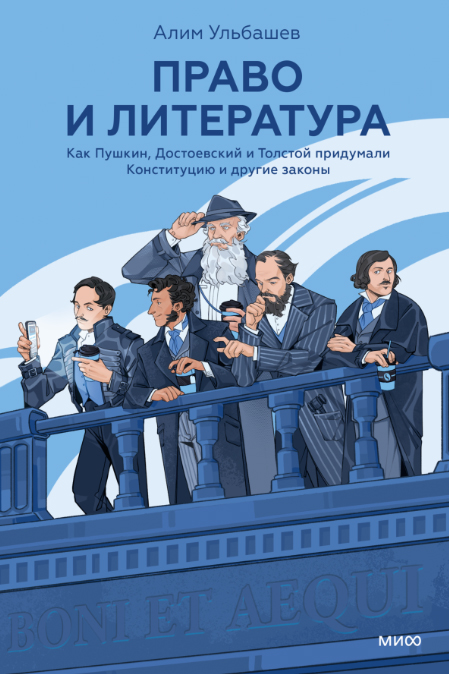
The book's cover features five key figures of Russian literature: Pushkin and Dostoevsky in the center, with Tolstoy towering over them like a giant of thought, Lermontov crouching on the left, and Gogol on the right. The writers gathered in the courtroom bear a very conditional resemblance to their traditional portraits, holding paper cups in their hands, possibly with pumpkin lattes (and Lermontov is generally looking at his smartphone), since the cover is made in the style of young adult, which is famous for the publishing house MYTH, which designs reprints of Russian classics in this way. In fact, the contingent of Russian and Soviet writers and poets addressed by Ulbashev is much broader (there are Zoshchenko, Bulgakov, Tsvetaeva, Gazdanov, and even Nosov), but the design of the book seems to betray the target audience of Law and Literature and its age range. This probably explains the somewhat simplified (in places) style of presentation, reminiscent of a textbook for secondary school age, although the task of getting the younger generation interested in native literature, at least in a legal context, is certainly worthy of all praise.
Ulbashev explains his original perspective in the preface, where he first complains about the apparent gap between jurisprudence and literature ("At first glance, everything literary is alien to jurisprudence: expressivity, imagery, metaphor, as if they have nothing to do with mathematically verified paragraphs, articles and paragraphs of laws, codes and regulations"), then very convincingly he argues that the real language of law is in fact extremely literary (such virtuosos of pre—revolutionary advocacy and judicial rhetoric as Fyodor Plevako, Anatoly Koni and others are mentioned as proof), and most importantly, "legal thought with its characteristic pragmatism and logic needs literature as a moral foundation, because it is precisely the artistic word that expresses the social ideals that the laws are designed to protect."

Using a variety of examples, Ulbashev traces the relationship between literature and jurisprudence, which mutually influence each other, although not always directly, but rather in a tortuous and complex way, and in fact perform a common socio—cultural function - to explain to a person what is good and what is bad. The title of the first part of the book, "The Past and Thoughts," is borrowed from Herzen, although he himself is not quoted in detail and is mentioned rather casually as "the main figure of Russian liberalism of the 19th century," and Pushkin is an example of ardent journalism with his poem "Slanderers of Russia," ambiguously perceived by his inner circle. And then the floor is given to Sergey Dovlatov, who explains why literature in Russia has always performed functions that the nature of things did not seem to provide for it, replacing a lot in the spiritual sphere — sometimes religion and philosophy. Russian Russian Orthodox church leaders and professional philosophers have not been able to do in Russia what Russian writers have been able to do — to form ideas about good and evil, what is necessary and forbidden, eternal and perishable, righteous and sinful..." Ulbashev sums up, noting that the development of Russian literature and legal science has largely synchronized since the 18th century..

The second part of the book is a "Literary glossary to the laws of the Russian state" (civil and criminal), which explains in detail the mechanism of Chichikov's scam with dead souls, and offers an alternative version of Raskolnikov's fate ("Civil law gives difficult, but always correct decisions. Knowledge of the law would allow Raskolnikov to reason with the old interest-bearing woman from Crime and Punishment, who profited from unhappy borrowers without overstepping the boundaries of what was permissible"), imaginary "crossovers" from different works are created ("The heroes of Yuri Olesha would be incredibly surprised if they happened to get acquainted with Gogol Chichikov"), and Some plot conflicts are also analyzed from a legal point of view: "An artist hired by a company to host a corporate event is, in a legal sense, not much different from Margarita at Satan's ball." Of course, Comrade Bender also appears here, whose weakness, as is well known, was to honor the Criminal Code, but in Ulbashev's interpretation, the great combinator also acts in full accordance with the Civil Code when he comes to the editorial office of the newspaper "Stank" to demand a refutation after the publication that defamed him "Fell under a horse."
The third part of the book, "The Constitution by Syllables," is quite original, where the author selects some articles of the basic law that are particularly important to him and provides them with a fairly wide range of thematically relevant cases from the literature. Eventually, the jurist even begins to animate the Constitution and sees it as a kind of literary character: "Speaking about the basic law of the country, we must be consistent and see not only the past of the Constitution, but also its current position. By today, the Constitution has its first wrinkles, its hair has turned sparsely gray, its health sometimes fails, and the youthful enthusiasm has faded from its eyes." As an illustration of the current state of the Constitution, Ulbashev highlights as particularly important the new article 79.1, added as part of the 2020 constitutional reform, on measures to maintain and strengthen international peace and security, ensure peaceful coexistence of states and peoples, and prevent interference in the internal affairs of the state.

Russian Russian literary commentary on this article is "The Word about Igor's Regiment" as an "example of patriotic poetics", built, however, not around victory, but around the defeat of Russian troops: "In the Word, failure in a particular military campaign is explained not by the strength of the enemy, but by disagreements among Russian princes who are unable to tame pride and cope. with conceit. By perpetuating Igor's campaign in the national memory, the author seems to be warning his contemporaries and descendants against similar strife in the future, in which he sees the main danger to the country." But victory over the enemy, as Ulbashev notes, often becomes an occasion for a Russian writer to "engage in humanistic reflection on the nature of war, on the need for peaceful coexistence, to doubt the correctness of state policy and to think about the price of victory, as Leo Tolstoy does in Hadji Murad.

From "Hadji Murad," the literary lawyer naturally moves on to "War and Peace," where Prince Andrew exposes the vile nature of Napoleon, who personifies "the abomination and baseness of the adventurous politics of that era." And the final literary association that Article 79.1 evokes in the author is Viktor Astafyev's novel "The Shepherd and the Shepherdess", where an old man and an old woman killed by the Nazis hold hands even after death and therefore come out victorious: "Their love survived even under bullets and shells, which means they defeated both death and the sworn enemy."". As the final link in this long associative chain, a conclusion is proposed that is not so much literary or legal, but moral, ethical and pedagogical.: "Perfection must be sought first of all in oneself, in one's own home, and only then to bring it to others. Making the world around you a better place, no matter how naive it may seem, can only be done by someone who is ready to transform himself, stay with pure thoughts and do good deeds."
Переведено сервисом «Яндекс Переводчик»
