"The Hedgehog in the Fog" is 50 years old. What you really need to know about the cartoon
- Новости
- Culture
- "The Hedgehog in the Fog" is 50 years old. What you really need to know about the cartoon


The animated film "Hedgehog in the Fog" celebrates 50 years since its release on October 23. This seemingly simple story has gained international recognition and has even been recognized as the best cartoon of all time. This is not just a masterpiece of Russian animation, but also a fairy tale-parable, which contains many meanings, and there are different versions of its interpretation. What the "Hedgehog in the Fog" tells about is in the Izvestia article.
Possible interpretations of the cartoon
• On the surface lies a story of friendship, curiosity, and trust. The hedgehog makes his way through the foggy forest to meet his friend the Bear Cub. He can walk the usual way, but when he sees the horse in the fog, he decides to go down there too. He knows the forest and it would seem that he risks nothing, but in the fog, where even "paws are not visible," everything becomes new and unexplored, and familiar objects seem to be fraught with danger.
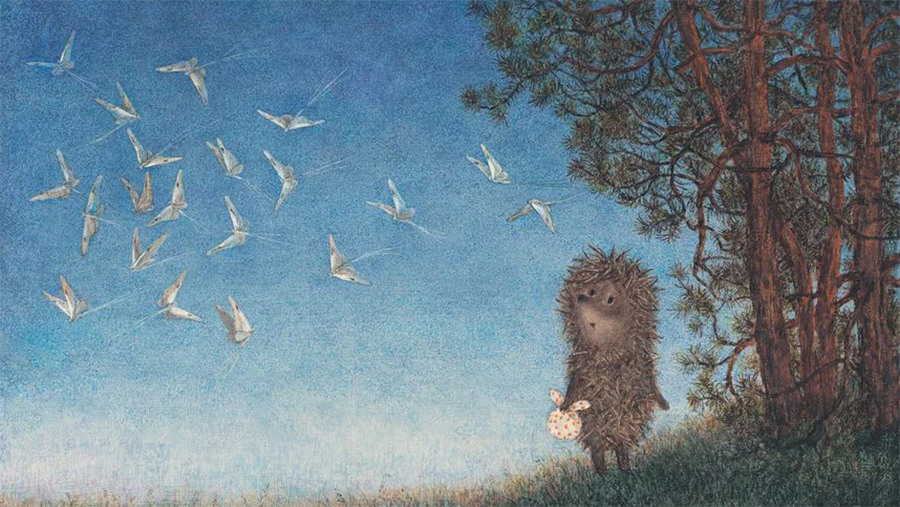
"The Hedgehog in the Fog" is the world's most famous domestic cartoon, which became the hallmark of Soviet and later Russian animation. His expressive techniques and deep philosophy are subjects of interest to Russian and foreign film and animation researchers. The cartoon won 35 national and international awards, and in 2003 was recognized as the best animated film of all time by 140 leading film critics.
• At the same time, in the universe of the cartoon author Yuri Norstein, the hero has no antagonists, and the Hedgehog is not in danger. The Owl following him treats the hero with interest, but does not try to attack, and when the Hedgehog encounters some difficulties, the characters themselves come to his aid. Gradually, the Hedgehog overcomes his fears and trusts fate with the words "let the river carry me by itself." As a result, he comes to his friend Little Bear, enriched with new knowledge about the world. But thanks to this going beyond the usual boundaries and exploring the unknown, the Hedgehog finds new friends. It's not for nothing that at the end of the tale he thinks not about the stars, which he came to count, but about the Horse.
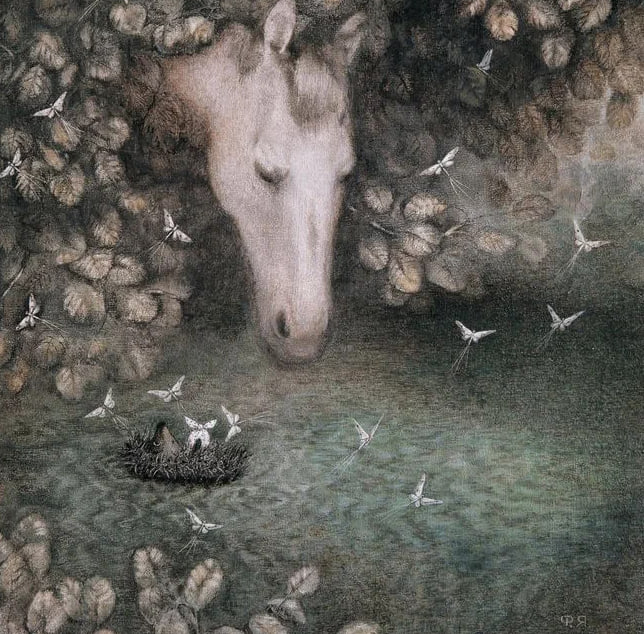
• The most frightening interpretation of the cartoon presents the path through the fog as a journey to the afterlife — in this version, the Bear Cub has died and is calling the Hedgehog to himself. Along the way, the main character meets various guides through the realm of the dead, helping him overcome obstacles and fears. After falling into the river of oblivion, the hero finally reconciled to death and can finally meet his friend. Even the bundle that the Hedgehog holds in his hands has a symbolic meaning in this version: it may contain the soul or love of the main character, which must be carried through the afterlife.
• Yuri Norstein himself did not support any of these versions. Talking about the cartoon, he recalled a phrase from Dante Alighieri's The Divine Comedy: "Halfway through my earthly life, I found myself in a gloomy forest." At the same time, Norstein considered what was happening in the cartoon to be an absolutely real life situation, alien to any mysticism. The hero has reached a certain point and got into a situation where there is a rethinking of the world around him and a "change in the philosophy of this little character," after which the world will no longer be the same for him.
Yu. Norstein
A cheerful, living creature was running around, and now it finds itself in a situation that is absolutely inadequate and comes out of this situation as a completely different person. This is actually what happens to us in life...
Artistic techniques
• The use of feature film techniques in animation takes the narrative beyond just a cartoon and hints at non-childish meanings. Yuri Norstein combines hand—drawn characters and frame-by-frame animation with elements of cinematography: the transition between the real and drawn world resembles a dream state - this technique destroys the "fourth wall" and helps the viewer immerse himself in the narrative.
• Hand—drawn characters were created using a multi-tiered layering method: images were placed in several layers at a distance from each other on special devices, thereby creating volume. The elements of the figures of each character were made of celluloid, and the fog was created using dusty glasses located on different levels — this principle was used in the ancient Chinese puppet theater. According to another version, tracing paper was used to create the fog. It most likely owes its origin to the fact that Norstein later used tracing paper to demonstrate the fog effect in lectures.
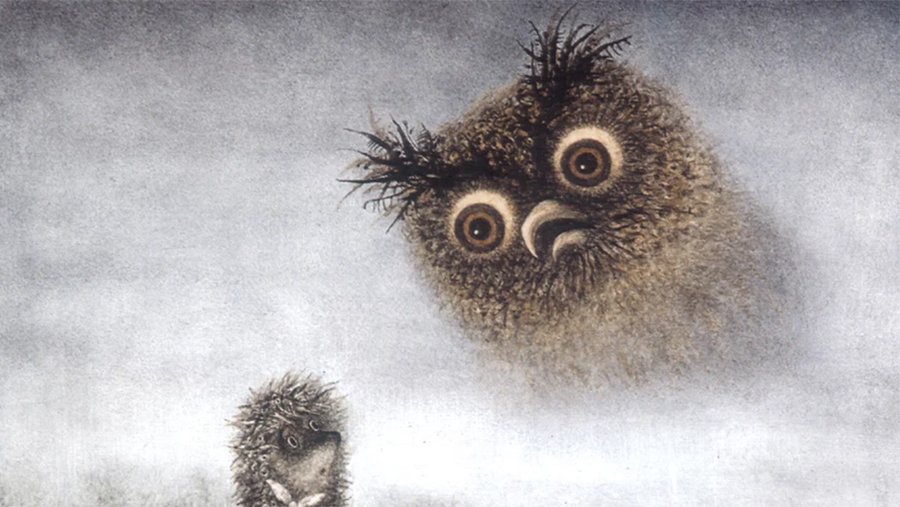
• The image of the Hedgehog, which is radically different from the traditional depiction of hedgehogs in animation, was created by Norstein's wife, animator Francesca Yarbusova. To achieve a "childish" image style, she painted the character with her left hand.
• The cartoon shows the influence of the East — the ascetic construction of frames with a large amount of unfilled space was made in the image of Japanese engravings.
• To depict water in the cartoon, cellophane and ordinary water were used, which was poured into a basin, and painted leaves were placed on top of it. According to Norstein, the Hedgehog was filmed "against the background of water by the river, and then graphically processed." Perfect accuracy was required when plotting frames, so the shooting was done with a stopwatch.
• The image of the falling leaf was obtained as a result of a combination of filming with an overlay drawing. Norstein has repeatedly said that cinematographer Alexander Zhukovsky played an important role in the creation of the cartoon: "He was more than a cinematographer, more than a cinematographer. He humanized the space."

• "Hedgehog in the Fog" was Norstein's first animated film, which was voiced by three actors at once. The bear speaks in the voice of actor Vyacheslav Nevinny, the Hedgehog was voiced by Maria Vinogradova, and the narrator was Alexei Batalov, who has an insinuating voice of the right timbre. Vyacheslav Nevinny himself, who voiced the Bear in the cartoon, said that credibility was very important to him. And to portray how his character was suffocating after searching for a Hedgehog, he, being an obese man, ran down and up the stairs of Soyuzmultfilm, after which he immediately went to the microphone.
How the cartoon was created
Yu. Norstein
I love films where there are no spectacular stories, where the idea itself is prosaic, but under the director's thought it takes on a global character. Then we get what is called a work of art.
When starting work on the cartoon, Yuri Norstein could not imagine what the ending would be: he said that the invented ending never coincides with what comes out of the work, and "the picture itself gives me direction." In Sergei Kozlovsky's fairy tale that inspired him, there was no Bear Cub, and the story ended with "someone invisible" in the river helping the Hedgehog reach the shore.
• For most animators, the main mystery was how the filmmakers managed to create the fog. At that time, the technique of tiered glasses used to work on the "Hedgehog in the Fog" was innovative. While giving a lecture in the USA in front of hundreds of animators, artists and computer graphics specialists, Norstein placed a Hedgehog figurine on a white background, and on top of it — a thin tracing paper, almost invisible in the image, but it is worth lifting it, and the figure is worse visible. The animator said that the projection was on the screen, and "as soon as the Hedgehog blurred in front of these people's eyes, they were shocked."
Переведено сервисом «Яндекс Переводчик»
