
Suffering blindly: how the drug mafia turns honest people into couriers

The sanctions policy of the West and the desire of our citizens to receive scarce goods from abroad stimulate the development of the illegal courier market. And travelers are increasingly becoming hostages of their valuable cargo because of the trip. This is actively used by smugglers and drug traffickers. A 60-year-old veterinarian from Voronezh found herself in a terrible situation, who out of the kindness of her heart took a bottle of rum from her best friend in her luggage after a vacation in Venezuela. A schoolmate turned out to be a participant in drug trafficking, and there was dissolved cocaine in a bottle of rum. This is not the first case of controversial criminal prosecution of so-called blind mules. However, the investigation has its own version of events. Izvestia investigated how they become unwitting participants in drug trafficking.
Rum and lightning
The Solntsevsky District Court is hearing a case on drug smuggling and trafficking. According to investigators, the accomplices organized the supply of cocaine dissolved in rum from Venezuela.
"Customs officers detained two [female drug couriers] in Vnukovo who organized the supply of prohibited substances from Latin America. A 1—liter bottle with a brown liquid with a peculiar odor was found in the luggage of the women who arrived from Caracas," TASS reported earlier. The examination revealed that the liquid contained more than 1 kg of cocaine. In February, the Solntsevsky district court detained 60-year-old Olga Stepanova, Antonina Zhuravleva and Andrei Plisko (the investigation considers him the organizer of the delivery). Later, the operatives tracked down the alleged customers, the Markins couple.

Olga Stepanova
As a result, there are five people on trial, four of whom confessed to cocaine trafficking and smuggling. The peculiarity of the trial is that only one of the defendants insists on her innocence, Olga Stepanova. She is Zhuravleva's best friend and long-time travel companion (they studied on the same parallel at school). It follows from the investigation materials (available to the editorial staff) that Antonina asked Stepanova to take her bottles of rum with her luggage (one of them contained a drug) allegedly because of baggage overload - she kindly agreed. But during a customs inspection, Zhuravleva cowardly disowned rum, exposing a classmate.
It turned out that the detectives initially developed a friend and accomplice of Zhuravleva, fitness trainer Plisko (he had already been caught in drug trafficking), at whose request she was supposed to deliver the forbidden cargo. But to avoid criminal liability, the woman slipped the bottle to her best friend. Zhuravleva, Plisko, and Markin confessed to drug trafficking and smuggling. Plisko and Zhuravleva also explained that Stepanova did not know about the drugs, and the Markins did not know about this figure at all, as they were not privy to the specific details of the supply. The veterinarian did not touch the fatal bottle, was not mentioned in correspondence as an accomplice, and had no problems with finances or the law.

It can happen to anyone
According to lawyer Elena Gerasimova, the investigation intended to stop the criminal prosecution of her client Stepanova after analyzing the testimony and conducting polygraph tests (the lie detector indicated the truthfulness of the veterinarian's testimony). But the decision was reconsidered.
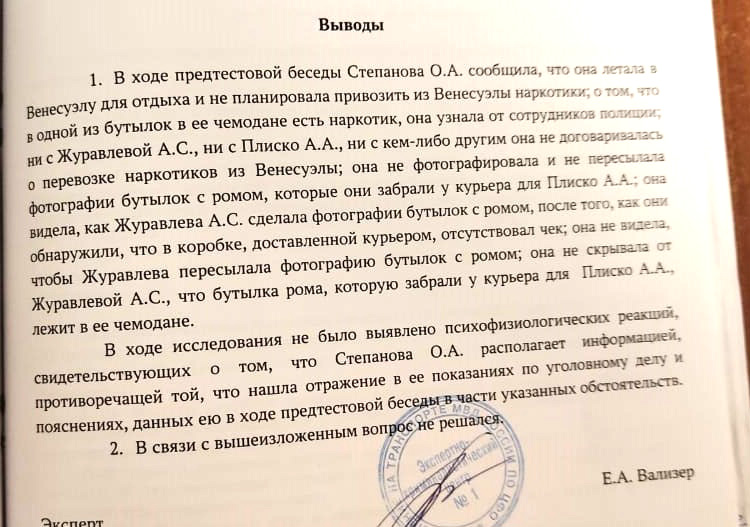
"The case of Olga Stepanova can be called a textbook case," said Elena Gerasimova, the defendant's lawyer. — She is a typical victim of criminals who organize drug trafficking, that is, a person used by intruders blindly. It is not for nothing that the Supreme Court of the Russian Federation specifically described this situation in paragraph 14 of the Plenum resolution No. 12 dated 04/27/2017 "On judicial practice in cases of smuggling" and explicitly stated that the actions of a person who did not realize that he had committed smuggling are not criminally punishable.
According to her, all the evidence gathered during the preliminary investigation and currently being examined by the court indicates Stepanova's innocence.
The defense is confident that justice will prevail in the end. According to Gerasimova, if the case had been tried by a jury, her client would certainly have been acquitted.
— But, unfortunately, the law does not allow her to choose this procedure. Olga herself, despite the enormity of the situation, does not lose heart, believes that the truth will win and she will be home soon.
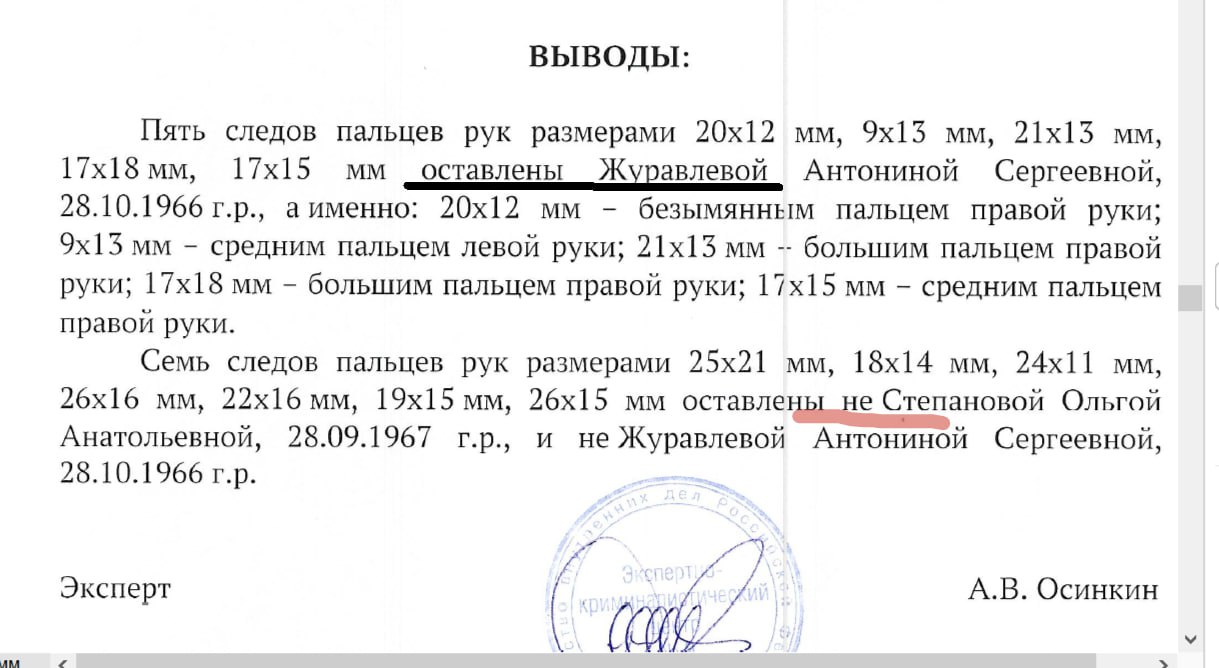
According to the defender, the investigation did not release Stepanova because of fear of sanctions from the management and supervisory authorities.
— The law has authorized the investigative authorities and prosecutors to make independent decisions on release, but in fact they avoid it in every possible way.
Stepanova has already spent almost two years in prison. If she is acquitted by the court, she retains the right to rehabilitation and appropriate compensation.
Her case is very similar to the story of other unwitting couriers of the drug mafia, flight attendants, who delivered several kilograms of hashish oil in shampoo bottles, which was previously reported by Izvestia. Most of the defendants in the investigation were acquitted after serving substantial time in pre-trial detention facilities.

The classic scheme
Muling is a method of transporting drugs with the help of people. Initially, this was the jargon for voluntary drug couriers who agreed to spend the drug inside their own body — for example, in the stomach, mouth, rectum or reproductive organs. This phenomenon is common both among smugglers and in the prison environment. Later, people who were tricked into participating in drug trafficking began to be designated in this way: passengers on various types of transport, truck drivers and car carriers (cross-border taxi drivers). "Blind mules" often take cargo without realizing that they are carrying drugs, and they often take contraband from casual lovers, friends, or strangers out of pity. Criminals do not worry about the cargo, as his mule is secretly accompanied by a fellow traveler from the mafia.
According to Sergey Pelikh, an expert in international organized crime and former head of the anti-drug unit of the Investigative Department of the Russian Interior Ministry, the investigator has the duty to prove not only the guilt of a person, but also his innocence.
—Couriers are being arrested or detained for a while, which the mafia uses for its own purposes blindly, not only in Russia, but all over the world," says the former investigator. — The fact is that almost every driver, in whose car the "secret" cargo and passengers with the "forbidden" were found, claims his innocence. Their guilt is proved in combination with other data. For example, if a person's phone has correspondence with drug dealers or unambiguous messages about the cargo, his guilt is clear. Or, for example, if the drug cache was made in the design of the car, it is hard to believe that the driver did not know about such an upgrade. The same can be said about hand luggage. Investigators are also analyzing other traces, such as hand washes and so on.

According to the expert, lie detectors are widely used in the police, but such studies do not provide an absolute guarantee.
— In my practice, we have attracted specialist scientists who could reasonably assume from the facial expressions and gestures of the interrogated whether he was lying or telling the truth, - says Pelikh. — These experts help the investigator to conduct the interrogation in the right direction, not to waste time on those who are not of interest. After the interrogation, the specialist provides the investigator with a conclusion.
In some countries, drug smuggling is punished even more harshly and justice is even more difficult to achieve. A real tragedy for Maria Dapirka from Rostov turned out to be an acquaintance with a Nigerian in Thailand, where the girl went to work as a guide for a year. The man courted beautifully, promised to marry, and intended to meet the girl's parents. In 2014, Maria was going to her homeland with her boyfriend, she had a connecting flight through Vietnamese Ho Chi Minh City. Before leaving, the Nigerian had a sudden change of plans, he promised to fly after and presented a large beautiful suitcase. During a transfer in the Vietnamese capital, a girl found a secret pocket with drugs in her luggage. Four years later, in 2018, she was sentenced to death. It was only through the efforts of her parents and Russian diplomats that Maria was pardoned. For her transfer to Russia, a court decision was necessary: the Rostov City Court sentenced the girl in absentia to 13 years and 4 months in a penal colony. Only after that, Dapirka was handed over to the Russian convoy. She is currently serving the rest of her sentence in her homeland.
Keep an eye on things
Both at airports and at train stations, a warning is repeatedly sounded over the speakerphone not to take things from strangers or unfamiliar people — this is done for anti-terrorist security and for the prevention of drug crimes, lawyer Ekaterina Krasnova explained to Izvestia.
— It is no coincidence that transport companies carry out significant preventive work with staff (conductors, flight attendants) — they forbid taking anything for transportation on pain of dismissal, - says Krasnova. — Previously, this phenomenon of "transmitting with a guide" was widespread, but today it has come to naught. It is because of the risks of becoming a drug courier. Proving innocence will cost gray hairs. And in some cases, without qualified legal assistance, the situation for a person can turn into a long prison term.

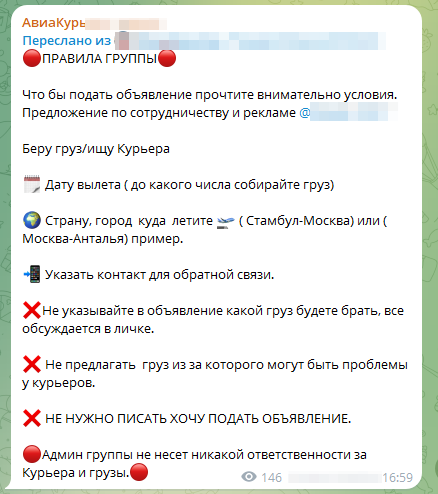
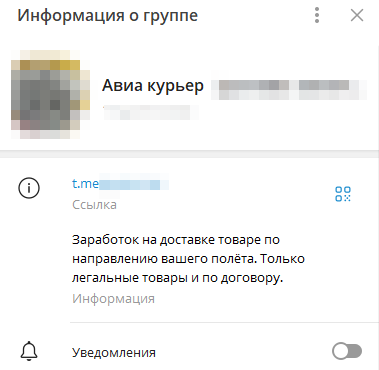
Meanwhile, the air courier service has received a new boost on social media — Izvestia analyzed several channels and even spoke on condition of anonymity with a person who transports things from Turkey to Russia for a commission.
"I often travel around and earn extra money along the way," the source told Izvestia. — I know that they can slip all sorts of rubbish. I even have a special portable UV flashlight. I mostly take documents in my hand luggage — people often need to transfer some papers or contracts to Russia. You can earn from 5 thousand and more per lot. In some cases, I transfer branded cosmetics, but I try to buy them myself abroad, rarely — appliances, and before that — toilet water too. But after all these stories, I'm afraid to take liquids, I don't even trust my friends.
Recall that in 2021, the Ninth Court of Cassation of General Jurisdiction ordered citizens to declare the luggage they had brought across the border at the request of friends.
Переведено сервисом «Яндекс Переводчик»
