
The free queen of masterpieces: why Irina Antonova was compared to the English Queen

Danilkin's new biopic about Irina Antonova, the legendary director of the Pushkin State Museum of Fine Arts, is called Madama's Palazzo. This pun immediately draws the reader into a certain semantic field, who has not yet opened the book, but only admires the golden curlicues on the cover, stylized as a rich portrait frame. Critic Lidia Maslova presents the book of the week, especially for Izvestia.
Lev Danilkin
"Madama's Palazzo: Irina Antonova's Imaginary Museum"
Moscow: Alpina non-fiction, 2025. 584 p.
All of Lev Danilkin's biographical books have titles with a subtle hint, with a double bottom — they half-jokingly encode the quintessence, the essence of the character being portrayed, as well as the key to the author's methodology of dissecting a particular fate, character, and the role of personality in history. For example, V.I. Lenin, under the gun of the original Danilkin optics, turned into a "Pantocrator of solar dust particles," Alexander Prokhanov into a "Man with an Egg," and Yuri Gagarin into a "Passenger with children."
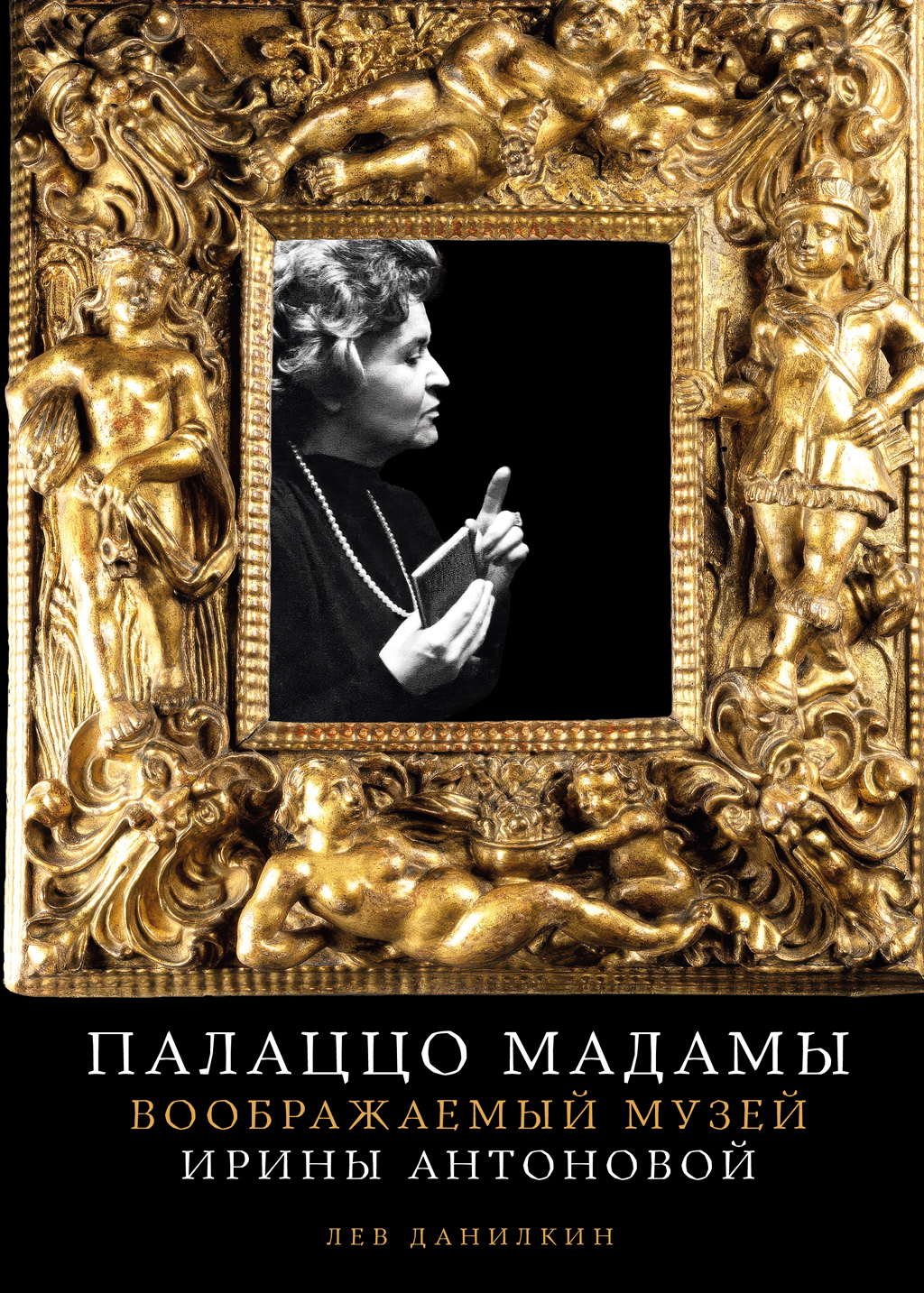
Firstly, the Danilkin name hints at the famous Turin architectural monument "Palazzo Madama", which is appropriate in the context of such an important part of Antonov's personality as his love for Italy: "IA's life was permeated, determined and overshadowed by Italy, far from only in a spiritually elusive way: the Italian Renaissance was her scientific specialty, her husband he was the author of a monograph on Italy in the 16th century; she, like several generations of Pushkin art historians, was a student of the great Italian B. R. Whipper. <...> Antonov's Pushkin was a kind of analogue of "Dead Souls", "The Last Day of Pompeii" and "The Appearance of Christ to the People" — a purely national phenomenon, the "main symbol" of the country, created, however, in Italy.

Secondly, "Madame" is one of Antonova's internal nicknames, which was used by employees who were in awe of her. And besides, "madama" acquires an additional jokingly colloquial overtone to the Russian ear, reducing pathos and causing frivolous associations, for example, with the cartoon "The Magic Ring" ("noble Madama in a fashionable toilet").

Irina Antonova, President of the Pushkin State Museum of Fine Arts, during the opening of the exhibition "Eternal Themes of Art" at the Pushkin State Museum of Fine Arts, dedicated to the 35th Svyatoslav Richter December Evenings Festival
In search of the most effective metaphors, Danilkin instantly switches genres of his narration, like Schumacher's shows, moving from a cartoon to a "heist thriller" (the story of Pushkin's "Gioconda") or to a production drama (personnel arrangements and ideological considerations that accompanied the appointment of a 38—year-old woman to the post, which was not quite usual for 1961). the post of director of the museum). This approach makes the Palazzo a fascinating read even for a person who is far from fine art and who last visited the museum in his deepest childhood, for example, to inspect the Borodino Panorama. It, which was kept in the Pushkin Museum until 1962, is also mentioned in the book, as a ballast that prevented (along with plaster casts left over from the founder of the museum, Ivan Tsvetaev) the Antonov battle for the transformation of Pushkin into the most prestigious exhibition site.
Through all the genre discord in "Madama's Palazzo" runs the semantic and stylistic core of the invariably regal image of the heroine, who almost surpassed the English Queen in aristocratic manners and the ability to present herself: "The common place was to compare her — "Soviet to the core" — with the "English Queen", and not ironically, namely that seriously: upon closer inspection, it gave the impression not so much of a successful copy as of the original." And Danilkin successfully inserts a quote from Pushkin's "The Tale of the Fisherman and the Fish" ("I don't want to be a pillar noblewoman, but I want to be a free queen"), arguing with Antonova's colleagues, who saw behind her desire to turn her "just a good" museum into a "supermuseum" an exceptionally exorbitant personal vanity.

Director of the State Museum of Fine Arts.Pushkin Irina Antonova at the opening ceremony of the exhibition "Famous and Unknown Karl Bryullov" at the Pushkin State Museum of Fine Arts in Moscow
The second part of the book's title, "Irina Antonova's Imaginary Museum," refers to an essay by Andre Malraux, whose concept of overlap between different works appealed to Antonova, the curator, who defined her favorite genre of exhibitions as "dialogues in the cultural space." Danilkin develops this idea using an elegant compositional technique: each of the 38 chapters of the book opens with an ekphrasis — a description of one of the works of art, in the history of which the address "Volkhonka 12" is found. The plot of a painting or sculpture is ingeniously and metaphorically linked to the vicissitudes of Antonov's biography. You get involved in this game very quickly, and when you see David (the giant one guarding Pushkin's Italian Courtyard) at the beginning of chapter IX, you try to guess in advance: what does David have in common with Irina Alexandrovna? The general is not long in coming: "Ready for a violent transformation of reality, David exerts pressure, pressure, suppresses the will of others by his very appearance; heroic, integral character, he is alone — but not separated from the world, a potential leader of the collective is seen in him...> Like David, IA served as the "sheriff", the "axis" of her museum — and no matter how amazing, precious and intricate objects, animate and inanimate, were exhibited in it, they were all somehow overshadowed by the shadow hanging over them."

The final pictorial reference to Antonova's image is nothing less than the Sistine Madonna, which is why the title of the book has an additional, almost religious connotation: "Ma Dame" is in a sense the Madonna: "... watching EEYORE surrounded by other people, we cannot get rid of the impression that she levitates a bit, like the main character in the Sistine Madonna, where everyone else falls a little bit under their own weight into clouds of stage smoke, and she walks right on a cloud..."

After such a passage, there is no doubt that the inner intention of "Madama's Palazzo" is a declaration of love, although this exquisite madrigal often comes close to the risky borderline with an epigram, simply because of the author's ironic nature. Feeling the provocativeness of many of the points of view expressed in the book (both his own and numerous interlocutors), Danilkin at the beginning tries to concoct a kind of "alibi" for himself in the eyes of those who do not imagine Antonova's biography other than in the genre of a reverent ceremonial portrait. To do this, the biographer pretends to be a "simplicissimus", as far removed from the art criticism environment as possible, "who graduated from the WRONG faculty yesterday, today he will not distinguish an etching with an aquatint from a dry needle, tomorrow he will confuse Tintoretto with Canaletto, and the day after tomorrow, inevitably, Venice with Vinnitsa." But it is this third-party view, according to Danilkin, that can turn out to be more objective, similarly, the extravagances written with cheeky and humorous notes, as if on behalf of a poorly educated "simpleton from the cold," only increase the interest of an unbiased reader in the described masterpieces.
And anyway, "flashes of good-natured humor" (which sometimes broke out, according to Danilkin, even from the formidable Antonova) do not interfere with sincere admiration, as evidenced, for example, by Danilkin's inspired fantasies about which sculpture his heroine will inevitably be immortalized: "There is not the slightest doubt that sooner or later at the State Museum of Fine Arts a monument to IA will also appear — the only question is what form the artistic embodiment of the "legendary director" will take: a giant white marble figure in a toga, with a scroll and a lyre, in the manner of Clio and Erato; an equestrian composition like Gattamelata or Colleoni, with IA as a second rider, a hint of her famous motorcycle ride with Jeremy Irons; the formidable Minerva, stretching her hand into the future — to where Pushkin has already absorbed all the other museums in the world and shines with eternal greatness..."

Irina Antonova, President of the Pushkin State Museum of Fine Arts, at the opening of the exhibition "Georgian Avant-Garde: 1900-1930s" at the Pushkin State Museum of Fine Arts in Moscow
In the meantime, while waiting for the upcoming monument, Lev Danilkin, purging his personal, romanticized and mythologized Irina Antonova from the official narrative that has developed around her (and formed by her), speaks in much the same spirit as Count Cagliostro from the film Formula of Love: he breathes life into a marble statue, although he risks appearing to someone as a charlatan warlock.
Переведено сервисом «Яндекс Переводчик»
