The challenge has been attempted: which of the Russian operators is recognized as the most technologically advanced
- Статьи
- Economy
- The challenge has been attempted: which of the Russian operators is recognized as the most technologically advanced


In recent years, the competitive advantage of telecommunications companies has been not only and not so much tariffs and even the quality of services. Their clients and investors pay attention to their technology: what package of services they provide now and will be able to provide in the future, whether they will be able to maintain their quality and expand the range. J'son&Partners Consulting answered the question about which companies are the most advanced in this regard and how their clients assess their willingness to innovate and technological breakthroughs. The conclusions reached by her analysts are described in the Izvestia article.
Why evaluate the technology of mobile operators
The debate about which mobile operator is more technologically advanced and which is less, that is, whose services are most relevant and which are not, has been going on, perhaps, since the very beginning of the history of Russian mobile communications. "And I have SMS messages, but you are not!" — this is how schoolchildren who bought their first phone in a "box" from cellular dealers formulated the advantages of their operators in the early 2000s. Now, of course, all mobile operators send SMS messages. But the question of which of them is more advanced in terms of the technology offered to customers and what the advantages are is still relevant after more than 20 years. The assessment in this area was conducted by analysts at J'son&Partners Consulting (J&P), one of Russia's oldest consulting companies specializing in telecom analytics. Izvestia got acquainted with the results of her research.
"In recent years, telecom operators have been paying more and more attention to technological development, and the very understanding of technological development has been transformed and expanded. If earlier it was understood primarily as infrastructure development, then criteria characterizing research activity and the breadth of the product portfolio for the B2C and B2B/B2G segments began to be considered along with them, and now important criteria for technological development are, for example, involvement in training personnel for the technology sector, participation in major digitalization projects. cities, transport, social institutions," they say. As follows from the document, the experts analyzed more than 70 parameters included in six groups: infrastructure base, research activity, innovations in basic B2C communication services, participation in technology training, the breadth of the product portfolio in B2C and B2B/B2G, as well as user perception.
When assessing manufacturability, six groups of criteria are taken into account, for each of the groups of indicators, its weight is equivalent to the share of the number of questions in the total number, according to the materials of J'son& Partners. "In each of the 70 criteria, the operator could receive from 0 to 3 points, that is, the maximum number of points for each group of criteria is equivalent to the product of the number of criteria by 3. For all groups of criteria, the score was converted into a percentage, thus, the maximum score of the telecom operator for each group of criteria is 100%," — it is indicated in them.
Which of the operators has more groundwork for the future
From the comparative analysis of J&P, it follows that MTS is the leader (79% out of 100 possible). Megafon is in second place (64%), Beeline is in third (59%). In addition to these companies, T2 and Rostelecom are also present in the rating. The factor that determined MTS' position was, first of all, the level of research activity, estimated by the number of patents, registered industrial designs and computer programs, as well as other indicators related to RID (intellectual property results). The result was also influenced by the number of innovations in basic communication services for the public and individuals (including, for example, the ability to redirect a call to a chat, the functionality of detecting generated voice and the ability to make calls via smart devices).
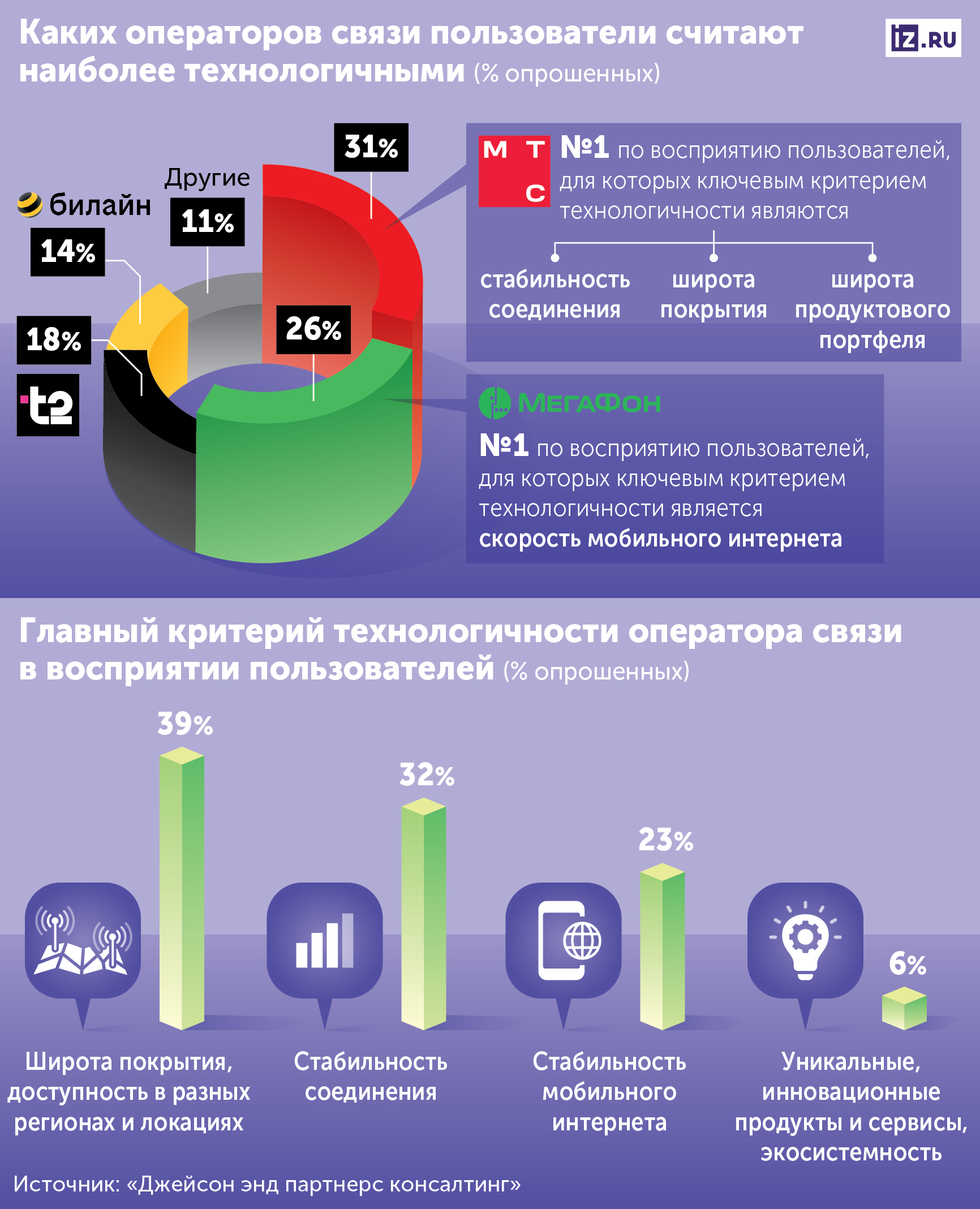
As part of the study, J&P conducted a survey of 1,500 subscribers, during which it was revealed that, on average, the most important criterion for subscribers is the breadth of coverage, availability of communications in different regions and locations. The perception of technology varies slightly by region: for example, in the Far Eastern Federal District, the most important criterion is connection stability, while in the North Caucasus Federal District, mobile Internet speed. In a survey conducted by analysts, MTS was named the most technologically advanced company of the "big five" by the majority of respondents (31%). It is followed by Megafon (26%), followed by T2 and Beeline (18% and 14%). "MTS is the leader in terms of technology, according to a user survey, with Megafon in second place and T2 in third. The main factors of MTS' leadership are groups of criteria in which the gap between MTS and other operators is the most significant: innovations in basic communications services for individuals and the level of research activity, analysts comment on their findings.

As part of the study, interviews were conducted with representatives of telecom operators, during which the operators indicated that one of their main priorities in terms of technological development is to prepare for the introduction of 5G. As for MTS, in 2025, it implemented a pilot architecture for 5G/6G, in which the base stations are located centrally in the PBX node. This approach accelerates the construction and modernization of the network, increases the efficiency and reliability of its operation, and reduces the fleet of equipment: according to the operator's estimates, it is achievable to reduce the need for base station control units by 70%.
Another aspect that makes the operator technologically attractive to customers is the concern for information security. According to J'son&Partners, one of the unique ones for the Russian market is MTS' premium Membrana telecom product, which implements several functions in the field of privacy and subscriber protection at once. For example, monitoring of personal data leaks, customizable blocking of ads and pop-ups in browsers, and the ability to create additional numbers and temporary mail. The Membrana has a version for children, the Membrana Kids, with additional features that are important for protecting children in the digital space. These include filtering incoming calls, secure Internet access, and the ability to manage a child's profile in the parent's app.
Cellular satellite communications via low—Earth orbit spacecraft (LEO) is an important foundation for the future, which all major mobile operators in Russia and around the world are striving to make. In the Russian Federation, such a project, in particular, is being implemented by Bureau 1440. In 2025, Megafon became the first operator in our country to agree to connect base stations in remote and hard-to-reach areas via LEO channels. In turn, MTS has launched a project to place 5G base stations on board low—orbit satellites. It is planned to launch it into commerce by 2030. Satellite communications can be more effective in rural areas where the construction of optical infrastructure is economically unjustified. "In addition, satellite communications in remote regions may be important, for example, for the digitalization of industrial organizations implementing UAVs, solutions based on the industrial Internet of Things and other technologies that require connectivity and stable, high—quality signal," J&P notes in its research.
An important component of the technological development of operators now is the ecosystem and the availability of developments in the field of equipment, because the main global vendors have left the Russian market, says Denis Kuskov, CEO of TelecomDaily. In terms of creating an ecosystem that, in addition to communications, includes financial services, media, and much more, including even scooter rentals, MTS stands apart from other Russian communications companies, the expert believes. This is extremely important because traditional telecom services are no longer a powerful driver of business development, while new service areas often grow in revenue faster and more actively than the communications market, he points out.
In addition, Irteya, a manufacturer of infrastructure equipment, is affiliated with MTS, Denis Kuskov continues. The availability of "sovereign" equipment is extremely important for operators — in the future it should become the basis for the development of 5G and other new, possibly even non-telecommunication technologies, he believes.
— The strength of MTS is that they play for a long time, at least in most cases. The company has been working in various directions for many years, testing the maximum possible hypotheses. And she has accumulated competencies that allow her to quickly develop new services and technologies on the scale of a huge business," says Sergey Vilyanov, analyst at Fintech Lab. — A technological breakthrough in the vast majority of cases becomes a derivative of accumulated experience. And MTS, in my opinion, acts more consistently than many of its business colleagues.
Who takes care of personnel training in Russian telecom and how
The shortage of personnel in the Russian IT and telecom industries has long been no secret to anyone. There are not enough qualified specialists not only because of the departure of some of them abroad. There are more and more "smart" machines and systems in industrial enterprises, and more and more "smart" electronics in the homes of Russians, which someone must develop, implement and maintain, including connecting to communication channels. It is not always promising to rely on the competencies of graduates of traditional educational institutions.
— After graduation, they can only write essays, they have to finish their studies, — the head of the training center of one of the IT companies commented on the situation to the author of this material. Therefore, telecom operators pay more attention to interaction with educational organizations — colleges and universities, according to J&P. As operators strengthen their R&D and become software developers, integrators, and participants in federal technology projects, they need specialists with applied telecom competencies, for example, in the field of communications technology, cybersecurity, and the Internet of Things. Previously, such projects were targeted, but their number will increase in 2024-2025, the study says.

For example, in 2024, Beeline opened the Beeline Laboratory on the basis of the Moscow Instrument Engineering College of Plekhanov Russian University of Economics, which will be used as part of the training in Network and System Administration. In 2025, the operator launched a product management training program based on the Master's degree program at the Central University.
Rostelecom, together with Cifra Invest Management Company and Avito, is implementing a project to implement the Digital Campus platform and develop a network of digital laboratories for university and college students. The platform is expected to reach more than 500 universities and 3 million students in the next three years.
MTS is not lagging behind its competitors in terms of educational initiatives, according to the J'son&Partners report. In 2024, she launched the Master's degree program "Research and Entrepreneurship in Artificial Intelligence" with the HSE Faculty of Computer Science. The faculty also has a basic MTS department.
Staff training is one of the top priorities for IT and telecom companies, Denis Kuskov believes. In the context of the total digital transformation of business, society and the state, their deficit will only increase in the long term, he is sure. Therefore, by laying the personnel base now, operators are creating an important foundation for their technological development in the future, the expert points out.
Переведено сервисом «Яндекс Переводчик»
