
Cinema is the most ancient of the arts for us: a universal creative package

Director Rashid Nugmanov, known to a wide audience primarily for the cult film "The Needle", summarizes his practical and teaching experience in a fundamental manual for everyone who studies drama. As even a layman knows, there is a lot of literature of this genre and orientation, the demand for it does not dry up, although the real practical effect of reading is difficult to prove, and the pleasure and educational benefits vary depending on the wit, erudition and literary talent of the authors. Critic Lidia Maslova presents the book of the week — especially for Izvestia.
Rashid Nugmanov
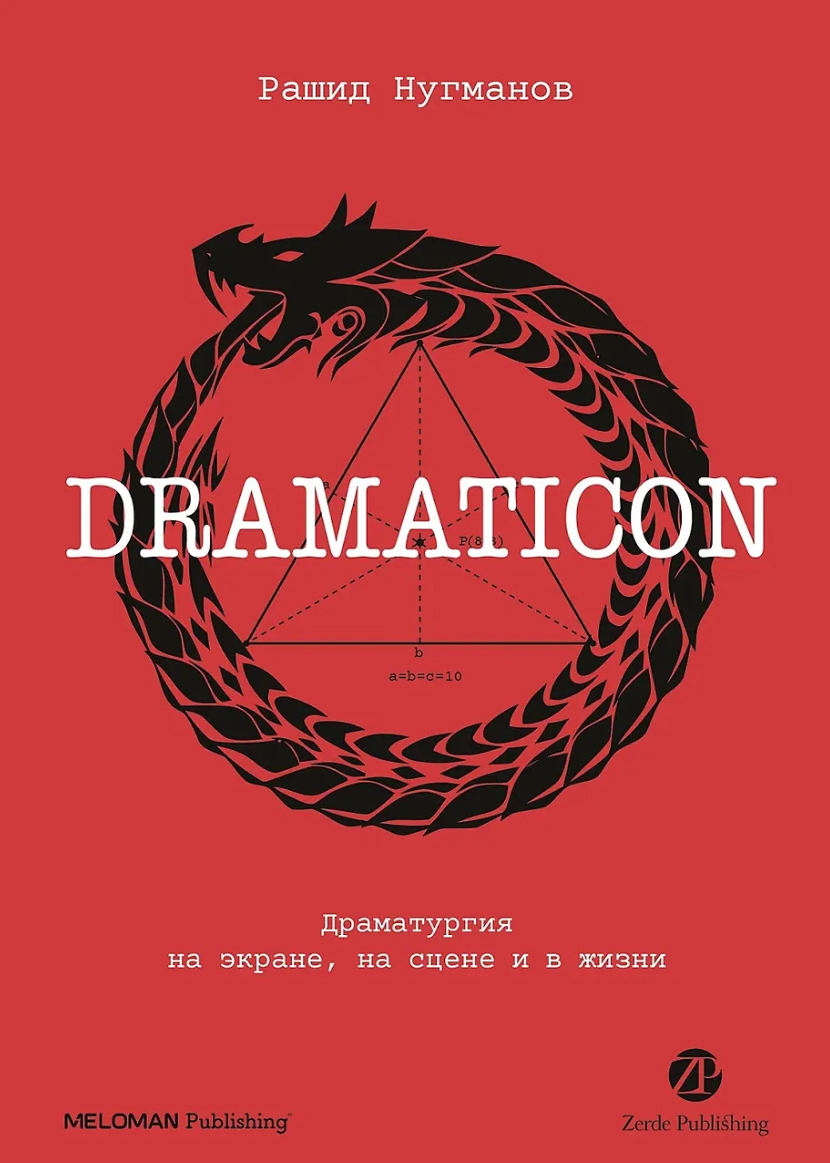
«Dramaticon: Drama on screen, on stage and in life"
Astana : Zerde Publishing, 2025. — 880 p.
The Dramaticon method proposed by Nugmanov summarizes and systematizes everything that needs to be understood about drama, "is a synthesis of systems and integrates any constructions based on the fundamental concepts of dramatic science," and also "integrates the above-mentioned dramatic systems into a new method that is applicable both in cinema and theater, as well as in life, whether it's a business or a personal relationship." Thus, without false modesty, taking a meta-position over everything previously written on the topic, the author of the book dances all the way from Aristotle himself with his "Poetics", calling cinema the oldest of the arts: "Yes, the means for embodying moving and sounding images in a fixed form appeared only in the 19th century, but the ability to see and hear dreams was It is inherent in man even before the emergence of painting and writing — before he learned how to cover cave walls with drawings and engrave phonetic signs on stone. It is for this reason that cinema has rapidly burst into the world and will always dominate the minds of mankind."
But in order to competently and expertly capture human minds and souls, it is necessary to learn the basic laws of drama, which have not fundamentally changed since Aristotelian times. Moreover, according to Nugmanov, without knowledge of these laws, it is impossible not only to write a conditioned script, but also to cope with problems in everyday life: "Any person is a screenwriter when planning his own life, and he is the main character in his own life scenario. Knowing the laws of drama will allow him to more consciously control his own destiny, his own world, even if he has nothing to do with cinema and theater."

Moving from Aristotle and Shakespeare to the present day, Nugmanov briefly reviews all the most authoritative manuals of screenwriting gurus, primarily Hollywood ones. The American classic of mythology, Joseph Campbell, with his "Thousand-Faced Hero" and the concept of Monomyph, passes through the book as an indisputable authority, and the famous textbook of Campbell's follower Christopher Vogler, "The Writer's Journey. Mythological structures in literature and cinema", which is placed in bedside tables in Hollywood hotels instead of the Bible. There is a subtle veiled irony in some of Nugmanov's references to colleagues: "In the book The Primer of a Screenwriter. How to write an interesting movie and TV series" Alexander Molchanov quotes a witty remark by an elderly cinematographer about the main secret of cinema: "Every second the viewer should be wondering what will happen next." The author does not mention the name of the sage, but he is absolutely right." It is clear that this "main secret" of the wise aksakal looks in many ways like the secret of a Polichinelle: none of the cinematographers, with the exception of some art-house perverts, do not want the audience to be bored, nevertheless, few people know how to make the audience burn with curiosity every second.

It is not without mockery mentioned in the book the manual of the American screenwriter Blake Snyder with the catchy title "Save the cat! Everything you need to know about the script." This "cat" (not necessarily literal, but often figurative), whom Snyder advises to save in the first minutes of the film in order to win over the viewer, repeatedly helps Nugmanov visually convey his thoughts, starting from the opposite, for example, in arguments about what a dramaturgically effective, "proactive" hero should be.: "By nature, the vast majority of people are insincere to one degree or another. Saints, saints, hypocrites and petty pretenders do not attract us. Either outright hypocrites or misguided idealists can be attractive. The former make wonderful villains. Secondly— they are outstanding heroes. The maximum that mediocrity between them can do is to save the cat."
Dramatikon can be considered not only as an applied manual, but also as a psychological training that deprives the future screenwriter of illusions and prepares him for a protracted stubborn struggle for a place in the film business, built on tightly regulated documentation, and frankly, on bureaucracy. The vulgar phrase "freedom of creativity" finally turns into a phantom as you read the Dramatikon: you turned on the wrong capslock, put an extra dot or chose the wrong font (Courier New instead of Courier Prime, specially designed for screenwriters, "immediately gives out an undemanding author") — and they immediately recognize you as an amateur sucker. and your "creativity" will be thrown in the trash without looking.

But you can avoid this if you carefully study the very useful first part of "From idea to the point of no return", especially its first chapter "Form", which gives scrupulous, with illustrative examples, instructions on how the script should be designed so that the reader (that is, the editor of the film company) at least I deigned to open it: "A properly formatted script will not make it brilliant, but it guarantees that the reader will at least start reading it, and not immediately send it to the trash. You will speak the same language and use common professional codes." Helping to comprehend these codes, Dramatikon offers a novice screenwriter a far from useless "full vocabulary of fashionable words", which allows at least at the language level to feel at home in the magical world of the film business and confidently juggle the terms "synopsis", "treatment", "scriptment", "tagline", "logline", "attractor", "breakdown", etc.

However, mastering professional jargon is not enough — it is necessary to be understandable not only to colleagues, but also to the general public, which is somewhat more difficult: "Your task is to convey your story to the maximum number of viewers, and they live according to the laws of our world, and you are forced to project the unknown into understandable images. This is what producers and investors expect from you, because cinema is a collective and at the same time a mass art that cannot be done alone, and this means that you have to deal with the harsh realities of the film industry." Reading these instructions, sometimes you want to sigh, like the young hero of the film "Courier", who listened to the instructions of a wise professor about what laws you will have to live by in society.: "What a gloomy picture you've painted..." But for desperate and ambitious young people who have no chance of marrying a producer's daughter and who are ready to pound on the fortress gates of the film business to bloody calluses, Nugmanov's textbook offers many interesting exercises that develop cinematic thinking and at least enrich erudition. Dramatikon not only guides the reader through all the stages (and I would like to write "circles of hell") of creating a screenplay (for example, through a detailed parallel analysis of such different film productions as "The Matrix" and "Chinatown"), but also initiates into various subtleties of filmmaking, both psychological and legal.

Nugmanov's well-structured, very logically constructed book is, in principle, capable of streamlining the thinking of a diligent reader, setting his brain straight, warning him against the most banal mistakes, and leading someone to original ideas. It's just a pity that a tragic gap inevitably arises between theory and practice, between clear thinking and chaotic reality: for ultimate success or at least cautious optimism about his career in the film business, an aspiring playwright needs to be sure that, alas, no one can guarantee that investors, producers and readers serving them The brains are in the same perfect order as those of the Dramatikon author and his thoughtful readers.
Переведено сервисом «Яндекс Переводчик»
