- Статьи
- Culture
- Heavenly grandmother said it in two: mythological and cultural heroes of the Buryats and Evenks

Heavenly grandmother said it in two: mythological and cultural heroes of the Buryats and Evenks

Exploring the myths of the peoples living around Lake Baikal, Alexander Isakov, an expert on Buryat folklore, immediately warns that there are not many of these peoples, more precisely, only three: the Buryats are the most numerous, the Evenks and the Russians are much rarer. Buryat myths naturally become the focus of the scientist's attention, including because the mythology of the Evenks has been studied and systematized much worse. Critic Lidia Maslova presents the book of the week, especially for Izvestia.
Alexander Isakov
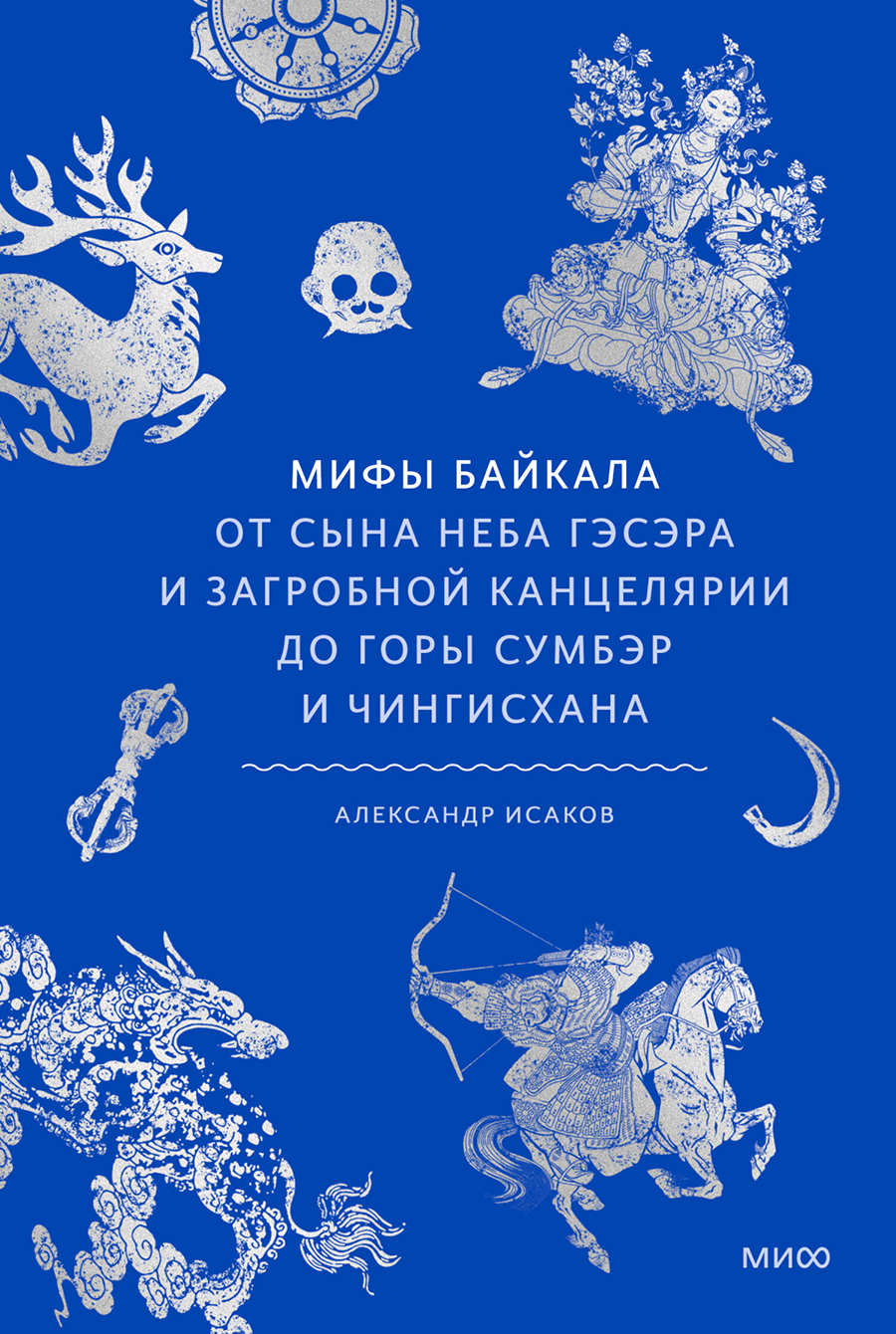
"Myths of Lake Baikal. From the son of heaven Gesar and the afterlife office to Mount Sumber and Genghis Khan"
Moscow : MIF, 2025, 208 p.
The Buryats in the book are classified not only geographically, but also on an important religious basis: the self-awareness of the Western (pre-Baikal) Buryats developed in line with shamanism, while the eastern (trans-Baikal) Buryats belong "to that part of the Mongolian world that entered the sphere of Buddhist influence." As for non—indigenous Russians, they act primarily as carriers and distributors of Christian mythology in the book: its images and plots, according to Isakov, influenced more the shamanists of the pre-Baikal Buryats and Evenks than the eastern Buryat Buddhists. This is explained by the fact that "Buddhism was officially recognized by the Russian rulers as one of the world's religions," so the Russians left the Buddhists to themselves, and began working with shamanists in terms of spiritual development, converting them to Christianity, although "even baptized Buryats and Evenks usually did not forget their traditions, so elements of Christian mythology in their the culture began to coexist with shamanic myths."

Thus, Baikal folklore is a layered pie in which "several worldviews overlap: the original mythology of the indigenous inhabitants of the Baikal region and the teachings of the world religions — Buddhism and Christianity, which later came to these lands." The first chapter, devoted to cosmogonic myths, tells us that the Buryats and Evenks, even before the arrival of Buddhism and Christianity, divided the world into three levels — upper, middle and lower. This concept is quite close to Buddhist cosmology, although the latter is more complicated — there are as many as six such tiers. The vertical division of the world order, where people live in the middle, with the best worlds on top and the worst below, undoubtedly makes shamanists related to Buddhists.: "Due to this similarity, Buddhist mythology among the Buryats was able to find common ground with shamanic mythology: Buddhist deities began to be perceived as neighbors of deities from the Upper World, and Buddhist hell as part of an alien and frightening Lower World."

In much the same way, the Christian worldview was able to take root on Baikal soil: "The Orthodox image of Heaven as the abode of God and the saints was correlated with the Upper World, and the idea of hell was understood through the already familiar myths about the Lower World." Isakov also sees traces of the influence of Christian ideas about God in the tradition of the Barguzin Evenks, explaining the origin of shamanism (the fifth chapter of the book is devoted to this colorful phenomenon): "... God was supposed to give the Evenks his faith, but he was busy, so the Evenks themselves began to shamanize, and God decided to leave everything as it is." Isakov quotes this touching story about the temporary abandonment of the Evenks from Peter Malykh's book "A few words about the Orochs and their Folklore" in 1924: "... I waited, I waited for the Orochs, but there was no God; then the orochs began to shamanize, began to make fish out of wood; he looks — God is coming; "What are you doing?" he asks; orochen says, "My man is sick, I want to practice shamanism." Then God says, "Well, do as you like," and he left; so orochen began to practice shamanism."
Of course, an important part of cosmogonic mythology is connected with the appearance of Lake Baikal proper, which the Buryats and Evenks call the sea "because of its shape and size, significantly exceeding the size of other lakes in the region." Most legends tend to believe that Lake Baikal is a huge crack in the earth caused by an earthquake sent to people as punishment for their sins: "Sometimes they try to solve the mystery of the origin of Lake Baikal through its name, which in Buryat sounds like Baikal. This word is consonant with the expression "Bye gal", which can be translated as "Stop, fire!". According to legend, a terrible fire was burning at the site of the sunken earth, and then people prayed that the fire would stop, and in response to their request, water poured from the sky, which filled the hole in the ground and formed a lake."

In the second chapter, "Myths of the Upper World", one can notice a curious tendency of the Baikal peoples to personify important and influential characters in myths in the form of a grandmother. The appearance of a grandmother can be assumed by both higher deities and celestial bodies, in particular the Sun and Moon: "They say that the mistress of the Sun is a grandmother with eight legs, with eight circles, and the mistress of the Moon is a grandmother with nine legs, with nine circles." The most famous epic hero of the Buryats, the messenger of heaven Gesar, also had a grandmother, the wise goddess Manzan—Gurme (who was also the grandmother of 55 Tengri, the supreme Buryat deities). In all his adventurous life, Gesar had never been able to upset her to death, although he had caused a lot of trouble. So, we owe one incident with grandma to the appearance of the constellation Ursa Major: once Gesar asked Manzan-Gourmet to "kill the seven sons of Khozhir, the head of the black celestial blacksmiths, and prepare seven ritual bowls from their heads. He used them to get Grandma Manzan Gourmet drunk. Angry, she threw these bowls into the sky, and they became seven stars." In addition, in the epic of Gesar, to which a separate chapter is devoted, it is said that the Milky Way is nothing more than the milk of the divine grandmother Manzan-Gourmet.

The influential grandmother is also found in Evenki folklore among the supreme deities, the creators of the world. The goddess Enekan-Buga (Heavenly Grandmother) is represented as an elderly woman living in heaven, although sometimes she takes the form of a moose or a deer, but in any case serves as a kind patroness of people and animals, from whom Evenks ask for happiness and well-being. Enekan-Bug also has a close assistant, personifying the spirit of fire, which the Evenks call Enekan-Togo — "Grandmother Fire."

Finally, the host spirit of Lake Baikal is more often female, since in the mythology of the Mongolian peoples, spirits of lakes and rivers are generally considered to be grandmothers and mothers. "The mistress of Lake Baikal in Buryat folklore is represented by a majestic, omnipotent grandmother, good—natured and benevolent if she is treated with respect and respect, but unrestrainedly angry and angry if she is treated with disrespect, disdain," Isakov explains the ambivalent, ambivalent character of the lady of Lake Baikal, which gives the Russian phraseology "grandmother said in two" almost the literal meaning.
Переведено сервисом «Яндекс Переводчик»
