- Статьи
- Science and technology
- From bandages: nanomaterial will reduce blood loss in emergency victims by 4 times

From bandages: nanomaterial will reduce blood loss in emergency victims by 4 times

Russian scientists have developed a new nanomaterial for medical dressings, the use of which reduces blood loss in complex wounds by four times compared with conventional dressings. A patch made of polymer fibers with the addition of copper nanoparticles and antibiotics prevents the development of infections and accelerates healing. This combination is able to counteract even the most dangerous drug-resistant strains of bacteria. Clinical trials of the development are expected to begin soon. According to surgeons and traumatologists, doctors are in great need of modern dressings that can facilitate their work.
Innovative bandage
MISIS University scientists have developed an innovative medical dressing with copper nanoparticles and antibiotics, which reduces blood loss by more than 4 times compared to conventional bandages and prevents infections from developing in the wound. The development was created specifically for use in the field in emergency zones.

— Researchers at our university have developed a bandage designed primarily for severe wounds in conditions of limited medical care. It is made of nanofibre material — the thinnest membrane, a fiber that is hundreds of times thinner than a human hair. The innovative patch, which has passed clinical trials, is able to reduce blood loss by almost 4 times compared to conventional dressings, accelerate wound healing, and destroy a wide range of bacterial strains. The bandage will also be effective in the treatment of diabetic ulcers and complex burns," said Alevtina Chernikova, Rector of NUST MISIS.

Difficult-to-heal wounds, including burns and severe injuries sustained in the field or emergency areas, often become foci of infection mainly due to bacteria resistant to most modern antibiotics. Infections caused by such microorganisms lead to serious consequences, and standard dressings are not able to simultaneously protect a complex wound from germs and accelerate its healing.
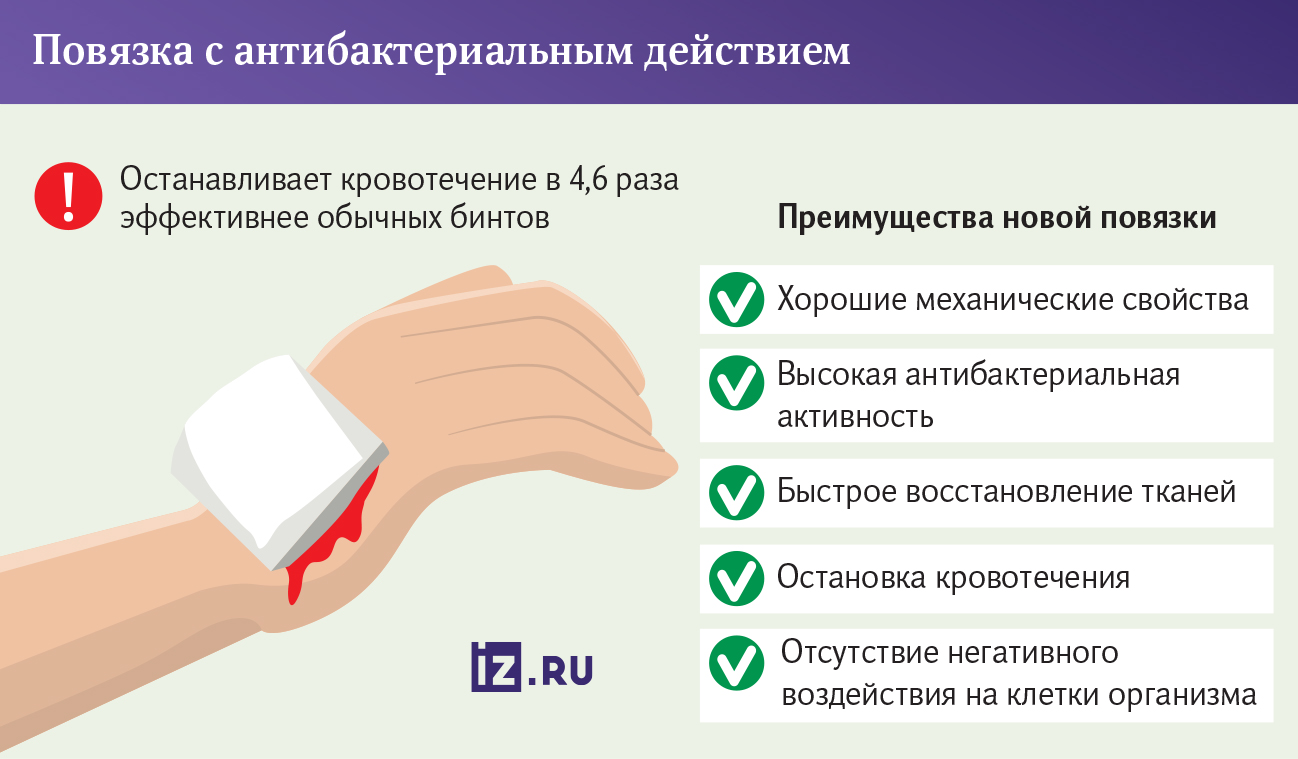
Tests have shown that the new bandage reduced blood loss by 4.6 times compared to conventional means. Scientists from Lomonosov Moscow State University and the State Scientific Center for Applied Microbiology and Biotechnology conducted a study of the bactericidal and fungicidal properties of the material, noting its high effectiveness against antibiotic—resistant strains of superbugs - Staphylococcus, Pseudomonas aeruginosa and E. coli, enterococcus and Candida auris fungus.
The base of the dressing, the membrane— is made of a biodegradable polymer polycaprolactone, reinforced with copper oxide nanoparticles and additionally treated with antibiotics neomycin and bacitracin.

— Polycaprolactone was chosen due to its biocompatibility, strength, and ability to mimic the extracellular matrix, which promotes tissue regeneration. Thin nanofibers were obtained by electroforming with the addition of copper oxide nanoparticles. At the same time, the resulting membranes have high mechanical strength — up to ~12 MPa at break, which exceeds the strength characteristics of many commercial dressings," said Kristina Kotyakova, PhD, Researcher at the NUST MISIS Inorganic Nanomaterials Research Center.
According to the authors, the study opens up new possibilities for combating antibiotic-resistant bacteria. In addition to field conditions, the development can also be used in hospitals. The project was supported by a grant from the Russian Science Foundation. In the near future, scientists plan to conduct expanded preclinical and clinical trials.
Prevention of wound infections
As noted by Yulia Paskhalova, Associate Professor of the Department of Disaster Medicine at the P. Lumumba Moscow Institute of Medical Sciences and Senior Researcher at the Department of Wounds and Wound Infections at the A.V. Vishnevsky National Research Medical Center for Surgery, the development of MISIS deserves attention, as it has excellent hemosorption and hemostatic properties shown during the first trials.
— First of all, such bandages are needed to prevent the development of wound infection, which remains an acute problem at the stages of evacuation, triage and first aid. The chosen combination of bacitracin and neomycin is very successful, since these are bactericidal and very broad—spectrum antibiotics that are not used systemically, and therefore the main pathogens that cause skin and soft tissue infections maintain a good sensitivity profile to them," says Yulia Paskhalova.

And the effectiveness in the treatment of chronic wounds, in particular burns and diabetic foot syndrome, can be clarified only at the stage of clinical trials, since models of chronic wounds, especially diabetic ones, have low validity, the expert said.

The work on accelerating the healing and regeneration of wounds (both superficial soft tissues and bone structures) is always useful, and the traumatologist Dmitry Efremov agrees. Such materials are needed in the treatment of major skin and muscle defects, so the invention is relevant and, if it passes all the necessary tests and is licensed, it will certainly be in demand.
Переведено сервисом «Яндекс Переводчик»
