- Статьи
- Science and technology
- Oriental sciences: scientists create batteries from Kuril bamboo and the first hydrogen train

Oriental sciences: scientists create batteries from Kuril bamboo and the first hydrogen train
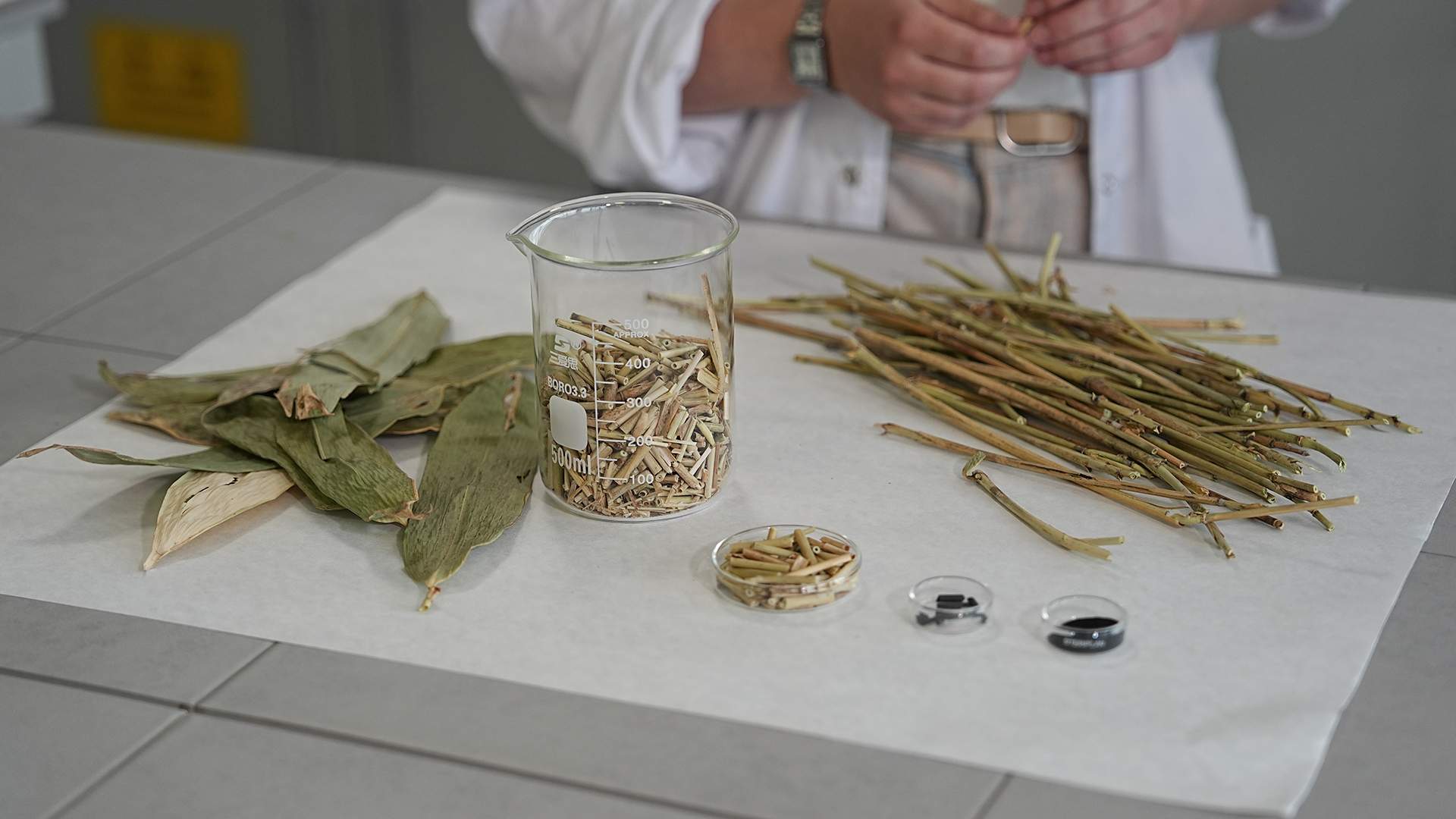
Russia is creating the world's first batteries made of Kuril bamboo, and if successfully tested, they will reduce the use of graphite, which is depleted. And this fall, work on the hull of the first domestic hydrogen-powered train will be completed. Sakhalin scientists are conducting these and other developments to preserve the environment and reduce harmful emissions into the atmosphere. For more information about how the region is becoming carbon neutral through innovation, see the Izvestia article.
Batteries made of Kuril bamboo
On the table in the laboratory "Electrochemical sources for renewable energy" of Sakhalin State University (SAKHGU) there are wide strips of algae and unusual branches that look like dried bamboo. It seems that a culinary master class on cooking Japanese cuisine is about to begin, but it's not sushi or rolls that are being prepared here, but batteries.
— Our laboratory is engaged in the production of cathode and anode materials. As you know, every battery has a plus and a minus. So, all the metal is concentrated in the cathode (minus), and it migrates to the anode (plus), an ionic charge flows there. We are developing both elements. In particular, we make anode materials from Kuril bamboo and algae," Polina Marmaza, a research engineer at the laboratory, told Izvestia.
At the first stage, scientists collect raw materials — in other words, vegetation from the Sea of Okhotsk on Sakhalin beaches, and also climb mountains. A unique endemic grows there — Kuril saza, or Kuril bamboo, or bamboo — a type of evergreen flowering plants of the genus, which is considered the only indigenous bamboo species in Russia. Then the plants are pyrolyzed, that is, they are exposed to high temperatures, an anode mass is produced and its electrochemical properties are studied.
In the future, the Kuril bamboo may become suitable for the manufacture of almost any solid-state batteries, the advantages of which are that their manufacture requires natural materials, the resource of which is inexhaustible, unlike graphite, the scientists said. This is useful from the point of view of ecology and entering a carbon-neutral economy, when a balance is achieved between harmful emissions and their absorption.
This study is unique, as no one in the world has yet used Sakhalin endemic plants for such purposes, in particular the Kuril carp. The work on the creation of such batteries is supported by the federal program "Youth Laboratories" of the national project "Youth and Children".
The first hydrogen train
Conservation of ecology and attention to nature in general can be called one of the key features of the region. In September of this year, the hull of the first prototype passenger train powered by hydrogen fuel cells, which will run on Sakhalin after 2027, will be presented. The advantage of such transport is that it does not emit harmful substances into the atmosphere. The exhaust of a hydrogen train contains only condensed water in the form of steam, which is already present in the environment.
The creation of such a machine is an experimental experience, which, if successful, will be replicated in other regions in the future, Alexey Belik, Chairman of the government of the Sakhalin Region, told Izvestia. The project is being developed jointly with Transmashholding.
— In accordance with Russian law, we are participants in a pilot project on carbon neutrality. And all the activities within the framework of this project together will provide an opportunity and quality of life and reduce CO2 emissions. At the moment, we are implementing an experimental project to create a hydrogen-powered train. And already in September, an inspection of the body of this locomotive is planned. And next year, its completion, completion of construction, and delivery to the territory of the region are planned so that it can be put into trial operation here," Alexey Belik added.
Currently, the issue of training specialists who will be able to work with hydrogen trains is being worked out, said Alexey Ognev, Vice-rector for Scientific Work at SAKHGU. In cooperation with the Far Eastern State University of Railways (DVGUPS), a training program will be developed and a special scientific depot will be introduced in which employees will be able to learn how to maintain and operate hydrogen technology.
Sakhalin Oblast is a pilot region of Russia for the implementation of the climate agenda. The goal is to make the region carbon neutral by the end of 2025.
Drones for flood control
Drones are widely used in the region to solve environmental problems. In addition, under the guidance of experienced teachers and mentors, students are trained to design drones in all schools in the region. For example, the new Chekhov School No. 25, which is being built in the southern part of Yuzhno-Sakhalinsk and is scheduled to open on September 1, will have a classroom equipped with designer kits with drones "Vzhik", "Aerosim" and "Chizhik" and others.
— Children have been learning about unmanned systems since elementary school. In the future, depending on the level of complexity of the UAVs they have designed, students will compete," said Tatiana Kofman, the school's director.
The drones themselves, created by schoolchildren, are used for various purposes, in particular for monitoring environmental conditions. For example, the Youth Design Bureau of the Advanced Engineering School of SAKHGU has developed special modular UAVs that are easy to assemble for specific tasks and can be equipped with any payload, be it gas analyzers or video cameras. A series of such drones were experimentally used to monitor the flood situation on the Pobedinka River. And this practice will be scaled up.
"In another case, it may be a different task, for example, monitoring the state of the air for carbon dioxide," Artur Berendyaev, director of the Sakhalin Regional Center for Innovative Creativity, told Izvestia.
Work on the creation of drones is underway as part of the national project "Unmanned Aircraft Systems". The research of the new SAKHGU laboratories is taking place within the framework of the Decade of Science and Technology in Russia.
Переведено сервисом «Яндекс Переводчик»
